 18th BRICS Summit


















- Technology, Sustainability and Customer Expectations: A Candid Conversation with Skyways MD Yashpal Sharma
By Team ADU
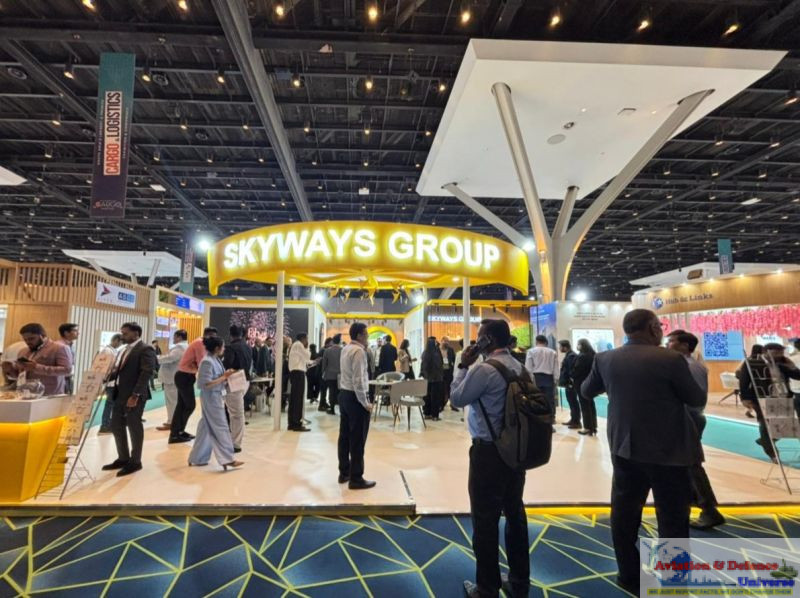
Mumbai. 31 December 2025. At a time when global supply chains are being reshaped by technology, sustainability imperatives, and evolving customer expectations, the logistics industry stands at a critical inflection point. Speaking with Aviation & Defence Universe (ADU) at the India International Cargo Show 2025 in Mumbai, Yashpal Sharma, Managing Director of Skyways Group, offered a candid and insightful perspective on how the sector is transforming. From the growing importance of integrated logistics solutions and technology adoption to sustainability, telematics, and data-driven customer demands, Sharma highlighted how Skyways is navigating complexity while strengthening its position as one of India’s leading logistics brands. His views reflect both the scale of change underway and the opportunities emerging for companies that can adapt quickly and strategically.
ADU. What are your key focus areas at the India International Cargo Show 2025? Are there specific objectives you are targeting at this event?
Yashpal Sharma. This show is extremely valuable because it brings together stakeholders from across the entire logistics spectrum—air, ocean, trucking, and allied services. It is one of the few platforms where the entire logistics ecosystem converges under one roof.
 This is the second time Skyways is exhibiting here, and interestingly, only the second time we have exhibited anywhere in India. Historically, we have exhibited overseas multiple times, but India was not a focus earlier. Last year was our first experience here, and we immediately saw strong value. The show allows us to meet customers, carrier partners, vendors, and stakeholders together in one place, while also giving them visibility into our systems and capabilities.
Importantly, we bring together our entire leadership team—both from India and overseas—so our global teams can directly interact with customers and partners, explore collaboration opportunities, and strengthen relationships. That makes this platform very meaningful for us.
ADU. How is Skyways contributing to the cargo and logistics ecosystem, and do you have plans to further expand your footprint in India or internationally?
Yashpal Sharma. We are currently on our IPO journey, so I need to answer future-facing questions in a broad and responsible manner. That said, Skyways has consistently expanded over the years, and that trend will continue. Today, we operate in over 30 cities in India and across 11 countries globally. Going forward, we aim to add new geographies every year—both domestically and internationally—while also expanding our product portfolio.
Skyways has been India’s largest air freight forwarder for the past several years. At the same time, we are scaling rapidly across ocean freight, trucking, cold chain solutions, and express e-commerce logistics. Our vision is to be a truly integrated logistics brand, offering end-to-end solutions—from air and ocean freight to warehousing and last-mile delivery.
The objective is simple: to address every logistics requirement of our customers and create strong value through operationally efficient, reliable, and scalable solutions.
ADU. Technology is reshaping logistics globally. Do you believe it is genuinely transformative, or is it sometimes overhyped?
Yashpal Sharma. Technology has touched every industry in the world, and logistics has been one of its  strongest adopters. In fact, logistics is what enables many of today’s business models. If you look at India’s quick-commerce ecosystem—where products are delivered in minutes—that efficiency is only possible because of advanced logistics and technology integration. From global e-commerce platforms to social commerce and even small manufacturers exporting across continents, logistics technology has enabled scale like never before.
The adoption of technology in logistics has been very strong, though it can always improve. New-age logistics technology companies are constantly pushing incumbents to adopt more efficient systems. This competitive pressure ultimately benefits the industry by driving innovation, transparency, and operational excellence.
ADU. Sustainability has become a major priority for customers and governments alike. How is sustainability shaping logistics and supply chains?
Yashpal Sharma. Sustainability is now central to logistics strategy. Transportation has historically depended on fossil fuels, but across air, sea, and road, the industry is steadily moving toward greater efficiency.
In ocean freight, carriers have already introduced measures like sulphur surcharges to reduce emissions. In aviation, newer aircraft generations are far more fuel-efficient than those built two decades ago, and this will continue until we eventually transition toward hydrogen-powered platforms.
On road transport, the shift toward electric vehicles is already visible, even for heavier commercial vehicles. EVs represent a transition phase between fossil fuels and future hydrogen-based solutions.
 Beyond fuel, sustainability also means eliminating inefficiencies. Nearly a decade ago, while I was President of the Air Cargo Forum India IT Committee, we led an initiative at Delhi airport that eliminated over 10,000 A4 sheets of paper per day through digitisation. This was achieved simply by questioning legacy processes and adopting technology where paper added no real value.
Today, sustainability initiatives also include IoT-enabled lighting systems, sensor-based energy optimisation, temperature-controlled warehousing efficiencies, and paperless documentation. The industry as a whole is making genuine efforts to become greener—not just Skyways, but the logistics sector collectively. We owe this responsibility to the next generation.
ADU. Telematics, IoT, sensors, and real-time visibility are transforming supply chains. How do you view this evolution, and how prepared is Skyways?
Yashpal Sharma. Technology has always been an integral part of Skyways’ growth story. We operate our own IT company and are among the top global executors in logistics technology adoption. We are already implementing AI-based tools, automation across select equipment, and advanced digital systems across our ecosystem. Automation and data intelligence are no longer optional—they are essential.That said, every technological leap comes with questions around data ownership, security, and control. These concerns are valid. Just as healthcare data is heavily encrypted and protected, logistics data ecosystems will continue to evolve robust safeguards.
Innovation always comes with challenges, but humanity has consistently found ways overcome them. Governments and enterprises will develop secure data centres, encryption protocols, and control mechanisms to ensure safety. The same evolution is happening with drones and unmanned systems—regulation and control will mature alongside technology.
ADU. Finally, what are customers truly expecting from logistics and supply chain organisations today?
Yashpal Sharma. After spending nearly 30 years in this industry, I can say that customer expectations are very clear. Most customers do not want to know how logistics happens. They want to know how fast, how reliably, and in what condition their goods will reach them.
Customers expect predictability—accurate timelines, quality assurance, and end-to-end visibility. Increasingly, they also want transparency into the entire value chain, including manufacturing, movement, and delivery.
 Today’s consumers want to place an order even before a product is manufactured and still know exactly when it will be delivered. This is where logistics, data, and manufacturing converge. The future customer will evaluate suppliers based on KPIs, dashboards, and performance analytics.
Whether it is a global retailer or a small artisan exporting internationally, data-driven decision-making will define supply chains. Companies that evolve, adapt, and transform faster than others will remain relevant.
ADU. Any final thoughts?
Yashpal Sharma. We are living in a very interesting time. Organisations that continue to evolve and adapt will stay relevant, and those that change faster than others will stay ahead of the curve.
The conversation with Yashpal Sharma reiterates a defining reality of today’s logistics and supply chain industry—change is no longer incremental but structural. As customer expectations shift toward speed, reliability, transparency, and end-to-end visibility, logistics providers must evolve beyond traditional freight forwarding into integrated, technology-driven solution providers. Sharma’s emphasis on sustainability, automation, and data security highlights the delicate balance between innovation and responsibility. At the same time, his insights reinforce that logistics remains the backbone of global trade, enabling everything from quick commerce to cross-border manufacturing. As Skyways continues its expansion journey, the interview reflects a broader industry truth: companies that invest in adaptability, technology, and operational excellence will remain relevant in an increasingly interconnected and demanding world.
Interview conducted by Shipra Sindwani















































































-A4-Size-(2)_page-0001.jpg)