

























- Vision 2035 Puts Technology and Industrial Collaboration at the Heart of India-UK Ties
- Beyond Buyer and Seller: India and UK Build a New Defence-Industrial Partnership
- Can India and the UK Turn Strategic Ambition into Industrial Capability?
By Theertha Panachoor
Hyderabad. 18 July 2026. For decades, distance defined the India-United Kingdom defence relationship. Today, it’s the design that defines it. For much of the post-independence era, India and the UK shared a defence relationship shaped more by history: Britain remained part of India’s military inheritance through legacy platforms, training traditions and institutional links, but the Cold War redirected procurement and defence-industrial cooperation towards the Soviet Union. For many years, London occupied a limited place in New Delhi’s evolving security partnerships but that is now changing. Defence has become one of the few areas where India and the United Kingdom appear to be moving with unusual speed, driven less by historical ties than by shared interests in industrial collaboration, technology and resilient supply chains.
From Cold War Distance To Comprehensive Partnership
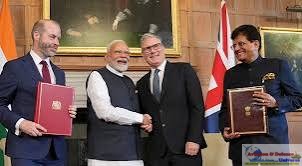
The shift did not happen all at once, rather, it arrived through a series of documents that gradually changed what the relationship was trying to achieve. The launch of the India-UK Vision 2035, announced alongside the Comprehensive Economic and Trade Agreement in London, placed defence industrial cooperation at the centre of the bilateral relationship through a dedicated ten-year Defence Industrial Roadmap. The focus had moved beyond sustaining engagement to creating long-term industrial capability.
Yet the current partnership did not emerge from scratch. Exercise Konkan, conducted by the Indian and Royal Navies since 2004, continued even when broader defence ties attracted limited political attention. Over two decades, the exercise preserved operational familiarity and steadily expanded interoperability. This matters since it meant that when political momentum returned, the relationship already possessed the habits of cooperation needed to support a more ambitious agenda.
Trade Sets The Pace
The speed with which the India-UK Comprehensive Economic and Trade Agreement moved from negotiation to implementation offers an indication of how both governments now approach the broader relationship. Signed in London on 24 July 2025 alongside the Double Contribution Convention and entering into force less than a year later on 15 July 2026, CETA established a clear timetable for economic cooperation. Defence has not progressed at the same pace, but it is beginning to adopt the same logic. With the launch of a dedicated Defence Industrial Roadmap, cooperation is no longer framed as an open-ended ambition but as a programme that can be measured against specific milestones.
The Dialogue Builds The Foundation
 Nothing about this partnership has been built overnight; they emerge through repeated institutional contact that allows governments, armed forces and industries to develop the confidence needed for more ambitious collaboration. India and the United Kingdom have built that relationship over the past several years.
The 24th India-UK Defence Consultative Group, held in London in April 2025, confirmed progress towards a Defence Industrial Cooperation Roadmap. The second India-UK 2+2 Foreign and Defence Dialogue in December 2024 reviewed Roadmap 2030 while advancing initiatives such as the Technology Security Initiative, the Infrastructure Finance Bridge and the Electric Propulsion Capability Partnership. Alongside these mechanisms, the Royal Navy’s Carrier Strike Group visited India, Exercise Konkan continued to expand operational cooperation, and Indian Air Force Qualified Flying Instructors began integrating into Royal Air Force training programmes.
None of these developments, taken individually, represents a major breakthrough. Together, they reveal a defence relationship that is becoming more institutionalised. Regular dialogue is no longer simply maintaining political contact but is creating the habits, networks and technical familiarity that make deeper industrial cooperation possible.
Room To Grow
For all the recent progress, the relationship is still in its early stages which precisely makes the relationship strategically significant. The United Kingdom brings established strengths in propulsion, aerospace, missile systems and advanced defence technologies while India offers one of the world’s largest modernisation programmes and an industrial policy increasingly geared towards co-development rather than procurement. Vision 2035 is an attempt to connect those complementary strengths.
Vision Writes The Machinery
 Vision 2035 matters because it finally answers a practical question: who is responsible for making all these ambitions happen? The Defence Industrial Roadmap adopted in July 2025 is where the partnership’s ambition became institutional, rather than adding another statement of intent, Vision 2035 established the mechanisms through which cooperation would be pursued and measured. It created a senior official-level monitoring framework, elevated the Foreign and Defence 2+2 Dialogue, and identified two flagship areas for co-development: the Electric Propulsion Capability Partnership and Jet Engine Advanced Core Technologies, the latter supported by Rolls-Royce’s offer of technology transfer on core engine systems.
The agenda extends well beyond conventional defence manufacturing. Vision 2035 commits both governments to collaboration in underwater systems, directed-energy weapons and maritime security through a Regional Maritime Security Centre of Excellence under the Indo-Pacific Oceans Initiative. It also broadens cooperation into space research and innovation while establishing regular Strategic Export and Technology Cooperation Dialogues to address licensing and export control issues that have long complicated defence-industrial collaboration between the two countries.
Much of this, however, predates the document itself. The UK Ministry of Defence launched Defence Partnership-India at Aero India 2025 as a dedicated programme office to deepen industrial engagement, alongside a UK-India Defence Partnership Pavilion. Meeting on the sidelines of the exhibition, the two countries’ defence secretaries described cooperation on electric propulsion and aero engines not as a mature programme, but as the beginning of a long-term industrial partnership. Vision 2035 did not create that momentum so much as give it structure.
Early Deliverables
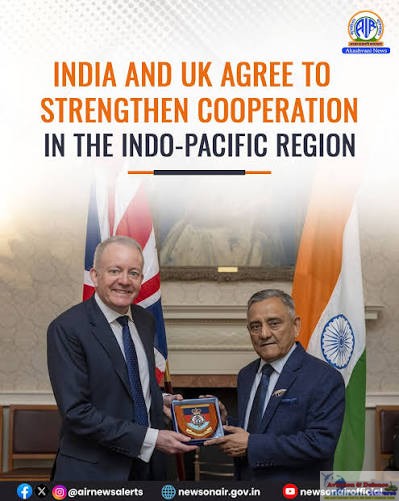 Eventually, every roadmap has to produce something tangible. By late 2025, the India-UK relationship had begun to do so. During Prime Minister Keir Starmer’s visit to Mumbai in October 2025, the two governments announced a government-to-government agreement for the supply of Lightweight Multirole Missile (LMM) systems, valued by the UK at £350 million. More significant than its value was its framing. Both governments presented the agreement as supporting India’s Atmanirbhar Bharat objectives and as the foundation for a long-term partnership on complex weapons rather than a one-off export.
Alongside the missile agreement, the two sides confirmed their intention to conclude an Inter-Governmental Agreement on maritime electric propulsion, while Aero India 2025 had already produced an earlier industrial outcome through a contract between Thales and Bharat Dynamics Limited for Starstreak laser-beam-riding man-portable air defence systems.
None of these agreements rivals the scale of India’s defence partnerships with France, Russia or the United States but that is not the point. Their significance lies in demonstrating that the India-UK defence relationship is beginning to generate tangible industrial outcomes rather than remaining confined to dialogue, roadmaps and joint statements. In a partnership that spent years producing frameworks, the appearance of actual programmes is itself a strategic shift.
The First Ministerial Review
Most strategic roadmaps are launched with fanfare and then slowly forgotten. Vision 2035 has, so far, avoided that fate. The clearest indication of that came in June 2026, when UK Foreign Secretary Yvette Cooper visited India for the first ministerial-level review of the partnership, less than a year after its adoption. Welcoming the visit, the Ministry of External Affairs described it as an opportunity to deepen the Comprehensive Strategic Partnership, while External Affairs Minister S. Jaishankar characterised the relationship as a “forward-looking highway” built around shared economic ambitions and high technology.
The discussions treated the Comprehensive Economic and Trade Agreement and the Defence Industrial Roadmap as complementary parts of the same strategic agenda. By reviewing both in the same ministerial conversation, New Delhi and London signalled that trade and defence are no longer being pursued as separate policy tracks, but as mutually reinforcing pillars of the bilateral relationship.
The timing of the visit was equally notable. It came just days after the UK Secretary of State for Business and Trade travelled to India to accelerate the implementation of CETA, illustrating London’s effort to align its commercial and strategic engagement with New Delhi. More importantly, it established a precedent that Roadmap 2030 never possessed: a regular ministerial mechanism through which progress under Vision 2035 can be assessed and political momentum sustained.
The Self-Reliance Test
 For decades, the India-United Kingdom defence relationship was sustained by history. Today, it is being asked to justify itself through outcomes.The agreements signed over the past eighteen months suggest that both governments are serious about rebuilding the partnership. But defence relationships are not ultimately measured by the number of dialogues they hold or roadmaps they publish. They are measured by the capabilities they create.
That is where Vision 2035 will either succeed or fall short. The missile agreement has shown that the relationship can produce contracts. The more difficult test lies ahead: whether cooperation on electric propulsion, jet engine technologies and other co-development programmes translates into lasting industrial capability inside India. If it does, the partnership will have moved beyond diversifying India’s suppliers to strengthening India’s defence-industrial base.
India-UK Defence Ties Based on Present & Future
India and the United Kingdom are entering a new phase in a relationship that is increasingly being shaped by the future rather than defined by the past. Trade, technology, defence, education, innovation and the Indo-Pacific are bringing the two countries closer at a time when both are seeking trusted partners and resilient supply chains in an increasingly uncertain world. The India-UK Vision 2035 and the Comprehensive  Economic and Trade Agreement provide an ambitious framework for translating this convergence into sustained cooperation, while the Defence Industrial Roadmap has placed co-development, advanced technologies and industrial capability at the heart of the strategic partnership. The future could see the relationship deepen further across jet engine technologies, maritime electric propulsion, complex weapons, underwater systems, space and emerging technologies, with Indian industrial scale and engineering talent complementing Britain’s established technological strengths. The real promise of the partnership, however, lies in moving beyond transactions towards jointly creating capabilities, intellectual property and global supply chains. If New Delhi and London can maintain political momentum while converting agreements into tangible industrial outcomes, India-UK ties could evolve into one of the most consequential technology and defence partnerships of the coming decade—a relationship built not merely on a shared history, but on the capabilities they choose to build together.
As India arrives at Farnborough International Airshow, the question is whether India and the UK can turn political ambition into industrial capability. That, more than any joint statement or ministerial visit, will determine whether Vision 2035 becomes a milestone or simply another roadmap.






















































































-A4-Size-(2)_page-0001.jpg)