


 18th BRICS Summit













- New Delhi Declaration Puts Multilateral Reform and Practical Cooperation Centre Stage
- 50+ Outcomes, One Declaration: India Pushes BRICS from Dialogue to Delivery
- No BRICS Currency, Yes to Local Trade: New Delhi Clarifies the Economic Agenda
- BRICS Speaks Against Terror: New Delhi Declaration Includes Cross-Border Terrorism
By Sangeeta Saxena
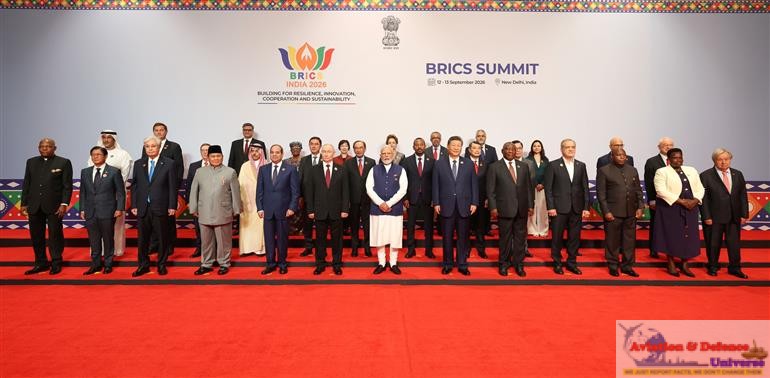
New Delhi. 12 September 2026. Twenty years after BRICS began its institutional journey, the grouping returned to New Delhi bigger, more diverse and carrying considerably greater geopolitical weight. The BRICS Summit was no longer simply a meeting of emerging economies; it was a gathering representing almost half the world’s population, seeking a stronger voice in deciding how that world is governed. Against the backdrop of wars, tariff tensions, disrupted supply chains, energy insecurity and demands for reform of institutions built for another era, India placed “Humanity First” at the heart of its fourth BRICS Chairship and pushed a simple but powerful proposition: the Global South should no longer remain merely a recipient of global rules—it must become a participant in writing them. With Resilience, Innovation, Cooperation and Sustainability defining the agenda, BRICS at 20 arrived in New Delhi not merely to celebrate how far it had travelled, but to confront the far bigger question of where it intends to take the changing world order next.
The first day of the BRICS Leaders’ Summit in New Delhi ended with much more than diplomatic handshakes and carefully crafted statements. It produced the New Delhi BRICS Leaders’ Declaration, more than 50 practical outcomes, a renewed push for reform of global governance institutions, a strong condemnation of terrorism and a consensus that dialogue and diplomacy—not confrontation—must remain the route through an increasingly fractured geopolitical landscape. For India, hosting BRICS in the year marking two decades of institutionalised cooperation also became an opportunity to position the grouping more firmly as a voice for the Global South and to demonstrate its own ability to bring an increasingly diverse BRICS membership to the negotiating table.
Briefing the media after the conclusion of the Day 1 Member Session, Secretary (Economic Relations), Ministry of External Affairs, Sudhakar Dalela, joined by Joint Secretary (Multilateral Economic Relations) Shambhu Hakki, described 2026 as a particularly significant year for BRICS. India assumed the Chairship in January for the fourth time, with the theme “Building for Resilience, Innovation, Cooperation and Sustainability” and Prime Minister Narendra Modi’s “Humanity First” approach guiding the year’s agenda.
The scale of the diplomatic exercise was significant. More than 350 meetings, both physical and virtual, have been organised during India’s Chairship across ministerial tracks, working groups, business engagements and people-centric initiatives. BRICS activities have extended to more than 30 Indian cities and involved central and state governments, industry, academia, youth, civil society and local communities.
Day 1 Puts Global Governance Reform on the Table
The first session of the Summit was held under the theme “Inclusive Global Governance and Strengthening Multilateralism.” According to Dalela, despite the different national perspectives around the table, there was broad convergence on the need to make international institutions “more representative, inclusive, effective, and responsive to today’s realities.”
BRICS leaders reiterated support for comprehensive reform of the United Nations, including the UN Security Council, and reform of the international financial architecture to provide developing countries and the Global South a stronger voice. They also discussed ongoing conflicts and economic uncertainties, stressing dialogue, diplomacy and peaceful resolution of differences.
The significance was difficult to miss. An expanded BRICS brings together countries with very different economic structures, political systems, strategic interests and geopolitical relationships. Yet Day 1 demonstrated that consensus could still be forged around a shared demand: institutions created for an earlier world order must evolve to reflect today’s distribution of economic and political weight.
Modi Proposes Four New BRICS Initiatives
Prime Minister Narendra Modi used the Member Session to put forward four specific proposals for future cooperation. These included a BRICS Troika mechanism, a BRICS Roadmap on Global Governance Reform, a Seafarer Emergency Support Initiative Network to assist seafarers in distress worldwide, and BRICS Global South Negotiation Support, intended to strengthen the capabilities of officials and young professionals from the Global South in emerging areas such as technology and global rule-making. The proposals reflected India’s effort to move BRICS beyond declaratory diplomacy towards mechanisms with identifiable practical applications.
New Delhi Declaration Becomes Day 1’s Defining Outcome
The Member Session concluded with the adoption of the New Delhi BRICS Leaders’ Declaration, which Dalela described as one of the defining outcomes of India’s Chairship. For New Delhi, the importance of the document lay not only in what it contained but in the fact that an increasingly diverse BRICS membership had agreed to it by consensus. “The New Delhi Declaration is a clear manifestation of their spirit of collaboration, their spirit of building consensus, and spirit of partnership, unity, and solidarity,” Dalela said. Alongside the Declaration, India announced more than 50 practical outcomes structured around the four pillars of resilience, innovation, cooperation and sustainability.
From Food Security to Start-ups: Making BRICS Practical
Under resilience, cooperation includes Centres of Excellence on Agro-ecology, a BRICS Network on Digital Agriculture and the BRICS Mission for Healthy Lifestyle, alongside mental wellness and disaster-risk reduction. The innovation pillar includes cooperation on Digital Public Infrastructure, a BRICS Science and Research Repository, and a BRICS Startup Innovation Fund and Incubator Network. Under cooperation, initiatives include a BRICS MSME Cooperation Portal, global-value-chain cooperation and a BRICS Logistics Supply Chain Cooperation Framework, while sustainability covers smart grids, energy storage, climate-resilient urban infrastructure, sustainable mobility and climate-resilient agriculture. The message emerging from the briefing was clear: India wants the relevance of BRICS to be measured not simply through geopolitical weight but through tangible outcomes that can reach citizens, businesses and communities.
BRICS Condemns Terrorism, Including Cross-Border Terrorism
Terrorism emerged as another important Day 1 outcome. Dalela said BRICS countries had “unequivocally condemned terrorism in all its forms and manifestations” and strongly condemned the terror attacks in Jammu and Kashmir the previous year. Pressed during the question-and-answer session on cross-border terrorism, he made the position explicit. “The BRICS leaders have taken a very clear stance on condemning terrorism in all its forms, and that also includes cross-border terrorism,” he said. He also pointed to consensus on combating the financing of terrorism, describing the Declaration’s language on the issue as a strong outcome.
West Asia Tests India’s Consensus-Building
Perhaps one of the more diplomatically challenging aspects of the Declaration concerned West Asia, where differences among BRICS members could have complicated the effort to reach common language. Questions at the press conference repeatedly focused on how India managed to bring differing positions together. Dalela explained that negotiations had taken place at several levels throughout the year—from Sherpas and Foreign Ministers to the leaders themselves. India’s approach, he said, was to allow members to express their national perspectives transparently before finding a “common denominator” acceptable to all.
The resulting consensus was centred on dialogue and diplomacy. “We all believe that dialogue and diplomacy should be the guiding parameter for addressing any conflict, any situation which requires solution,” Dalela said, adding that this was the route towards lasting peace, security and stability.
He also linked geopolitical instability to economic consequences. BRICS members, he said, recognised the need to maintain the smooth flow of global trade, supply chains and energy supplies in accordance with international law.
No BRICS Currency Proposal
The question that frequently follows BRICS meetings—whether the grouping intends to create a common currency—also received a direct answer. There is currently no proposal for a BRICS currency. Dalela said discussions on settling trade in local currencies have been underway within BRICS for more than a decade. Such settlements are viewed as a practical mechanism for reducing transaction costs and complementing existing global payment and settlement systems. But he was categorical on a common currency: “There is no proposal in the BRICS for BRICS currency as of now. The distinction is significant. BRICS is examining ways to facilitate greater intra-group trade and reduce transaction costs, but that should not be conflated with the creation of a euro-style common currency.
BRICS Pushes Back Against Unilateral Trade Measures
The Summit also addressed unilateral tariffs and other coercive economic measures. Dalela said BRICS had maintained a consistent position that unilateral coercive, tariff or environmental measures affecting trade must conform to international law and WTO rules. The issue assumes particular relevance at a time when trade restrictions, tariffs, economic security policies and geopolitical competition are increasingly reshaping global supply chains.
India, China, Russia and the UNSC Question
UN Security Council reform generated several questions during the briefing, particularly about whether China and Russia support India’s aspiration for a greater role. Dalela said there was “clear convergence” during the closed session on the need for UN and Security Council reform. He pointed to language recognising the legitimate aspirations of African countries and to previous BRICS consensus in which China and Russia reiterated support for the aspirations of Brazil and India to play a greater role in the United Nations, including its Security Council. The Declaration also recognises the need for emerging and developing countries from Africa, Asia and Latin America to play a greater role in international affairs.
Innovation Brings India and China to Common Ground
Against the backdrop of wider geopolitical complexities, innovation emerged as an area where India sees scope for deeper collaboration with China and other BRICS members. Dalela pointed to the BRICS Incubator Network and proposed BRICS Startup Innovation Fund as examples, saying India wanted to pursue innovation cooperation with China and the other members. The emphasis was also physically visible at the Summit. Leaders were taken through the specially curated “Bharat Innovate” exhibition showcasing India’s achievements in innovation, entrepreneurship, technology and development.
India Projects Its Convening Power
Behind the initiatives and Declaration lay another story: India’s effort to demonstrate its ability to convene countries that do not necessarily agree with one another. Dalela argued that effective participation across BRICS’ numerous ministerial tracks reflected “India’s convening power” and the trust members placed in New Delhi’s ability to steer discussions transparently and objectively, “build bridges and forge consensus.” That may ultimately be one of the important diplomatic measures of India’s 2026 Chairship. BRICS has expanded, and with expansion comes greater representation—but also greater complexity. The ability to preserve consensus while accommodating that diversity will determine whether enlargement translates into greater global influence or simply a larger negotiating table.
Day 1 Ends, Global South Moves to Day 2
The symbolism of the opening day was heightened by its coincidence with United Nations Day for South-South Cooperation. It provided an apt backdrop for a Summit in which strengthening the voice of emerging and developing economies repeatedly surfaced as a central theme. Day 2 will broaden that conversation. The open session is set to include BRICS partner countries, outreach invitees—including countries chairing important institutions of global governance and the Global South—and heads of international organisations. Day 1 also carried softer but significant symbolism. Leaders jointly planted trees under India’s “Ek Ped Maa Ke Naam” initiative, while a commemorative postal stamp marked two decades of BRICS institutional cooperation.
Consensus Becomes New Delhi’s Day 1 Currency
If there was one word that defined the first day of BRICS 2026, it was consensus. Not unanimity of worldview, not the disappearance of geopolitical differences and certainly not the emergence of a political or military bloc—but the ability of a diverse group of emerging and developing powers to find enough common ground to speak collectively on global governance, development, terrorism, trade, technology, sustainability and geopolitical instability. India’s larger message after Day 1 was equally evident: BRICS must deliver for people if it wants to remain relevant as an institution. More than 350 engagements, over 50 practical outcomes and initiatives spanning agriculture, healthcare, digital infrastructure, MSMEs, start-ups, supply chains, energy and climate resilience represent New Delhi’s attempt to translate that philosophy into action.
But the geopolitical significance runs deeper. At 20, BRICS is larger, more diverse and consequently harder to steer. Yet the New Delhi Declaration demonstrated that its members could still find a common denominator. For India, that was perhaps Day 1’s most important diplomatic achievement: bringing different voices to one table, keeping the Global South at its centre and attempting to turn diversity from a negotiating challenge into BRICS’ strength.
As the doors open wider on Day 2 to partner countries, outreach nations and international organisations, the question will no longer simply be how much BRICS has expanded. It will be how effectively an expanded BRICS can convert its collective weight into influence—and its declarations into delivery.














































-A4-Size-(2)_page-0001.jpg)