















- This superior quality rice to be delivered directly to Army Supply Depots, including in Ladakh & North East
- MoU inked with FCI to enable use of its warehousing, manpower & material-handling resources during operational contingencies
- The initiative embodies a collective resolve where the hard work of a farmer transforms into the strength of a soldier, says Rajnath Singh
- “Resilient supply chains and soldiers’ welfare integral to national security”
- “Op Sindoor highlighted the need for resilient logistics chains to sustain military operations”
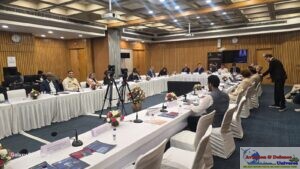
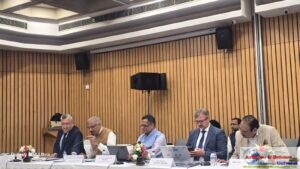
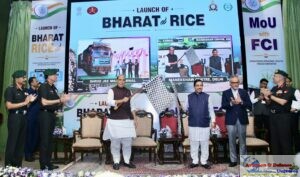
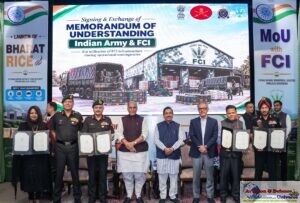
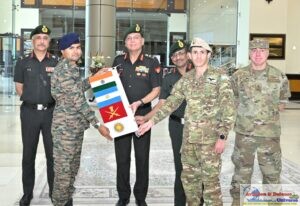
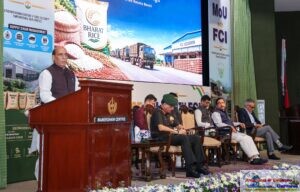 The Indian Army launched ‘Bharat Rice’ for the defence forces, at a ceremony graced by Raksha Mantri Rajnath Singh and Minister of Consumer Affairs, Food & Public Distribution Pralhad Joshi in New Delhi on October 12, 2026. The event also featured the signing of an MoU between the Indian Army and Food Corporation of India (FCI) for utilisation of its infrastructure during operational contingencies. This superior quality rice will be delivered directly to Army Supply Depots, including those in far-flung areas of Ladakh and the North East, instead of being collected by Army depots from local FCI facilities.
In his address, Raksha Mantri described ‘Bharat Rice’ as a bond of trust that begins in the farmer’s field and extends to the soldier’s plate. He stated that the initiative provides a tangible form to the spirit of ‘Jai Jawan, Jai Kisan’ as it embodies a collective resolve where the hard work of a farmer transforms into the strength of a soldier. “This superior-quality rice will be provided in accordance with standard specifications. Furthermore, we are ensuring ergonomic packaging. While this initiative might appear small, it offers immense operational relief to the soldiers responsible for transporting rations to remote and difficult terrains,” he added.
 Rajnath Singh emphasised that the soldiers’ operational readiness is not defined by weaponry alone; it also lies in their physical health, mental balance, morale and stamina, especially as they serve in harshest of conditions. He termed the welfare of soldiers as not a peripheral issue, but an integral component of national security, adding that healthy food, robust equipment and complete training boost the morale of troops, making them ready to face every challenge, and protect the nation.
Raksha Mantri asserted that in modern-day warfare, weapons, platforms, and technology are not the only critical elements; logistics itself is combat power. He stated that wars today are not won solely on the front lines, and factors such as the strength of supply chains, storage capacity, transportation networks, warehousing infrastructure, and the ability for timely replenishment play an equally crucial role.
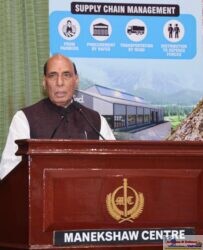 “The strategic analysis of Operation Sindoor indicated that warning times could be extremely short in future conflicts. Scenarios involving zero-warning situations and the integration of technology into warfare could severely test our preparedness. Such conflicts could also put the endurance of our logistics chains and supply networks to the test. Therefore, we must build logistics resilience to sustain our operations. This MoU with FCI represents a significant step in that direction,” said Rajnath Singh.
Raksha Mantri added that FCI possesses warehouses, storage infrastructure, modern silos, material handling equipment, and trained manpower across the country, including the operationally significant areas. This initiative is proof that the country’s existing national capacity can be aligned with national security requirements when the need arises, he said, adding that it represents a dual-use approach, wherein the country’s infrastructure and capabilities serve not just a single purpose, but cater to both civil and military needs.
Rajnath Singh underlined that just as fighter aircraft are now landing on expressways, and roads & bridges built by Border Roads Organisation are being utilised by local residents too, FCI godowns will no longer be limited to food storage; they will become an integral part of the Indian Army’s supply chain. “This approach will optimise resources and strengthen national resilience. Integrating existing infrastructure with operational planning allows us to save time and utilise resources more effectively. This MoU is far more than a mere administrative arrangement. It acts as a force multiplier for operational preparedness and reflects our ‘Whole-of-Government’ and ‘Whole-of-Nation’ approach,” he said.
 Raksha Mantri highlighted the Government’s focus on every aspect of our soldiers’ welfare, adding that emphasis has been placed on self-reliance and modernisation across all sectors, from weaponry and technology to clothing, equipment, and training. “Today, India produces a significant portion of its defence requirements domestically,” he said, underlining that innovation and coordination are the basis of the Government’s resolve to continuously provide best quality products to the soldiers, make the supply chains more resilient, ensure timely deliveries to forward areas, and better utilise civilian infrastructure for national security. He added that when the soldiers stand guard at the borders, they must have the confidence that the entire country stands with them. He termed boosting the morale of soldiers as the Government’s priority, emphasising that this resolve is not of the government alone; it is shared by the farmers, the cooperative sector, the civil administration, and the nation at large.
Speaking on the occasion, Minister of Consumer Affairs, Food & Public Distribution Pralhad Joshi appreciated the ‘Bharat Rice’ initiative, and said that it is a matter of pride for his department to provide superior quality rice to those who protect the nation with unmatched bravery and dedication. “To provide quality food to the nation’s protectors and cater to their needs is our duty,” he said.
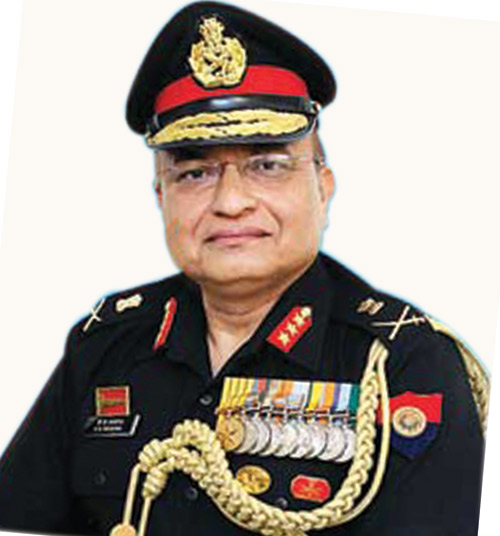
Chief of the Army Staff General Dhiraj Seth, Secretary (Food and Public Distribution) Sanjeev Chopra and senior officials from the Ministry of Defence, Ministry of Consumer Affairs, Food and Public Distribution, FCI, National Agricultural Cooperative Marketing Federation of India Limited (NAFED) and the cooperative sector were present on the occasion.







































































-A4-Size-(2)_page-0001.jpg)