







- MRFA This Financial Year? Air Chief Reveals Hope and Fifth-Generation Options
- Aatmanirbharta Cannot Cost Preparedness: A.P. Singh’s Parting Message
- Always Ready, Always Evolving: IAF Marks 94 Years with a Future-Focused Vision
By Sangeeta Saxena
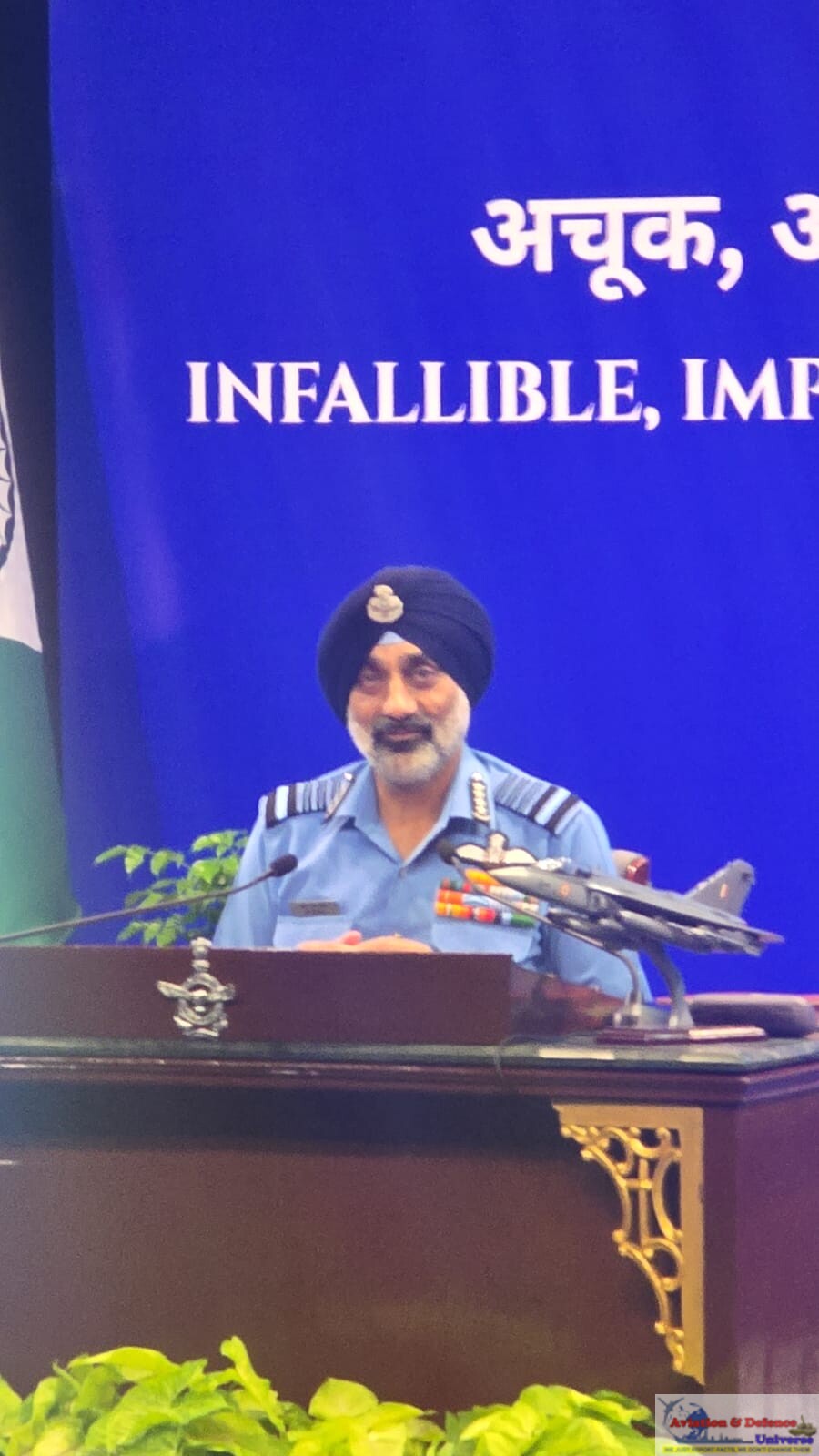
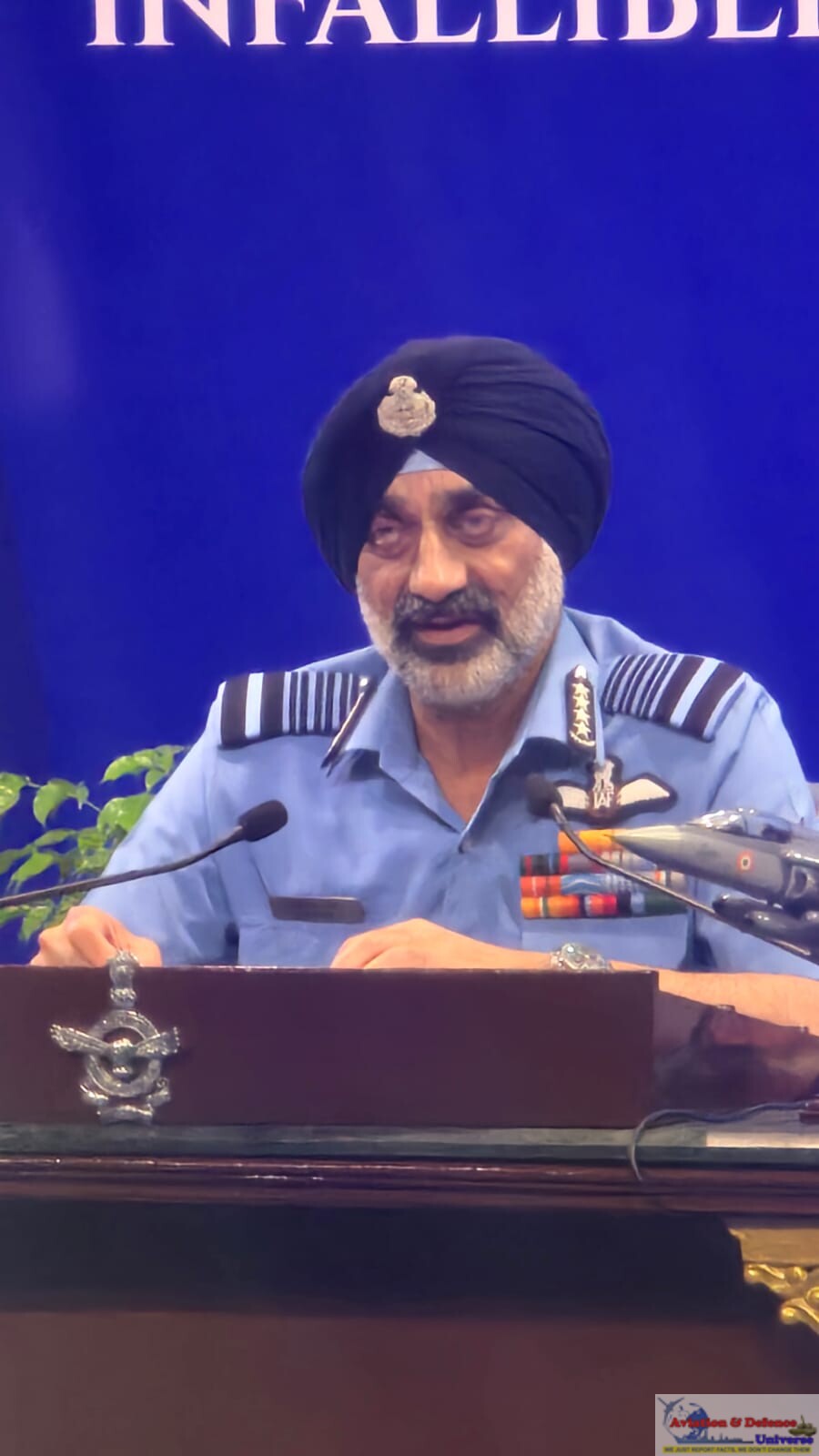
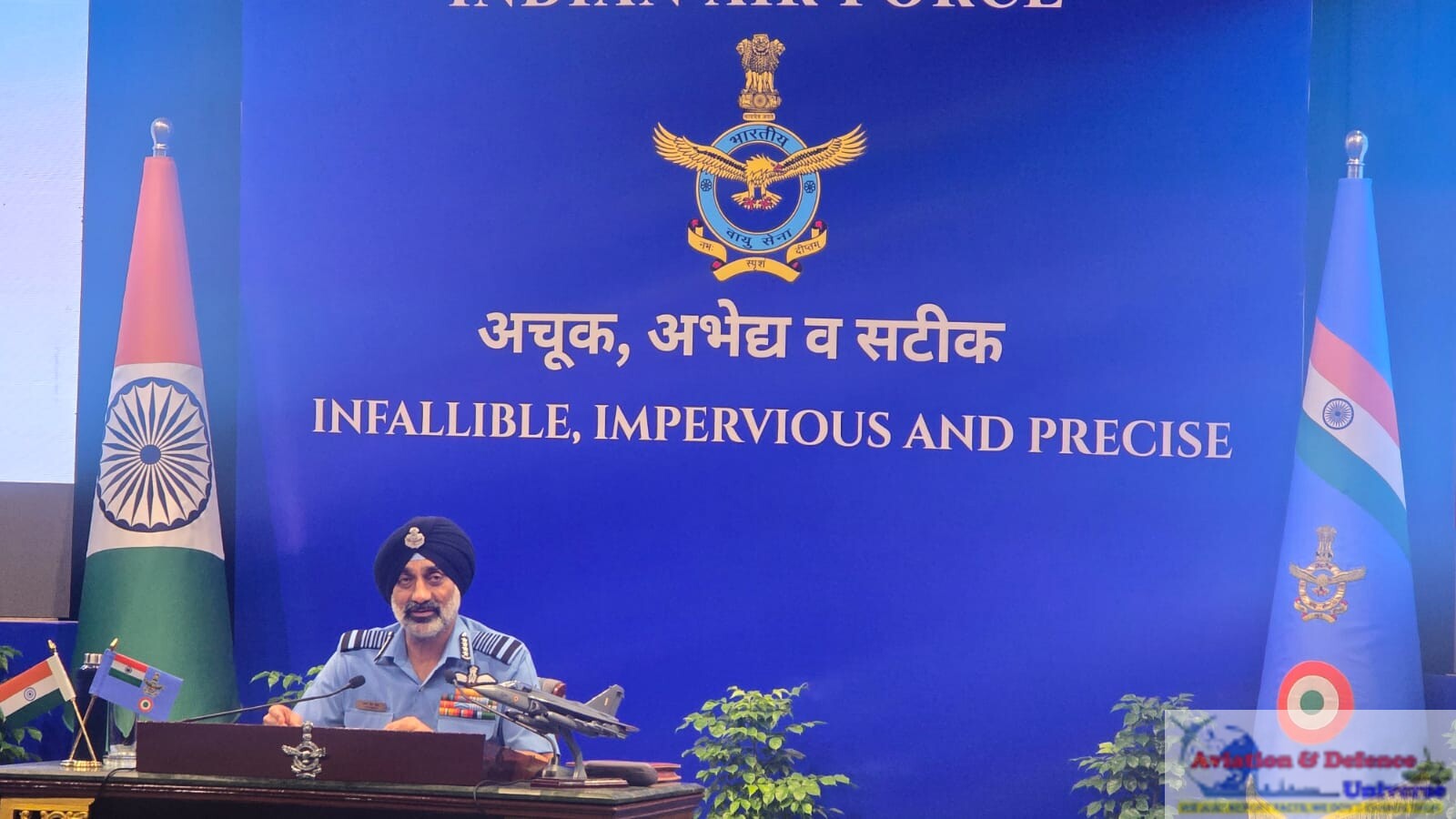
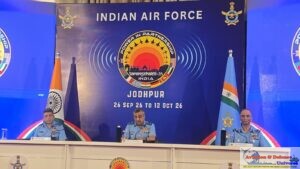
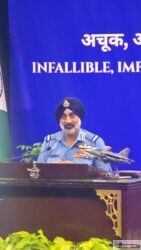
New Delhi. 03 October 2026. As Air Chief Marshal A.P. Singh prepares to relinquish command, his final assessment leaves neither room for complacency nor cause for despair. Fighter numbers must rise, delayed programmes must accelerate, indigenous design institutions require sharper priorities, and India cannot postpone the decision to build its own aero-engine. The IAF’s wishlist, as envisaged by Chief of the Air Staff Air Chief Marshal A.P. Singh, is both urgent and ambitious: the annual induction of 36 to 40 fighters to rebuild strength towards 42 squadrons; timely delivery of the Tejas Mk1A; accelerated development of the Tejas Mk2 and AMCA and the early conclusion of the MRFA programme to bridge immediate capability gaps. The Chief also wants faster development and integration of the Astra Mk2 and Mk3 beyond-visual-range missiles, a Make in India medium transport aircraft, stronger air-defence and surveillance networks, and carefully structured theatre commands informed by the operational lessons of Operation Sindoor. Overarching this equipment roadmap is his vision of a networked, AI-augmented and adaptable aerospace force in which indigenous development moves faster, institutions prioritise programmes more sharply, humans remain in the decision-making chain and Aatmanirbharta strengthens—rather than compromises—India’s combat preparedness.
IAF Needs up to 40 New Fighters Every Year
The Air Chief reiterated that India needed to induct nearly two fighter squadrons annually to arrest the decline in strength and move towards the sanctioned figure of 42 squadrons.
“We need almost two aircraft squadrons to be inducted every year.” He quantified the requirement, “Anything between 36 and 40 aircraft should be produced and inducted into the Air Force for us to stop going down from 30 fighter squadrons and start improving towards the slated target of 42.”
The future requirement could be even greater, he cautioned. HAL had spoken of producing more than 20 aircraft annually, with 24 frequently cited as the intended capacity. However, engine availability would determine the actual output.
“If the Mk1A supply starts and the engine issues are sorted out—12 more engines are expected this year and thereafter about 20 engines per year have been promised—let us say HAL produces 20 aircraft.” The proposed MRFA programme could add approximately 12 aircraft annually. “ If the MRFA contract goes through, we will get about 12 aircraft per year with that contract. That makes the number around 32.” Additional aircraft orders could bring the annual induction figure closer to the required level.
“We will be in the region of 30 to 35, or 40 aircraft per year, in case these things go through as planned.” He added, “We are hoping these things will happen and we will be able to achieve the pace of growth that we have set for ourselves.”
MRFA Could Be Signed During the Financial Year
Air Chief Marshal Singh welcomed the progress made on several major acquisition programmes, noting that some had received Acceptance of Necessity and others were moving through subsequent approval stages. “We are happy that these programmes have progressed further.” He declined to prescribe precise acquisition timelines because negotiations involved both the buyer and the prospective supplier. “The due process is being followed, so I will not be able to give you timelines.” On MRFA, however, he expressed hope, “If things go well, MRFA should be able to be signed this financial year. That is my hope.”
He cautioned that negotiations were necessarily bilateral.“Everything is not in the acquisition wing’s hands or the Ministry of Defence’s hands. The other player also has to come around. When you negotiate, it is a two-way activity.”
Fifth-Generation Fighter Option Cannot Be Ruled Out
With potential delays in the indigenous AMCA programme and neighbouring air forces moving towards fifth-generation platforms, the IAF could have to consider an interim acquisition. “We have to look at some platform in case there are delays in AMCA. If we have to fill the gap and our adversaries are getting their fifth-generation aircraft, we need to look at some fifth-generation aircraft.”
On Russia’s offer of the Su-57, he said, “The Russians have been pushing, but no decision has been taken as of now—which platform, whether we would like to go there or not. That is with the Ministry of Defence.” He added that the IAF wanted both the number of aircraft and the diversity of operational platforms to increase.
Tejas MRFA and AMCA Form the Future Fighter Mix
Asked whether India was simultaneously pursuing too many aircraft programmes, the Air Chief said no single fighter could meet every operational requirement economically. “We cannot have one solution for all kinds of situations. One aircraft cannot do all the roles that we want it to do.”
A universal platform would also be prohibitively expensive and risk being employed below its potential. “Even if you have an aircraft which can do all the roles, that aircraft will cost a lot, and then we are using it sub-optimally.” The IAF consequently needed a balanced combination of aircraft.
“We have to have a happy mix of three or four types, at least in fighters, for us to perform all our roles in a good manner.” He identified the prospective fleet, “In the near future, it will be Tejas, Tejas Mk2, MRFA and AMCA. This, according to me, is a very healthy mix.”
MRFA would provide a comparatively rapid response to the immediate shortage. “With MRFA coming in, we have a quick solution to our dwindling numbers because Make in India through transfer of technology will always be faster than R&D.”
Indigenous Programmes Need Sharper Prioritisation
Although endorsing concurrent indigenous programmes, Air Chief Marshal Singh expressed concern about the burden placed on a limited design ecosystem. “There is a little worry which even I have, and I have voiced this opinion: we need to make sure that we give the correct prioritisation to these programmes.” He suggested that the aerospace design ecosystem might have to expand institutionally.
“Maybe we have to have two different ADAs for two different programmes, so that there is very clear prioritisation and one group is looking at one programme.” When the same team handled several programmes, progress could become fragmented.
“If the same group is involved in two programmes, obviously there is time-sharing going on.” He consequently called for reducing the number of major programmes handled simultaneously by the same organisation. “There is a requirement to reduce the number of programmes which are going on at any time—no doubt.” Because projects initiated at different times had now converged, a solution was required.
“These programmes were started in different time frames, but they have got bunched up. We need to find a solution quickly by focusing on one, clearing it and moving on. Regarding the Tejas Mk1A, he said, “From ADA’s side, we should close this programme and move on from there.”
Indigenous Engine Decision Cannot Wait
The Chief also stressed the strategic need for an Indian-designed and manufactured aero-engine. “We need to take some decisions. The negotiations are going on.” An indigenous engine programme, he said, would provide the foundation for future projects. “The engine programme will give us at least one engine designed in India and made in India, which will give us a launch pad to get on to other programmes.” Without such a decision, foreign dependence would persist. “Reliance on foreign OEMs for engines will continue forever if we do not take that decision.” Many choices being made now would show results only after several years.
“These decisions which are being taken now are going to show good effect after a few years, maybe after about a decade. But these are the things which will actually make us absolutely Aatmanirbhar.”
Contractual Delays Will Attract Penalties
Asked whether HAL and other public-sector manufacturers would be penalised for delays in the Tejas programme, Air Chief Marshal Singh said contractual provisions applied irrespective of ownership. “In any delay, there is a penalty in the contract. Penalty will be imposed in case of delay—and it is imposed.” He rejected the suggestion that public-sector companies would be treated differently. “It is not necessary that only the private sector will be penalised and a DPSU will not be penalised. Penalty is imposed.”
Theatre Commands Must Absorb Lessons from Operation Sindoor
Air Chief Marshal Singh again clarified that the Air Force was not opposed to the creation of theatre commands. “I have made it clear every time that the Indian Air Force is not against theatre commands. I am not talking personally as A.P. Singh; the Air Force as a whole has been working towards it and has been part of the discussion throughout.”
Operation Sindoor, however, had created a new body of first-hand operational experience that needed to inform the proposed structures. “We have a new situation which we saw after Operation Sindoor. Post-Operation Sindoor, discussions had to be taken in a slightly different direction because we gained some first-hand experience.”
He said the organisational model, order of implementation and pace of transition should all be reconsidered in the light of these lessons. “We should look at all those and then take a decision.” With changes taking place within the Chiefs of Staff Committee, he expected a fresh examination of the options. “The new lot will have fresh minds looking at it. Maybe they will come out with a slightly better one—not only what kind of organisation we have to make, but in what sequence it should be made and whether it should be done in one go or incrementally.”
The final decision would rest with the government. “Those decisions, I am sure, the government will take when we project the options to them.” He declined to reveal the alternatives under consideration. “I would not like to share the options here. These are closed-door discussions.”
Astra Family to Strengthen Beyond-Visual-Range Combat
Discussing the IAF’s beyond-visual-range capability, Air Chief Marshal Singh outlined a three-stage indigenous missile roadmap. “Astra, Astra Mk2 and Astra Mk3—there are three programmes which are going on in BVR.” The original Astra was in production, Astra Mk2 was midway through development and Astra Mk3 remained at an earlier R&D stage. “Astra is in production. Mk2 is midway through R&D, and Mk3 is in the initial stages of R&D.” Until the indigenous variants became available in adequate numbers, the IAF was seeking additional imported missiles. “Some missiles which we have purchased from outside and which are of good range—we are trying to get more numbers of them.”
The combination of imported weapons and the Astra family would address operational requirements. “Astra and those missiles together will meet our weapon requirements. If we get Mk2 and then Mk3, our trajectory is absolutely fine.” He voiced strong confidence in Astra Mk2. “The R&D of Mk2 is just a question of time. There is hardly any doubt in anybody’s mind whether we will succeed. It is a success story.” Integration work was already being planned. “We are already working towards integrating Mk2 on our major platforms.”
Warfare Is Moving from Contact to Long Range
Looking two decades ahead, the Air Chief said rapid technological change made precise forecasting impossible. “The Air Force is changing. Everywhere, things are changing. We are going from contact kind of battle to a long-range battle. What is going to happen in 20 years, with the way technology is leapfrogging, I do not think anybody can predict.” The IAF’s central requirement would be adaptability. “We have to keep moving on. We have to become more and more adaptable.”
He illustrated how operational requirements could revive capabilities once considered obsolete. “Some years back, when we were into beyond-visual-range combat, we thought guns might not be part of the game anymore.” The spread of small drones, slow-moving UAVs and other low-cost airborne threats had changed that assumption.
“Now, with smaller drones, smaller aircraft and slow movers coming in, you have no option but to get closer to them and have a weapon which can hit them directly.” The IAF would consequently continue adjusting its doctrine and equipment to the threat it faced.
Self Reliance Is a Necessity
The Air Chief warned that conflicts worldwide were depleting ammunition stocks, equipment inventories and logistics capacity. “Countries are running low on their stockpiles of ammunition. They are running low on systems, weapons and aircraft, and their logistics lines are getting constrained because of conflicts all around.” For India, self-reliance was therefore an operational imperative. “Having self-reliance is an essential requirement today. For us, it is a necessity.” He referred to the IAF’s involvement in programmes including the Tejas Mk1A, Tejas Mk2, AMCA, Akash, Akash-NG, Project Kusha, Pralay, BrahMos, Astra, SAAW, airborne early-warning systems, HTT-40, Advanced Light Helicopter Dhruv, Light Combat Helicopter Prachand, the proposed Indian Multi-Role Helicopter and several indigenous radar programmes. “All these amplify my comment that we have been pushing Aatmanirbharta to the best of our capability.”
Technology Delayed Is Technology Denied
Assessing the progress of Make in India, Air Chief Marshal Singh said an end user would naturally want capabilities immediately, while developers and manufacturers faced constraints that were not always visible to the Services. “Being a user, it is wrong for me to say whether I am satisfied or not satisfied, because it involves so many things. Sitting here, I do not know how much their shoes pinch.” Nevertheless, he had consistently demanded timely delivery. “I have been demanding and asking: bring things to me on time.” Reiterating one of his best-known observations, he said, “Technology delayed is technology denied.”
At the same time, operational preparedness could not be compromised indefinitely in the name of self-reliance. “We cannot have Aatmanirbharta at the cost of our national defence preparedness.” He acknowledged that building a domestic aerospace ecosystem was necessarily a long-term process. “Aatmanirbharta cannot happen overnight. A whole ecosystem has to be created. It takes time.”
On the direction of travel, he remained optimistic. “Are we moving in the right direction? I am very positive that we are.” On the pace, he added, “As a user, I would want it as of yesterday. But those involved in R&D and production know their constraints.” He advocated regular institutional review. “As a nation, we need to keep introspecting. We have to keep doing some kind of audit to see whether things are happening in the right way.”
Defence programmes, he said, should not depend upon the personal preferences of individual officeholders. “It should not be because of somebody’s whims and fancies that projects are getting scuttled. The process should go on as a system.” He concluded on this subject, “I am sure we are on the right path and we will succeed. We are on an exponential growth path, and we are growing better every day.”
Artificial Intelligence Will Assist but Humans Will Decide
Outlining the IAF’s technological vision, Air Chief Marshal Singh said artificial intelligence was already entering virtually every functional field. “Our vision is very clear: we have to have an AI-augmented force.” However, the Service did not intend to remove human judgement from consequential decisions. “AI is entering every field of the Indian Air Force today, but it is an AI-augmented force where AI assists and the human remains in the decision-making chain.”
Air-Defence Vigil Never Stops
The Air Chief reaffirmed the IAF’s responsibility for defending Indian airspace under the Union War Book. “Let me assure you that 24 hours a day, 365 days a year, our aircraft and systems are churning and aircraft are on standby to protect the skies of the nation.” Operational vigilance continued regardless of festivals, crises or other national events. “Our pilots and operators are continuously on their guard, ready to defend the skies.” He assured the country, “As India navigates these turbulent and uncertain times, the nation will continue to turn to the military, and specifically the Indian Air Force, for effective military solutions as and when called for.” His message was emphatic, “I can assure the nation that we are always ready.”
Peacetime Missions Do Not Dilute Combat Readiness
Asked about the IAF’s involvement in government tasks outside conventional war-fighting—including humanitarian missions and other national requirements—the Air Chief said such responsibilities were intrinsic to military service. “There are roles which are given to us in peacetime, and the Indian Air Force exists for that. It is not just during war that the Indian Air Force will come in.” If the Service possessed the necessary capacity, it should support legitimate national missions. “If we have the capability to aid any government process, we should be able to aid that process. It does not matter what it is.” He offered a clear assurance, “It is never done at the cost of our preparedness.” The Ministry of Defence, he added, assigned such tasks only after establishing that the IAF had sufficient bandwidth.
Vigilance Against Honey Traps and Corruption
Answering questions about personnel falling prey to honey traps or facing corruption allegations, Air Chief Marshal Singh said personnel were regularly sensitised. “Personally, wherever I go, I speak to them and tell them how they can be trapped and how they can be honey-trapped.” Regarding a previous case in which officers had been charge-sheeted, he declined to prejudge the matter. “Those officers are fighting their case. It is a sub judice matter, so for me to say something will not be right.” He acknowledged that investigations could sometimes make officers hesitant to exercise judgement. “These cases do impact decision-making at times. People get worried that if we take a decision, tomorrow it may backfire on them.” His advice was to act honestly and fulfil the responsibilities of command. “If we have to take a decision, we have to take a decision. If we are true at heart, I am sure things will fall into place.”
In response to a separate incident involving an Indian pilot, Smit Machchar, he praised the pilot’s response. “What our Indian pilot Maheshwar has done is exceptionally great. He has shown presence of mind, physical resolve and mental resolve.” He added, “Every Indian is proud of that, and it is a lesson for us.” On possible insider threats within the IAF, he said close professional interaction made unusual behaviour easier to detect. “We operate together so often and meet so often that we can recognise somebody getting out of line. We can recognise him in time.”
Court Order Will Be Implemented
Addressing a question concerning Priyanka Saxena, the Air Chief said the IAF would comply with the court’s judgement. “Her court judgement has come, so we have to follow the court judgement.” He said she would begin training after completing medical treatment.
“In her training, physical fitness as a soldier will be trained. Along with that, she will be trained in her branch as well.” Thereafter, she would be appointed in accordance with the court’s order and would serve under a Short Service Commission.
New Medium Transport Aircraft Will Be Made in India
On the future medium transport aircraft requirement, Air Chief Marshal Singh said a request for proposal had been issued for 60 aircraft. “For the medium transport aircraft, we have issued an RFP for 60 aircraft of a certain class.” Both public- and private-sector Indian companies had been approached. “A large number of Indian players have been given that RFP, including the public sector as well as the private sector.” He clarified, “It will be a Make in India aircraft. It is not being bought from outside.”
His message on theatre commands was equally measured—jointness must progress, but it must absorb the operational lessons of Operation Sindoor. Whether discussing honey traps, contractual penalties, peacetime duties or round-the-clock air defence, the outgoing Chief remained consistent: institutional integrity, operational readiness and human judgement must anchor every technological leap. He may leave office on 31 October, but his parting credo will continue to echo through the Service—move faster, remain adaptable, become self-reliant and stay “always ready.”



































































-A4-Size-(2)_page-0001.jpg)