





























- Louis B Warren states – The American Century on Trial
- Questions – Can a Divided Nation Still Lead the World?
- The American Dream Meets the American Dilemma
By Sangeeta Saxena
New Delhi. 17 October 2026. History has witnessed the rise and fall of empires, but when the world’s mightiest superpower begins to question its own invincibility, one haunting enigma emerges: Is the American Century Coming to an End? The question is as unsettling as it is compelling. Can the nation that once dictated the rhythm of global politics, commanded the world’s most formidable military, shaped international institutions and championed the ideals of democracy now be witnessing the gradual erosion of its own supremacy? Is America losing its grip on the world, or is the world simply learning to move beyond America’s grip? As China rises, alliances are tested, geopolitical fault lines deepen and political divisions threaten to fracture the American dream from within, the enigma becomes increasingly intriguing. Is this the decline of a superpower, the painful transformation of a nation, or merely the end of an era when Washington’s word was the world’s final word? Louis B. Warren’s America in the 21st Century confronts this paradox with a provocative proposition: perhaps the greatest challenge to American power is not the emergence of a stronger adversary abroad, but the weakening of America’s own foundations at home. The American Century may not yet be over, but the certainty that it would last forever certainly is.
For much of the twentieth century, the United States shaped the international order with unmatched economic resources, formidable military strength, technological innovation and diplomatic influence. It emerged victorious from the Cold War, led international institutions, maintained military alliances across continents and projected an image of political stability and national confidence. Yet the twenty-first century has presented a profoundly different picture. Political polarisation has deepened, cultural divisions have intensified, economic globalisation has generated both prosperity and discontent, and the rise of China has challenged America’s once-unquestioned strategic predominance.
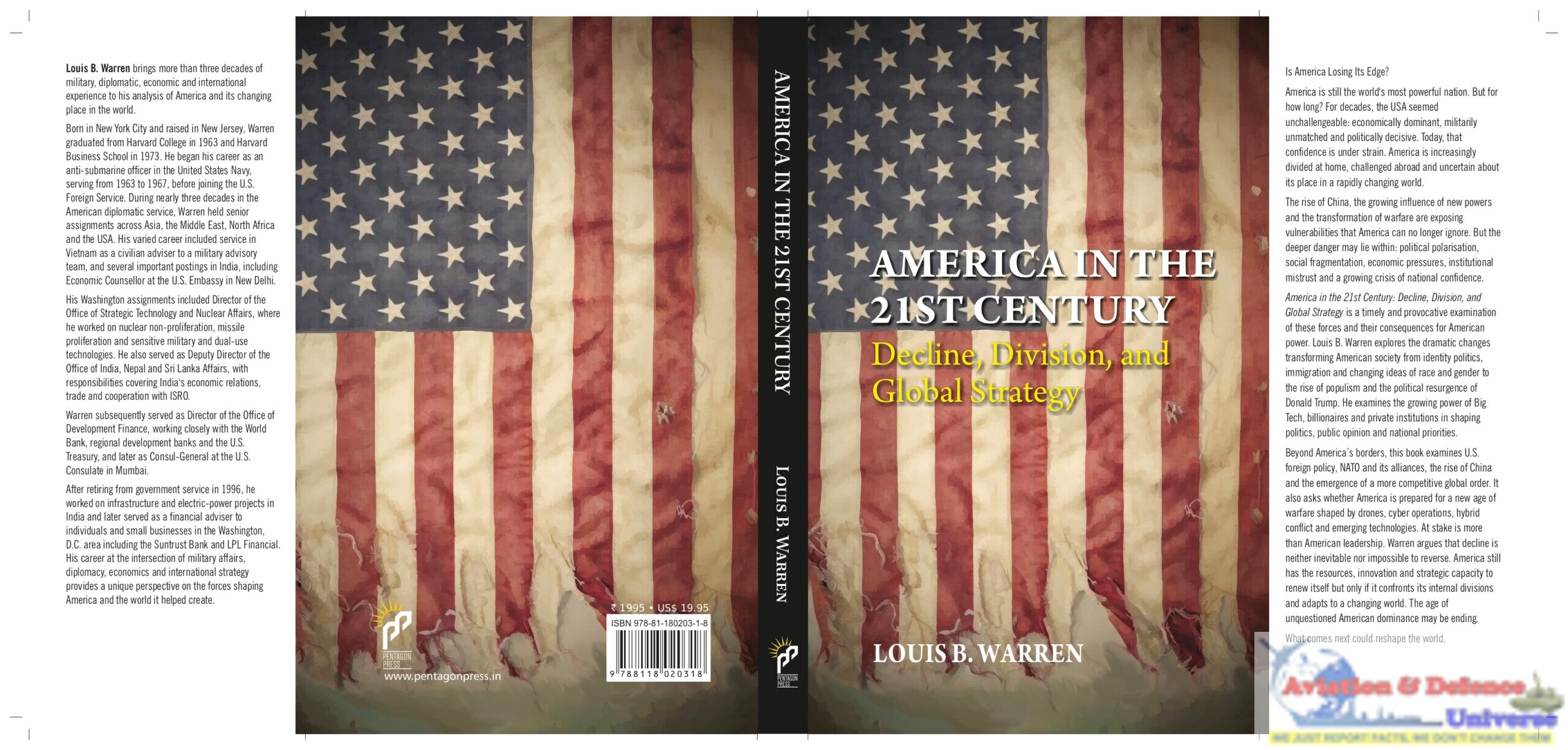
It is against this turbulent backdrop that Louis B. Warren examines the changing character of American power in America in the 21st Century: Decline, Division, and Global Strategy.
Warren’s central concern is not simply whether the United States remains powerful. It undoubtedly does. His more consequential question is whether America retains the political cohesion, industrial capacity, institutional credibility and strategic judgement necessary to sustain its leadership in an increasingly competitive world. The book moves across American society, political ideology, elections, economic policy, defence preparedness, international alliances and geopolitical crises. It connects domestic divisions with the country’s ability to exercise influence abroad, suggesting that the most serious challenge to American leadership may arise not only from external competitors but also from unresolved tensions within the American political system.
Warren writes from an explicitly moderately conservative perspective, which he acknowledges in his introduction. This is important to the way the book should be read. His interpretations of progressive politics, immigration, race, gender, the media and the Biden administration are frequently critical, while his assessment of Donald Trump combines recognition of certain policy achievements with serious reservations about the consequences of his leadership and foreign-policy decisions.
The book is therefore both an examination of American transformation and an argument about the sources of American decline. Its value lies in the breadth of issues it brings together, although many of its more contentious conclusions require critical evaluation rather than unquestioning acceptance.
The supplied manuscript is dated 2027 and includes accounts of events beyond October 2026. This review assesses the author’s arguments as presented in that manuscript; references to later events should not be treated as independently verified historical developments.
Louis B. Warren brings an unusual combination of military, diplomatic, economic and international experience to his assessment of American power. A graduate of Harvard College and Harvard Business School, Warren served as an anti-submarine officer in the United States Navy before beginning a lengthy career in the US Foreign Service. His diplomatic assignments included postings across Asia, the Middle East and North Africa, as well as significant responsibilities relating to India. He served as Economic Counsellor at the US Embassy in New Delhi and subsequently as Consul-General in Mumbai. His Washington assignments included responsibilities involving strategic technology, nuclear affairs, missile proliferation, development finance and relations with South Asian countries. Following his retirement from government service, he worked on infrastructure and power-sector projects in India and in financial advisory roles. This background lends particular weight to his discussions of national security, diplomacy, technological competition and the changing balance of international power. Warren approaches contemporary America not only as a political observer but as someone who has participated in the institutions through which American power has historically been exercised.
A chapter-by-chapter review is particularly necessary because Warren’s argument is cumulative. The book begins with the transformation of American society and political ideology, moves through the historical origins of polarisation and the contrasting Biden and Trump presidencies, and culminates in an assessment of American foreign policy, alliances and strategic challenges. Its 23 chapters cover subjects that might initially appear disconnected—cultural conflict, crime, immigration, finance, elections, NATO, China, Iran and military preparedness—but Warren treats them as different manifestations of a larger crisis of national direction. Reviewing each chapter individually allows the reader to identify the author’s central arguments, assess their evidentiary strength and understand how domestic political developments influence America’s international standing.
A New America — The Transformation of a Nation
Warren opens his analysis with Joe Biden’s inauguration in January 2021, presenting it as the beginning of a major political and cultural realignment. What appeared to many Americans as a restoration of conventional government after Donald Trump’s first presidency is interpreted by Warren as the emergence of a different governing philosophy, supported by influential sections of academia, the media, corporate America and the federal bureaucracy.
The chapter examines the growing influence of progressive political ideas, diversity and inclusion policies, immigration debates, climate policy and changing attitudes towards race and gender. Warren argues that the political outlook of America’s professional and institutional elites had become increasingly distant from the priorities of sections of the middle and working classes.
The chapter establishes one of the book’s principal themes: the erosion of a broadly shared American national identity.Warren provides a clear account of the ideological conflict that shapes his subsequent analysis.
The Origins of Wokeness — Ideology, Academia and Cultural Conflict
The second chapter traces the historical roots of what Warren calls “wokeness,” beginning with the intellectual upheavals of the 1930s and continuing through the civil rights movement, the Vietnam War, the New Left and the expansion of progressive ideas within American universities.
Warren associates the development of contemporary identity politics with changing attitudes towards American history, capitalism, race, authority and national institutions. He argues that ideas originating in intellectual circles eventually influenced corporations, professional organisations, public institutions and political parties.
The chapter is particularly concerned with the relationship between academic thought and political power. Warren sees universities as important centres for the development and dissemination of ideas that subsequently reshape wider society.
The chapter offers an identifiable historical interpretation, but its causal argument is open to debate. Modern progressive movements have varied intellectual origins, and their development cannot be explained entirely through the ideological lineage Warren emphasises. The chapter is most useful when read as an account of conservative concerns about cultural transformation rather than a definitive history of those movements.
Unipolar to Multipolar World — The End of Unchallenged American Dominance
This chapter shifts the discussion from domestic politics to the international system. Warren examines America’s emergence as the dominant global power following the collapse of the Soviet Union and the subsequent erosion of its relative strategic advantage. The author contrasts the optimism of the 1990s with the geopolitical realities of the twenty-first century. The rise of China, Russia’s renewed assertiveness, technological competition, regional conflicts and the growing importance of emerging powers have complicated America’s ability to shape international outcomes.
Particular attention is given to the decline of the assumption that economic integration and liberal democracy would eventually produce a more peaceful and politically convergent world. Warren argues that strategic competition, military preparedness and national interest have returned to the centre of international relations.
This is one of the book’s strongest chapters for defence and strategic affairs readers. It connects the changing distribution of economic and military capabilities with the limitations of American global leadership. Nevertheless, the transition to multipolarity is more complicated than a simple decline in American power, since the United States continues to possess substantial advantages in alliances, finance, innovation and global military reach.
The Impact of the Vietnam War — The Conflict That Changed America
Warren treats the Vietnam War not merely as a military defeat but as a transformative event in American political and cultural history. Drawing partly on his own experience of the period, he examines how the war weakened confidence in political leadership, increased public scepticism towards government and intensified ideological divisions within American society.
The chapter gives particular attention to the relationship between anti-war activism, universities, intellectual life and the emergence of political movements critical of traditional American institutions.
For Warren, the legacy of Vietnam extends far beyond the fall of Saigon in 1975. It contributed to a lasting transformation in how sections of American society understood patriotism, authority, military intervention and national identity.
The chapter is valuable because it connects military history with long-term political consequences. Warren’s professional background adds perspective, his argument places greater emphasis on the cultural consequences of anti-war activism than on the legitimate policy and ethical questions raised by the war itself.
The Polarisation of American Politics — When Consensus Became Confrontation
Chapter Five examines the widening ideological distance between Republicans and Democrats. Warren contrasts the relatively broad political consensus of earlier decades with the increasingly confrontational environment that developed during the twenty-first century. He discusses the Obama presidency, changes in party coalitions, the influence of social and cultural issues and the growing separation between progressive urban centres and conservative regions. The chapter suggests that political disagreements have evolved from disputes over policy into conflicts over competing visions of American identity.
Warren also examines the role of the media, political institutions and public attitudes in reinforcing these divisions.The chapter successfully identifies polarisation as a major obstacle to stable governance. Its most important implication is that frequent changes in political direction can weaken long-term planning. However, the causes of polarisation are complex and include developments within both political parties, economic inequality, electoral incentives and changes in the information environment.
The Rise of Trump — Populism Challenges the Establishment
The sixth chapter examines Donald Trump’s unexpected victory in the 2016 presidential election and the political forces that enabled his rise.
Warren interprets Trump’s success as a rebellion against established political institutions and an increasingly distant professional elite. Economic insecurity, cultural resentment, immigration concerns, dissatisfaction with globalisation and scepticism towards traditional political leadership all feature in his explanation.
The chapter also considers Trump’s confrontational political style, his relationship with the media and the intense opposition that characterised his first presidency. Trump emerges as both a product of American polarisation and an accelerant of it.
Warren provides an effective explanation of why Trump’s appeal extended beyond conventional Republican voters. His analysis is strongest when connecting political populism with economic and cultural dissatisfaction. The chapter also invites a wider question: whether Trump’s movement represented a corrective to institutional failures or introduced new risks to democratic norms and political stability.
Lockdown and Protest — America in Crisis
Chapter Seven concentrates on the extraordinary turbulence of 2020, when the COVID-19 pandemic coincided with nationwide protests following the death of George Floyd. Warren examines the public-health response, restrictions on economic and social activity, political disagreements over lockdowns and the consequences for businesses and communities.
The chapter then turns to racial justice protests, episodes of violence, policing controversies and the political consequences of the unrest. The author argues that these simultaneous crises exposed weaknesses in leadership, public trust and national cohesion. He also links the events to Trump’s electoral defeat and the confrontation surrounding the transfer of power.
The chapter captures the intensity of a period when public health, civil liberties, racial justice and electoral politics became deeply entangled. However, its treatment of contested pandemic policies and protest movements requires careful separation of established evidence from partisan interpretation. The chapter’s lasting contribution is its demonstration of how crises can magnify existing political divisions.
Joseph Biden in Power — The Promise and Problems of Restoration
Warren’s examination of the Biden presidency begins with the administration’s efforts to reverse many of Trump’s policies.The chapter discusses Biden’s leadership, the influence of his advisers, political appointments, executive decision-making and the administration’s progressive policy orientation.
Particular attention is given to questions about Biden’s age, public performance and capacity to exercise presidential authority. Warren presents these concerns as part of a broader criticism of transparency and accountability within the administration.
The chapter also considers how political priorities shaped institutional decision-making and public communication.
Warren raises legitimate questions about presidential leadership, administrative accountability and public confidence. Yet assessments of an individual’s health and decision-making capacity require reliable evidence and should not be reduced to political characterisation. The chapter is best understood as a critical interpretation of the Biden administration rather than a neutral institutional history.
Culture — The Battle Over American Identity
Chapter Nine examines cultural change as a central dimension of American political conflict. Warren considers the influence of universities, entertainment, media, corporate institutions and social movements on contemporary attitudes towards race, gender, identity and national history.
The chapter argues that cultural disagreements have become increasingly politicised, transforming questions of personal values and social recognition into broader disputes about national identity and institutional authority. A recurring concern is the declining ability of Americans with different beliefs to participate in a shared public conversation.
The chapter is important because political divisions cannot be understood through elections and economic policy alone. Cultural identity has become a powerful source of political mobilisation. However, the analysis would be stronger if it more consistently distinguished between demands for equal rights, institutional policies and the more confrontational forms of activism Warren criticises.
Biden Administration Domestic Policies — Reform, Spending and Regulation
The chapter ten evaluates the domestic policy direction of the Biden administration.
Warren examines immigration, energy policy, environmental regulation, public expenditure, economic stimulus, social programmes and the administration’s efforts to implement progressive priorities through federal institutions.
He is particularly critical of policies he believes increased government intervention, weakened border control or imposed economic costs without sufficiently considering their consequences.
The chapter also reflects Warren’s broader concern about the relationship between political ideology and practical governance.
The chapter provides a useful overview of the domestic policy controversies surrounding the Biden presidency. Its principal weakness is that the assessment frequently privileges costs and political objections over competing evidence concerning policy benefits. A balanced evaluation must consider both intended outcomes and measurable consequences.
Red and Blue States — Two Americas Under One Constitution
Warren examines the growing differences between Republican-leaning and Democratic-leaning states. The chapter eleven explores how America’s federal structure permits contrasting approaches to taxation, regulation, education, immigration, public safety and social policy.
These differences have increasingly become markers of political identity. Warren portrays the divide between conservative and progressive states as evidence of a weakening national consensus.
At the same time, the chapter demonstrates the continuing importance of federalism, which allows states to adopt different policies within a common constitutional framework.
This chapter is particularly effective in showing how polarisation has acquired a geographical dimension. However, the red-state/blue-state distinction can obscure considerable diversity within individual states, including differences between urban, suburban and rural communities.
Crime and Justice — Law, Order and Public Confidence
Chapter Twelve turns to crime, policing and the criminal justice system. Warren examines debates surrounding law enforcement, prosecution, public safety and criminal justice reform. These questions are placed within the wider context of ideological disagreement over the responsibilities of government and the rights of individuals.
The chapter reflects the author’s concern that public confidence deteriorates when citizens perceive institutions as inconsistent, politicised or unable to maintain order.
Public safety and the legitimacy of criminal justice institutions are essential dimensions of effective governance. Warren’s discussion highlights their political significance, although any assessment of crime trends and justice reforms must distinguish public perception from statistical evidence and consider the competing objectives of security, fairness and accountability.
Foreign Policy and Defence under Biden — Alliances, Afghanistan and Strategic Competition
The thirteenth chapter is particularly important for readers concerned with international relations and military affairs.
Warren evaluates the Biden administration’s handling of Afghanistan, Russia’s invasion of Ukraine, relations with China, the Middle East and America’s traditional alliances.
The withdrawal from Afghanistan receives critical attention as an episode that damaged perceptions of American competence and reliability.
The chapter also examines Washington’s efforts to support Ukraine and maintain Western unity against Russian aggression, alongside the challenges posed by China’s expanding economic and military capabilities.
Warren questions whether the administration possessed a sufficiently coherent strategy for managing simultaneous geopolitical pressures.
The chapter raises important questions about credibility, deterrence and alliance management. Its strongest contribution is the recognition that foreign-policy decisions affect how allies and adversaries calculate American resolve. However, policy failures should be evaluated alongside the strategic constraints and competing risks confronting decision-makers.
Finance and Business under Biden — Economic Strength and Structural Vulnerability
This chapter examines the economic consequences of the Biden administration’s policies and the wider transformation of American business.
Warren discusses inflation, government spending, business confidence, regulation and the changing relationship between large corporations and political institutions.
He is particularly concerned about the growing influence of major technology companies and financial institutions, arguing that their economic resources increasingly translate into political power.
The chapter also contributes to the book’s larger argument about America’s shift away from manufacturing towards services, finance and technology.
Warren identifies an important strategic issue: economic size alone does not guarantee industrial resilience. Manufacturing capacity, technological supply chains and productive investment matter greatly in periods of geopolitical competition. Nevertheless, the chapter’s policy judgements would benefit from more systematic comparison of economic indicators across administrations.
Summing Up the Biden Years — An Administration Under Scrutiny
Chapter Fifteen consolidates Warren’s assessment of the Biden presidency.
The author reviews the administration’s domestic and foreign-policy record, focusing on immigration, economic management, ideological priorities, presidential leadership and international crises.
His overall judgement is strongly critical. Warren sees the Biden years as a period in which political polarisation intensified and important strategic challenges remained unresolved. The chapter serves as a transition from the Biden presidency to the political circumstances that enabled Donald Trump’s return.
The chapter is useful for understanding Warren’s overall interpretation of the administration. Its forceful conclusions make the author’s position clear, but a more comparative assessment of achievements, failures and inherited challenges would have provided greater analytical balance.
Palestinians and Anti-Semitism — The Middle East Conflict in American Society
Warren examines the impact of the Israeli-Palestinian conflict on American politics, universities, public opinion and social relations.
The chapter traces aspects of the historical conflict before turning to the political consequences of the October 7, 2023 Hamas attacks and Israel’s military operations in Gaza. It discusses pro-Palestinian activism, anti-Semitism, campus demonstrations and the divisions these issues have generated within American society.
Warren is particularly concerned about the emergence of anti-Semitic rhetoric and hostility towards Jewish communities within some political and activist environments.
The chapter illustrates how an international conflict can become a major domestic political issue, influencing elections, universities, media discourse and party coalitions.
The chapter addresses an important and highly sensitive subject. Its analysis is strongest when examining the political consequences of the conflict within the United States. A balanced interpretation must nevertheless distinguish criticism of Israeli government policies from anti-Semitism, while recognising both the suffering of Palestinian civilians and the security concerns of Israelis.
The Election of 2024 — Trump’s Political Resurrection
The seventeenth chapter examines the presidential election that returned Donald Trump to the White House.
Warren identifies Biden’s poor debate performance, concerns about presidential leadership, the attempted assassination of Trump and Kamala Harris’s subsequent candidacy as defining developments.
The chapter explores the electoral significance of immigration, economic dissatisfaction, cultural conflict and the appeal of Trump’s promise to restore American strength.
Trump’s political comeback is presented as evidence that the populist movement which emerged in 2016 had become an enduring force rather than a temporary disruption.
Warren effectively captures the dramatic character of the election and the resilience of Trump’s political appeal. However, electoral outcomes rarely have a single explanation. Changes in voter coalitions, economic perceptions, campaign organisation and public confidence must all be considered when assessing the result.
Political Extremism and Violence — The Threat from Within
This chapter examines political radicalisation and the increasing acceptance of confrontational rhetoric and violence among extremist movements.
Warren discusses developments on both the far left and far right, the influence of ideological movements, anti-Semitism, social media and the declining authority of traditional political institutions.
He is particularly concerned about the vulnerability of younger Americans to radicalisation when they lose confidence in political leadership, social institutions and constitutional principles.
The chapter raises the possibility that ideological commitment may increasingly displace reasoned political disagreement.
This is among the book’s most important chapters because it addresses a threat that transcends party affiliation. Political violence and intimidation undermine the foundations of constitutional democracy. Warren’s argument would be stronger with a more systematic comparison of the scale, organisation and consequences of different extremist movements, rather than relying primarily on illustrative episodes.
Trump Domestic Priorities — Restoration or Disruption?
Chapter Nineteen examines the second Trump administration’s domestic programme.
Warren identifies major priorities including stricter immigration enforcement, reversal of diversity and inclusion initiatives, reductions in federal bureaucracy, energy development, industrial revival and changes to government regulation.
The chapter also considers the influence of powerful technology entrepreneurs and the growing relationship between private wealth, technological capability and political authority.
A particularly important concern is the concentration of power in major technology companies, especially as artificial intelligence and digital surveillance acquire greater economic and political significance.
Warren portrays the administration’s programme as an attempt to reverse the ideological direction of the Biden years, while acknowledging that some methods and consequences have generated substantial controversy.
The chapter illustrates the scale of policy reversal possible within America’s presidential system. It also raises a deeper question about governance: whether rapid political change can restore institutional effectiveness or whether repeated ideological reversals further weaken administrative continuity and public trust.
Foreign Policy and Defence under Trump — America First in a Changing World
This is one of the most strategically significant chapters in the book. Warren examines Trump’s preference for bilateral negotiations, tariffs, transactional diplomacy and a foreign policy explicitly organised around American national interests.
The chapter explores relations with Russia and China, the future of NATO, defence expenditure, strategic competition, nuclear deterrence and the implications of changing military technologies.
Trump’s approach to alliances receives particular attention. Warren questions whether pressure on allies to increase defence expenditure can be separated from the broader requirement to maintain trust and strategic credibility.
The chapter also considers the possibility of renewed nuclear proliferation if countries begin to doubt the reliability of American security guarantees.
The chapter effectively identifies the tension between national-interest diplomacy and alliance-based strategic leadership. Greater burden-sharing may strengthen collective defence, but uncertainty about American commitments can weaken deterrence. The discussion is especially valuable in highlighting how diplomatic signalling, military capability and credibility are interconnected.
For an Indian defence readership, the chapter also invites reflection on how an increasingly transactional Washington might affect defence partnerships, technology cooperation and strategic autonomy.
Europe — The Transatlantic Relationship Under Strain
Warren devotes a separate chapter to Europe because he considers the transformation of American relations with European allies to be particularly consequential.
He recalls the historical importance of the Marshall Plan, NATO, American nuclear guarantees and the broader transatlantic partnership established after the Second World War.
Against this background, the chapter examines disagreements over defence spending, European security, Russia, Ukraine and the future of American commitments to NATO.
Warren is critical of diplomatic approaches that risk weakening relations with countries that have traditionally been central to American global influence.
The chapter also considers Europe’s economic and technological challenges, including debates about artificial intelligence and the growing power of private technology companies.
This chapter makes a persuasive case that alliances are not simply financial obligations. They are strategic assets built through decades of cooperation and political trust. Warren’s analysis is particularly relevant at a time when European governments are reassessing defence capabilities and the degree to which they can depend on American leadership.
The Middle East, Iran and Operation Epic Fury — The Perils of Military Escalation
Chapter Twenty-Two examines the historical and strategic foundations of American involvement in the Middle East.
Warren traces the importance of oil, American relations with Gulf states, support for Israel and the consequences of Iran’s 1979 Islamic Revolution.
The chapter then turns to the manuscript’s account of a 2026 US-Israeli confrontation with Iran, identified as Operation Epic Fury. Warren evaluates the risks of military escalation, disruption to energy supplies, instability in the Gulf and the consequences of attempts to reshape the regional balance of power through force.
He also considers the strategic importance of the Strait of Hormuz, the vulnerability of regional economies and the difficulties of achieving political objectives through military action alone.
: The chapter’s central strategic argument is compelling: military superiority does not necessarily translate into political success. Regional conflict can create economic disruption, strengthen hardline political forces and generate consequences extending far beyond the immediate battlefield.
Can America Reverse Its Decline?
The concluding chapter brings together Warren’s central concerns about political polarisation, institutional weakness, economic transformation and the erosion of American strategic dominance.
Drawing on wider debates about the fragmentation of international order, Warren argues that the United States is entering an era in which its leadership can no longer be taken for granted.
The chapter considers the growing importance of China, the changing nature of warfare, the weakening of traditional political consensus and the influence of technological and financial elites.
Importantly, Warren does not present American decline as inevitable. He argues that the country retains substantial advantages in innovation, resources, education, entrepreneurship and military capability.
His proposed remedies include stronger institutional accountability, greater emphasis on merit, educational reform, protection of intellectual diversity, improved research standards and renewed civic education.
The final message is therefore conditional rather than fatalistic: America’s future depends on whether its political institutions and society can recover sufficient common purpose to address long-term challenges.
The concluding chapter provides an appropriate culmination to the book’s arguments. Warren’s concern about declining institutional trust is particularly significant. However, the solutions he proposes would benefit from a fuller discussion of how political compromise might be rebuilt in a society whose competing groups often disagree about the nature of the problem itself.
The Strengths and Limitations of Warren’s Argument
The greatest strength of America in the 21st Century is its recognition that national power cannot be measured through military expenditure, economic output or technological achievement alone.
Warren repeatedly returns to the relationship between domestic stability and international influence. A country may possess extraordinary military capabilities but struggle to employ them effectively if political leaders cannot maintain consensus, allies question its reliability and institutions lose public confidence.
The book is particularly valuable in four respects
First, Warren brings professional experience in diplomacy, defence and economic affairs to his discussion. His familiarity with international institutions and American foreign policy gives his strategic observations an informed perspective.
Second, the book connects domestic politics with global power. Cultural divisions, economic inequality, electoral instability and institutional mistrust are treated as matters with direct consequences for national security.
Third, Warren recognises the changing distribution of international power. China’s rise, the growing significance of technological competition and the transition towards a more contested international order form an important background to his assessment.
Fourth, the book raises questions about the future of military effectiveness. Industrial production, technological resilience, advanced weapons systems, alliances and the capacity to sustain prolonged conflict are all essential considerations in an era of renewed great-power competition.
Nevertheless, the book has identifiable limitations
Its political perspective is strongly conservative, especially in discussions of progressive ideology, cultural identity and the Biden administration. Although Warren acknowledges his standpoint, some chapters present controversial interpretations with greater certainty than the available discussion necessarily supports.
The book also combines historical narrative, political commentary and strategic assessment. This makes it accessible and engaging, but the distinction between documented events, personal interpretation and speculative consequences is not always sufficiently clear.
A more systematic examination of competing political explanations would have strengthened its conclusions, particularly regarding immigration, cultural change, economic performance and institutional bias.
Finally, the book’s considerable breadth occasionally comes at the expense of analytical depth. Twenty-three chapters cover a vast range of issues, and some complex subjects would benefit from fuller comparative evidence.
These reservations do not diminish the importance of the questions Warren raises. Rather, they define the manner in which the book should be approached: as a provocative and informed interpretation of contemporary American transformation, not as an ideologically neutral account.
Why the Book Matters to India and the Global Strategic Community
For Indian readers, Warren’s book is particularly relevant because the United States remains a major partner in defence cooperation, advanced technology, trade, education and Indo-Pacific security.
India’s strategic calculations are influenced not only by American military strength but also by the continuity of Washington’s foreign policy, its relationship with China, its commitment to regional partnerships and its willingness to sustain long-term international cooperation.
Warren’s discussion of the transition from unipolarity to multipolarity is especially significant. India is navigating a world in which the United States remains powerful, China continues to expand its influence and emerging powers seek greater autonomy in international decision-making.
The book also reinforces the importance of defence-industrial capacity. In an era increasingly shaped by drones, artificial intelligence, cyber operations, precision weapons and contested supply chains, technological innovation must be supported by the ability to manufacture, maintain and replace military equipment at scale.
For India, the wider lesson is that strategic partnerships must be evaluated alongside domestic capability, industrial self-reliance and the preservation of independent decision-making.
Warren’s professional association with India adds an additional dimension to this discussion. His diplomatic and economic assignments in New Delhi and Mumbai give him a background in understanding the relationship between American policy and India’s strategic environment.
A Critique of the Author’s Language and Writing Style
Louis B. Warren’s book is written in a language that is direct, assertive, accessible and frequently provocative, reflecting the author’s extensive experience in diplomacy, defence and international affairs. His prose carries the confidence of a practitioner rather than the detachment of a conventional academic, making complex political developments and geopolitical challenges understandable to a broad readership. Warren avoids excessive theoretical terminology, preferring straightforward explanations, historical references and decisive observations that give his narrative a sense of urgency. His writing is particularly effective when examining American foreign policy, military preparedness, international alliances and the shifting balance of global power, where his professional familiarity lends authority to the discussion.
However, the language becomes noticeably more ideological when addressing domestic politics, progressive movements, immigration, identity politics and the contrasting presidencies of Biden and Trump. Expressions such as “woke ideology,” “ideological fanaticism” and “phony charge of collusion” reveal a strongly evaluative vocabulary that occasionally blurs the distinction between objective analysis and personal political judgement. His frequent use of categorical assertions and emotionally charged descriptions adds force to the narrative but sometimes reduces the analytical neutrality expected of a serious political study.
The writing is also occasionally repetitive, particularly when discussing polarisation, institutional decline and the influence of progressive politics. Nevertheless, Warren’s conversational yet authoritative style ensures that the book remains engaging rather than academically cumbersome. Its greatest linguistic strength lies in its clarity and conviction; its principal weakness is that conviction sometimes overtakes balance. Ultimately, Warren writes not merely to inform readers about America’s changing position in the world, but to persuade them that the country faces a profound political and strategic reckoning. This combination of accessible language, professional insight and unapologetic opinion makes the book compelling, even when its arguments invite disagreement.
A Superpower Confronts Its Own Contradictions
The United States entered the twenty-first century confident in its economic leadership, military supremacy, technological ingenuity and ability to shape the international order. Yet the decades that followed have exposed contradictions within that confidence.
America remains a formidable power, but its political divisions have deepened. Its technological companies command extraordinary resources, yet industrial resilience has become a strategic concern. Its military remains globally influential, yet prolonged conflicts, changing technologies and increasingly capable adversaries have complicated the exercise of force. Its alliances remain indispensable, yet political uncertainty has raised questions about their future.
Louis B. Warren’s America in the 21st Century: Decline, Division, and Global Strategy examines these contradictions through the eyes of a former American military officer and diplomat who believes that the greatest danger to the country’s future may lie in the erosion of the political and institutional foundations that historically sustained its strength.
The book is often argumentative, occasionally contentious and unmistakably shaped by its author’s political convictions. But it asks a question that cannot easily be dismissed.
Can a nation continue to lead the world if it increasingly struggles to find common purpose within its own borders? That is the central dilemma running through Warren’s twenty-three chapters. The American century was built on more than aircraft carriers, financial markets, scientific breakthroughs and diplomatic alliances. It was also sustained by confidence in institutions, national ambition, industrial capacity and the ability to mobilise society behind shared objectives.
Warren’s book ultimately suggests that the future of American leadership will depend not simply on whether Washington can outcompete Beijing, deter Moscow or maintain influence in the Middle East. It will depend on whether America can restore the political coherence, strategic discipline and institutional credibility necessary to turn its considerable resources into enduring national power.
The United States has not ceased to be a superpower. The question is whether it can remain one in a world that is changing faster than its politics can agree on how to respond.
And that makes America in the 21st Century a thought-provoking read for policymakers, diplomats, defence professionals, strategic analysts and anyone seeking to understand the uncertain future of American power.
Book: America in the 21st Century: Decline, Division, and Global Strategy
Author: Louis B. Warren
Publisher: Pentagon Press LLP, New Delhi
Rate : Rs.1995/-
ISBN: 978-81-180203-1-8
















































































-A4-Size-(2)_page-0001.jpg)