





























- Meeting the Challenges of Multi-Domain Operations
New Delhi. 13 August 2026. For decades, the story of India’s defence manufacturing ecosystem was largely defined by an archaic model of import, assemble, licence-produce and thereafter attempt to gradually build domestic capability. That model is changing as the dynamics of modern warfare evolve.
With a focus on Atmanirbharta, India’s defence industry is increasingly moving towards indigenous design, manufacturing, technology creation and absorption and, importantly, the creation of complete weapons and equipment ecosystems within the country. The emergence of private-sector companies across the critical sectors of ammunition, unmanned systems, precision weapons, protection systems and weapons based on land, air and sea platforms is a reflection of that transition.
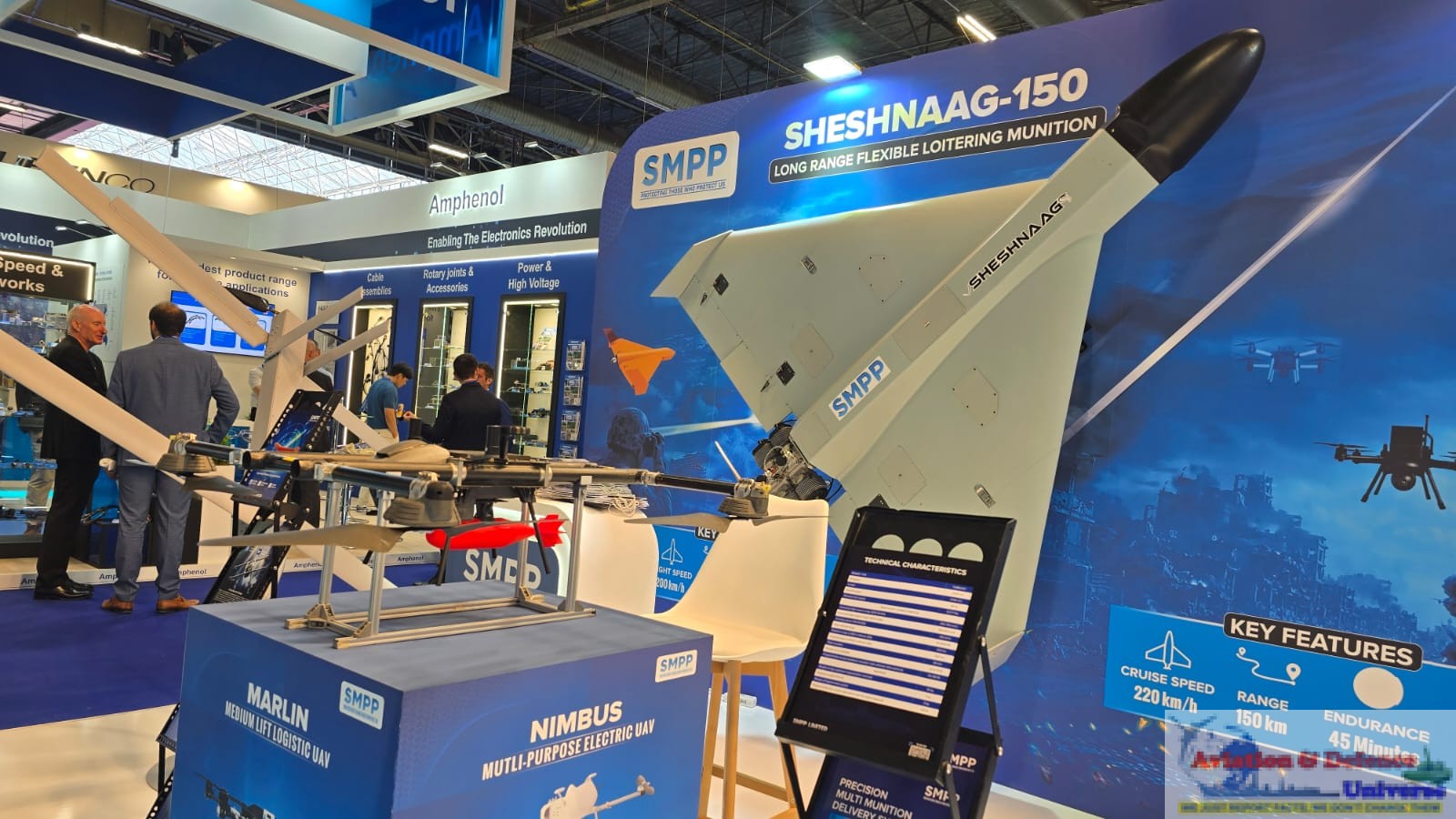
There are few companies which illustrate this evolution as clearly as SMPP. The company’s journey began with a strong focus on ballistic protection products for soldier survivability. Today, it is expanding into the domain of large-calibre ammunition, unmanned aerial systems, loitering munitions and precision-strike capabilities.
This is more than an expansion of its product portfolio. It represents a shift from protecting the soldier on the battlefield to providing capabilities that can help the armed forces detect, engage and neutralise threats with greater range, precision and accuracy of engagement.
From protecting the soldier to enabling the battlefield
SMPP has built its credentials over decades around personnel protection and armour solutions. Its ballistic protection systems have been developed for the demanding requirements of the Indian armed forces, CAPFs and paramilitary forces, with the company recently completing large-scale deliveries of bulletproof jackets and ballistic helmets to the armed forces and police forces.
In 2025, SMPP received Emergency Procurement orders for 27,700 bulletproof jackets and 11,700 advanced ballistic helmets. The company subsequently expanded its delivery commitments to security forces, demonstrating its ability to manufacture and deliver critical equipment at scale. But the significance of SMPP’s evolution lies in what comes next. The company is moving deeper into technologies that determine not only whether a soldier survives a battlefield, but how effectively a force can generate combat power through ammunition provisioning.
Ammunition: building depth in a strategic capability
Ammunition is often less visible than platforms such as fighter aircraft, tanks or helicopters, but it is among the most strategically important components of military preparedness. A sophisticated weapons platform without a secure and reliable ammunition supply chain cannot deliver sustained combat capability. Recognising this, SMPP is establishing a major ammunition manufacturing facility in Himachal Pradesh. The company has obtained an industrial licence covering ammunition for tanks, artillery guns, mortars and infantry support weapons, with its initial focus including 155mm artillery ammunition and Bi-Modular Charge Systems (BMCS).
The move takes SMPP into one of the most demanding areas of defence manufacturing, where metallurgy, energetics, precision engineering, quality assurance, safety and production scale must come together. SMPP has stated that it successfully cleared user trials and DGQA evaluations for BMCS and 155mm artillery ammunition, including Boat Tail and Base Bleed variants. The company’s ammunition ambitions, however, extend beyond conventional rounds. The future battlefield is increasingly defined by precision.
From conventional ammunition to precision technology
Modern warfare places a premium on achieving the desired battlefield effect with greater accuracy, range and efficiency. Precision-guided ammunition, loitering munitions and unmanned platforms are changing the relationship between intelligence, targeting and kinetic effect. This is where SMPP’s expansion into unmanned systems and its international technology partnerships become particularly relevant.
In November 2025, SMPP entered into a teaming agreement with KNDS for the KATANA family of 155mm precision-guided artillery ammunition. The KATANA family includes Ballistic Range, Extended Range and High Precision variants, with its guidance architecture combining GNSS and an inertial measurement unit. Future variants are expected to incorporate a semi-active laser seeker.
The partnership provides SMPP with an entry into precision-guided artillery while complementing its growing domestic ammunition capabilities.
In June 2026, SMPP entered into a further teaming agreement with KNDS to manufacture advanced loitering munitions in India. The agreement covers systems including VELOCE and RODEUR, along with the ISTAR family of drones, combining technology transfer with indigenous manufacturing under the Make in India framework.
Taken together, the agreements broaden SMPP’s role from conventional ammunition and protection systems into precision strike and unmanned battlefield capabilities.
The battlefield is moving into the aerial domain
The other major pillar of SMPP’s expansion is unmanned systems. The rapid proliferation of drones and loitering munitions across contemporary conflicts has fundamentally altered battlefield dynamics. Unmanned systems can provide persistent surveillance, rapid target acquisition and precision strike capability while reducing the risk to personnel.
SMPP entered this segment with a focus on both surveillance and strike systems. In June 2026, the company announced completion of deliveries of 106 jet-powered Peacekeeper (Agnivaig) drones to the Indian Army – 100 operational systems and six training systems.
SMPP said the system demonstrated a circular error probable (CEP) of less than five metres and an operational range of approximately 180 kilometres during user trials, including operation in a heavily jammed and spoofed environment.
This development is significant because it demonstrates that SMPP’s unmanned-systems strategy is not limited to assembling commercial drones. It is moving towards defence-grade unmanned systems designed around specific operational requirements.
This also creates a natural bridge between the company’s established strengths and its emerging capabilities. Materials, composites, manufacturing engineering, payload integration and systems-level production have relevance across protection, ammunition and unmanned platforms.
Building an integrated precision-strike capability
SMPP’s expanding portfolio increasingly reflects the way modern warfare is evolving. The modern kill chain links surveillance, target identification, command and control, precision guidance and kinetic effect. The more closely these elements can be connected, the faster a military can move from finding a target to fixing and engaging it.
SMPP’s own evolution is moving in this direction – from ballistic protection and conventional ammunition towards UAVs, precision-guided ammunition and loitering munitions. The significance, therefore, is not simply that the company is manufacturing more products. It is developing capabilities across multiple points of the battlefield value chain.
Partnerships that strengthen, rather than dilute, indigenisation
There is sometimes a misconception that partnering with international defence companies is inherently contrary to the objective of self-reliance. In reality, India’s defence industrialisation is likely to depend on a combination of indigenous innovation and carefully structured international partnerships.
The critical question is not whether foreign technology is involved. It is where manufacturing takes place, how much capability is absorbed, whether Indian suppliers become part of the value chain, and whether the partnership contributes to a sustainable domestic industrial base.
The SMPP-KNDS relationship is relevant in precisely this context. The agreements covering precision-guided artillery ammunition and loitering munitions provide a model of international collaboration linked to manufacturing and technology transfer in India.
For SMPP, the opportunity is to convert access to global technology and expertise into deeper domestic manufacturing capability. That distinction will become increasingly important as India seeks to reduce import dependence while positioning itself as a defence manufacturing and export hub.
The next phase of Atmanirbhar Bharat
India’s defence indigenisation story is entering a more sophisticated phase. The first stage was about creating domestic manufacturing capacity. The next is about developing depth – across materials, components, systems, ammunition, electronics, propulsion, guidance, software, platforms and integration.
Companies such as SMPP will play an important role in this transition because their growth is increasingly taking place across interconnected capability areas.
- Ballistic protection builds expertise in materials, manufacturing and survivability.
- Ammunition adds precision engineering, production scale and energetic systems.
- UAVs bring together aerostructures, propulsion, payloads, communications and mission systems.
- Loitering munitions and precision-guided weapons add sensing, navigation, guidance and precision effects.
Taken together, these capabilities create something more valuable than a collection of products: a deeper indigenous defence technology and manufacturing ecosystem.
That may ultimately be the more important measure of Atmanirbhar Bharat.
From supplier to strategic capability partner
SMPP’s transformation is therefore best understood not as a company diversifying away from ballistic protection, but as a company building outward from its core engineering and manufacturing strengths.
The bulletproof jacket remains important, as does the ballistic helmet. But the battlefield around the soldier is changing rapidly. The soldier now operates alongside unmanned systems, precision artillery, networked sensors and increasingly sophisticated strike capabilities. India’s defence manufacturers must evolve accordingly.
SMPP’s move into ammunition and UAVs, followed by its partnerships with global defence companies such as KNDS, reflects this new industrial reality. It demonstrates how an Indian company can use decades of manufacturing experience as the foundation for entering increasingly technology-intensive domains.
The larger story is not simply about what SMPP will manufacture next. It is about India’s transition from being a major defence buyer to becoming a country capable of designing, manufacturing, integrating and sustaining increasingly sophisticated defence systems at home.
And that is where the real meaning of indigenisation lies-not in closing the door to global technology, but in ensuring that international partnerships ultimately strengthen India’s own industrial capability, technology base and strategic autonomy.

















































































-A4-Size-(2)_page-0001.jpg)