

 18th BRICS Summit














- NewSpace to National Security: Key Themes at India Space Congress 2026
- From Orbit to Opportunity: India Space Congress 2026 to Map the Future
- Driving Innovation, Security and Collaboration in Space
By Sangeeta Saxena
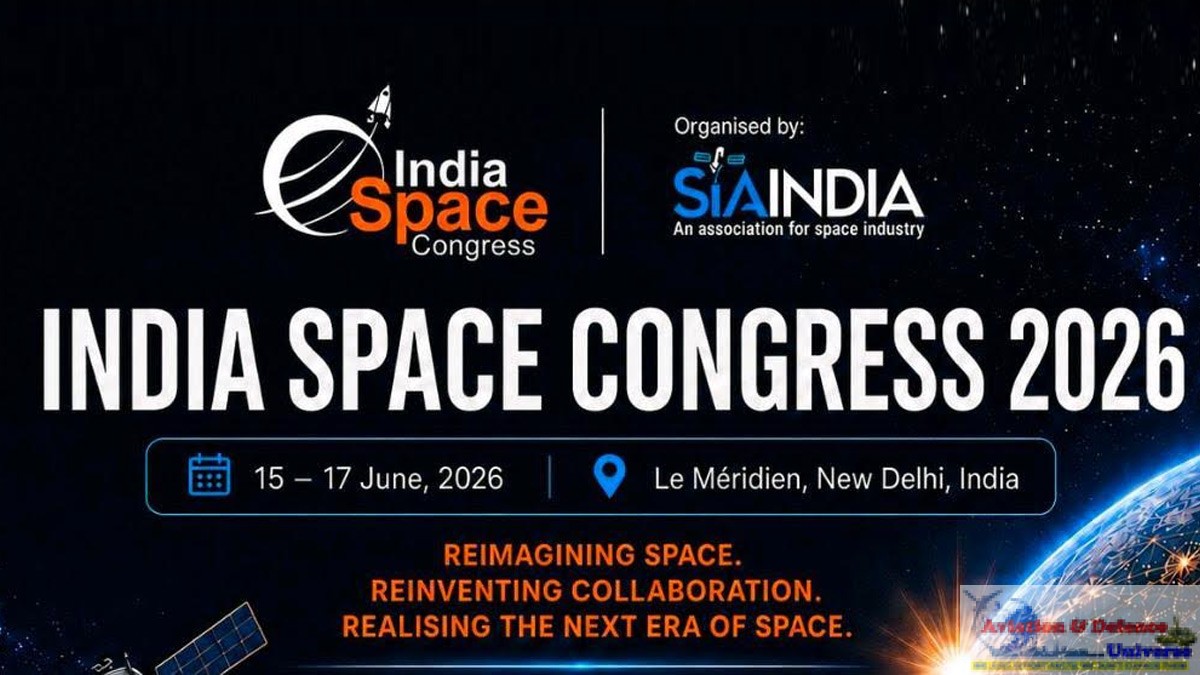
Paris/New Delhi. 14 June 2026. As India accelerates towards becoming a global space power, the India Space Congress (ISC) 2026, scheduled from 15–17 June at Hotel Le Meridien, New Delhi, promises to be one of the country’s most significant space sector gatherings. Organised by SIA-India, the three-day congress will bring together policymakers, defence leaders, space agencies, industry executives, startups, academia and international partners to deliberate upon the future of space technology, security, commerce and governance. With themes ranging from satellite communications and launch systems to space security, venture capital and human spaceflight, the event reflects the growing convergence of strategic, commercial and scientific dimensions of the global space economy. The programme demonstrates India’s ambition to emerge not only as a launch provider but also as a leader in NewSpace innovation, sovereign capabilities and international collaboration.
The opening day begins with a Global Leadership Plenary featuring Dr. Subba Rao Pavuluri, Dr. Shailesh Nayak, Hughes India Executive Vice President Ramesh Ramaswany, Vice Admiral A.B. Singh (Retd.), Dr. Sharad Kumar Yadav, Thailand’s GISTDA representative Phee Choosri and Dr. Mumin Chen from the Taipei Economic and Cultural Centre. The plenary sets the tone for discussions on global cooperation and the evolving space order.
The first set of sessions explores Direct-to-Device Satellite Connectivity, examining how satellite-enabled communications could revolutionise connectivity across remote geographies. Parallel discussions on Reusable Launch Vehicles and Return-to-Earth Systems analyse emerging technologies that are reducing launch costs and making rapid re-flight possible. Simultaneously, experts deliberate on treating space infrastructure as a strategic national asset to strengthen resilience and defence preparedness.
A Global Space Agency Leaders Roundtable brings together representatives from the Philippines Space Agency, GISTDA and international partners to discuss multilateral cooperation, standards and global governance. Another session focuses on In-Orbit Servicing and Space Logistics, an emerging market covering satellite servicing, debris removal and orbital infrastructure.
The afternoon sessions examine India’s NewSpace Manufacturing Ecosystem through centres of excellence, particularly Karnataka’s SpaceTech initiative, while a policy dialogue on Space Risks addresses orbital congestion, liability and insurance mechanisms. Connectivity remains a recurring theme with discussions on In-Flight and At-Sea Satellite Communications, while ORF and SIA-India jointly explore India’s role in the global space economy. The India Space Policy Ideathon (Geo-Niti 2026) seeks to build a future talent pipeline in space policy and geospatial intelligence. Further sessions examine satellite-enabled digital infrastructure in India’s Northeast, sovereign satellite ecosystems, EU-India space collaboration, hybrid 5G/6G satellite networks and orbital data centres powered by edge AI, before the first day concludes.
The second day opens with a plenary on Global Collaboration in Space, featuring Luxembourg Ambassador Christian Biever, UNOOSA Director Aarti Holla Maini and IN-SPACe Chairman Dr. Pawan Goenka. Sessions begin with discussions on satellite connectivity as a parallel digital backbone, arguing that SATCOM should function alongside fibre and mobile networks as a national infrastructure layer. Another session examines Satellite Mission Systems and Payload Innovation, focusing on AI-enabled sensing, miniaturisation and onboard processing technologies. Regulatory experts then debate spectrum asymmetry, licensing models and competitive markets in next-generation satcom.
Propulsion experts discuss electric propulsion systems and reusable technologies, while strategic thinkers examine the emerging Seabed-to-Space doctrine, integrating maritime, terrestrial and orbital domains. The post-lunch sessions focus on Multi-Orbit Satellite Networks, integrating GEO, MEO and LEO constellations for resilient communications. Another track examines the use of space technologies for disaster resilience and rapid response.
Human spaceflight takes centre stage with discussions on life support systems, crew health and commercial opportunities linked to future missions. Parallel sessions explore international market access and cross-border supply chains for Indian space startups. Later discussions focus on building India’s indigenous satcom ecosystem, leveraging PM Gati Shakti and geospatial platforms for innovation and presenting an exclusive market intelligence briefing on India Satcom Outlook 2035. The day concludes with an industry roundtable aimed at fostering partnerships and policy dialogue.
The final day opens with a focus on Space Security and Strategic Autonomy, featuring DSCI CEO Vinayak Godse, Lt Gen P.J.S. Pannu (Retd.) and Lt Gen D.S. Rana of Strategic Forces Command. Sessions on Ground Segment as a Service (GSaaS) explore new satcom business models, while another track analyses how Earth Observation companies can move from data provision to recurring revenue generation. Security takes centre stage through discussions on Space Domain Awareness, asset protection and counterspace threats. Experts examine Persistent ISR from Space using LEO constellations for surveillance and national security. A highly anticipated session on Venture Capital for the Space Economy brings together leading investors to discuss financing models, institutional capital and market readiness for space startups. Further discussions analyse the trillion-dollar space economy, sovereign capabilities in cybersecurity and data protection and innovation in defence-space technologies.
The final sessions examine secure satellite communications for military operations, space biomanufacturing, homeland security applications, resilient multi-domain networks, future media distribution architectures and the rapidly growing India-U.S. space partnership.
Technical workshops focus on resilient positioning, navigation and timing systems, including NavIC and anti-spoofing technologies, while experts deliberate on strategic technologies shaping future defence space systems. The congress concludes with a closing ceremony titled “Charting the Next Era of Space,” featuring leaders from government, industry, academia and international agencies.
India Space Congress 2026 reflects the extraordinary transformation of India’s space ecosystem—from a state-led programme to a vibrant, globally connected NewSpace economy. The three-day event demonstrates how space today lies at the intersection of national security, economic growth, technological innovation and international diplomacy. From direct-to-device communications and reusable launch systems to space security, venture capital and human spaceflight, the congress underscores India’s growing role in shaping the future of the global space economy. As India aspires to become a leading space power and a trillion-dollar economy, the conversations in New Delhi may well define the contours of the nation’s next giant leap into space.


































































-A4-Size-(2)_page-0001.jpg)