


















- Italy as Partner Country at BSX 2026 Shall Focus on an India–Italy Space Ecosystem
- Turning Two Complementary Space Ecosystems into One Powerful Partnership
By Sangeeta Saxena
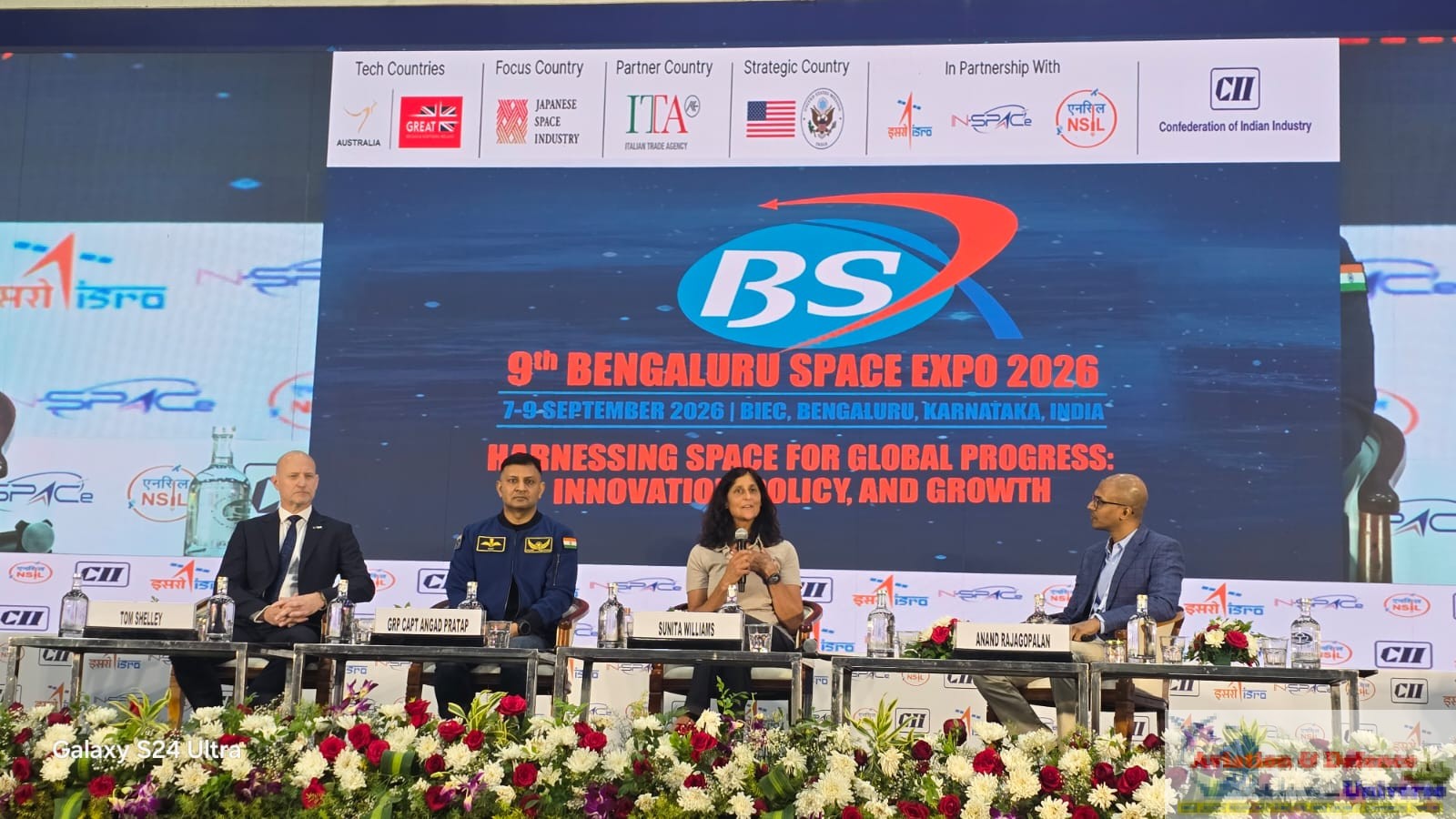
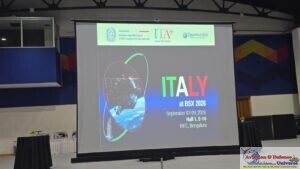
New Delhi. 13 August 2026. When Italy arrives at Bengaluru Space Expo (BSX) 2026 as the Partner Country this September, it will be with an aim extending far beyond exhibiting satellites, technologies or industrial capabilities. Its message to India’s rapidly expanding space ecosystem is both simple and significant: move from cooperation to co-creation.
In an exclusive pre-BSX 2026 interview with Aviation & Defence Universe (ADU), Sergio Ledda, Scientific Attaché at the Embassy of Italy in New Delhi, outlines an ambitious vision for connecting two increasingly complementary space ecosystems. From Earth observation, lunar science and heliophysics to artificial intelligence, quantum technologies, space situational awareness and orbital sustainability, Ledda sees enormous possibilities for combining Italian scientific and technological expertise with India’s growing industrial scale, NewSpace dynamism and entrepreneurial energy. The Italy–India Joint Strategic Action Plan 2025–2029, which explicitly identifies space as an area for deeper cooperation, provides an important strategic framework for taking that relationship forward.
This conversation offers a glimpse into a bilateral space relationship preparing for its next orbit—one where science meets commerce, established institutions meet NewSpace entrepreneurs, and two nations look beyond reaching space towards using space technologies to create economic growth, sustainability and resilience on Earth.
ADU. Italy is the Partner Country for BSX 2026 in Bengaluru. What significance does Italy attach to this partnership, and what message does Italy want to bring to India’s space ecosystem through its participation?
Sergio Ledda. Italy attaches great importance to being Partner Country at the Bengaluru Space Expo 2026. Bengaluru is one of the most dynamic space and technology ecosystems in India, and BSX provides an excellent platform to bring together institutions, industry, start-ups, investors and the research community. For Italy, this partnership is much more than an opportunity to showcase our space industry. It is an opportunity to strengthen a relationship that already has a solid institutional and scientific foundation. Italy and India have a long history of cooperation in space, including around 25 years of collaboration between the Italian Space Agency, ASI, and ISRO. Today, we are entering a new phase in which institutional cooperation is increasingly complemented by direct interaction between our industrial ecosystems. At BSX, eight Italian space companies will participate, and Italy will be present as Partner Country. Our message is therefore very clear. we want to move from cooperation to co-creation. We see India and Italy as highly complementary space ecosystems. The objective is not to compete for the same space, but to combine capabilities, technologies, research excellence and industrial strengths in order to develop solutions together for the global space economy.
ADU. India and Italy have witnessed a noticeable strengthening of their strategic relationship in recent years. Where does science, technology and particularly space cooperation fit into this growing bilateral partnership?
Sergio Ledda. Science, technology and innovation are at the heart of the increasingly strategic relationship between Italy and India. The Italy–India Joint Strategic Action Plan 2025–2029 explicitly identifies space as one of the areas in which our two countries intend to deepen cooperation. The objective is to expand cooperation between space agencies, academic institutions and research centers in areas including Earth observation, heliophysics and space exploration, with particular attention to lunar science, astrophysics, AI and Quantum Technology. Space is particularly important because it connects scientific research, advanced technologies, industrial capabilities and applications with a direct impact on society and the economy. Our cooperation can therefore address challenges that are common to both countries and to the international community. climate change, agricultural resilience, disaster management, monitoring of infrastructure, environmental protection and sustainable development.
At the same time, space is becoming increasingly connected with new strategic technologies such as artificial intelligence, quantum technologies, advanced communications and high-performance computing. This creates an exceptionally broad field for cooperation between Italian and Indian universities, research institutions, space agencies, large companies and start-ups.
ADU. India’s space sector has undergone a major transformation with increasing private-sector participation. How is Italy viewing the emergence of India’s space companies and start-ups?
Sergio Ledda. We see the transformation of the Indian space sector with great interest and appreciation. The emergence of a dynamic private space ecosystem represents one of the most significant developments in the international space sector. India has created an environment in which start-ups and private companies can increasingly contribute to the space value chain, complementing the extraordinary capabilities developed over decades by ISRO. For Italy, this creates an important opportunity for partnership.
The Italian space ecosystem includes large companies, highly specialised SMEs, innovative start-ups, research institutions and universities. We believe that many of these capabilities are complementary to those emerging in India. This is why the Italian Trade Agency, in coordination with IN-SPACe, has been working to facilitate direct interaction between the two industrial ecosystems. In September 2025, an Italian space-industry mission travelled to India, and this was followed in May 2026 by an Indian industrial delegation led by IN-SPACe visiting Italy during Space Meetings Veneto. The latter included several Indian space companies and start-ups. These missions are important because they create the conditions for something more ambitious than commercial exchange. joint projects, co-design, co-development and potentially co-production. We are already seeing Italian companies exploring partnerships and, in some cases, considering establishing a presence in India. This is precisely the kind of two-way industrial integration that we would like to encourage.
ADU. What role can the Italian Space Agency and ISRO play in creating a stronger institutional framework for bilateral cooperation, particularly in research, technology development and future missions?
Sergio Ledda. ASI and ISRO have a fundamental role because they provide the intitutional and scientific framework within which cooperation can develop with greater ambition and continuity. The approximately 25-year history of cooperation between the two agencies provides a strong foundation. The next step should be to use this experience to identify new areas in which research institutions, universities and industry can work together. I see particular opportunities in Earth observation, lunar exploration, heliophysics and space science, as well as in emerging technologies such as artificial intelligence and quantum technologies.
Institutional cooperation is particularly important for developing long-term scientific programmes and future missions, while creating mechanisms through which the results of research can be transferred towards industry. In this sense, ASI and ISRO can act not only as institutional partners, but also as catalysts for broader ecosystems of cooperation involving universities, research centres, large companies, SMEs and start-ups.
ADU. Space situational awareness, space traffic management and orbital sustainability are becoming increasingly important as the number of satellites grows. Could these emerge as new areas of India–Italy cooperation?
Sergio Ledda. The rapid expansion of space activities makes sustainability and responsible use of outer space essential. As the number of satellites and commercial missions increases, space situational awareness, space traffic management, debris monitoring and orbital sustainability will become increasingly important for all space-faring countries. Italy believes that cooperation in these areas should be based on shared scientific knowledge, technological development and responsible behaviour. This is also an area where our broader scientific capabilities can converge. Space systems increasingly depend on sophisticated sensors, data analysis, artificial intelligence, high-performance computing and advanced communications.
India and Italy could therefore explore cooperation not only in monitoring the space environment, but also in developing technologies and scientific methods that support safer and more sustainable space operations. For us, sustainability is not an additional element of space policy; it should be incorporated into the design of future space activities from the beginning.
ADU. The global space economy is rapidly shifting from government-dominated programmes towards commercially driven activity. How can India and Italy work together to capture a larger share of this emerging global space economy?
Sergio Ledda. The answer is cooperation across the entire value chain. India has developed extraordinary capabilities in areas such as satellite systems, launch services, space applications and increasingly through its dynamic start-up ecosystem. Italy has a highly diversified industrial and technological base, with strong capabilities in satellite systems, Earth observation, telecommunications, scientific instruments, exploration technologies and advanced manufacturing. The opportunity is to connect these strengths. We should encourage Italian and Indian companies to move beyond traditional supplier relationships and towards partnerships for joint design, joint development, manufacturing and access to international markets.
This is particularly relevant for Earth observation. Satellite data can support climate-change monitoring, agriculture, water management, disaster-risk reduction, infrastructure resilience and many other applications. These are global markets in which India and Italy can develop solutions together. Our recent industrial missions have demonstrated that there is a strong interest on both sides. The next objective is to transform contacts into concrete industrial projects and long-term partnerships.
ADU. Scientific cooperation is ultimately built around people. What opportunities exist for greater exchanges between Indian and Italian scientists, researchers, engineers, students and universities?
Sergio Ledda. This is perhaps the most important dimension of all. Space cooperation cannot be sustainable without people capable of generating new knowledge and developing the technologies of the future. Italy and India already have strong academic and scientific connections, and we should increasingly connect these communities to the space sector. There is significant potential for joint research and researcher mobility in astrophysics, Earth observation, heliophysics, lunar science, quantum technologies, artificial intelligence, advanced materials, telecommunications and space engineering. We should also encourage cooperation between universities, research centres and industry, so that young researchers and engineers can move more easily between fundamental research, technological development and industrial applications. For us, the objective should be to create a continuous pipeline of talent and knowledge between Italy and India, involving students, PhD candidates, researchers, engineers and entrepreneurs.
ADU. Deep-tech and space start-ups often face challenges in accessing finance and international markets. Can India and Italy explore mechanisms that connect start-ups with investors, incubators and technology ecosystems in both countries?
Sergio Ledda. Yes, and I believe this should become an important component of our cooperation. Space and deep-tech companies often require significant investment and long development cycles before reaching the market. International partnerships can therefore be particularly valuable. India and Italy could facilitate connections between incubators, accelerators, technology-transfer offices, venture-capital communities and industrial investors.
The objective should not simply be to help companies enter each other’s markets. It should be to create opportunities for joint ventures, joint technology development and access to third markets. We are also engaging with IN-SPACe in a fruitful discussion on the standards and regulatory frameworks required to effectively enable co-design and, in particular, co-production between Italian and Indian companies in the space sector. An open and fair market cannot develop without greater clarity and alignment between the standards and requirements of the two ecosystems. This should be seen as a strategic pathway for strengthening cooperation between Italy and India and, more broadly, between India and Europe. This is another reason why missions such as those organised between Italy and India are so important. When entrepreneurs, investors and technology developers meet directly, they can identify opportunities, build trust and develop partnerships that would be difficult to create through institutional dialogue alone.
ADU. Space is increasingly intertwined with strategic autonomy, economic security and national resilience. How can India and Italy cooperate while ensuring that their partnership remains focused on peaceful, sustainable and responsible uses of outer space?
Sergio Ledda. Italy considers the peaceful, sustainable and responsible use of outer space a fundamental principle. Italy assumed the presidency of the United Nations Committee for the 2026–2027 period (COPUOS), with the idea of improving global space governance. At the same time, space technologies are increasingly important for economic security and societal resilience. Earth observation, telecommunications, navigation and space-based services are essential for modern economies and for responding to challenges such as climate change and natural disasters. Our approach is therefore to combine technological ambition with responsibility. Italy and India can cooperate in developing technologies that contribute to resilience while maintaining a strong commitment to international law, sustainability and the peaceful exploration and use of outer space. This principle should guide both institutional and commercial cooperation.
ADU. As Italy prepares to participate as Partner Country at BSX 2026, what is your message to India’s space industry, scientific community and rapidly expanding NewSpace ecosystem?
Sergio Ledda. Our message is very simple. Italy is here as a partner for the long term. BSX 2026 is an important opportunity to demonstrate the depth and breadth of the relationship between our two space ecosystems. The participation of eight Italian companies, together with the presence of Italy as Partner Country, reflects the growing interest of the Italian space industry in India. But we want to go beyond exhibitions and business meetings. As mentioned before, we want to develop a relationship based on complementarity, co-design and co-development. These are complementary strengths. Our ambition is therefore to build an ecosystem in which Italian and Indian companies can establish long-term partnerships, invest in each other’s markets, co-design technologies and eventually co-produce solutions for India, Italy and international markets. And finally, I would emphasise that the future of space cooperation is not only about reaching farther into space. It is also about using space technologies to improve life on Earth. Italy and India can work together to make space a driver of scientific discovery, technological innovation, economic growth, environmental sustainability and resilience.
As Italy prepares to take centre stage as Partner Country at BSX 2026, Sergio Ledda’s message leaves little ambiguity about the direction in which Rome wants the India–Italy space relationship to travel. The foundations are already substantial: nearly a quarter-century of ASI–ISRO cooperation, an expanding strategic relationship between the two governments, growing exchanges between their industries and a new generation of private space companies eager to look beyond national markets. What comes next is the harder—and potentially far more rewarding—task of converting this goodwill into technologies, missions and businesses created together. The possibilities stretch from Earth observation, lunar exploration and helio-physics to AI, quantum technologies, advanced communications, space sustainability and NewSpace entrepreneurship. Equally important is the human bridge: scientists, engineers, students, researchers and entrepreneurs moving between the two ecosystems and creating the relationships from which future technologies will emerge.
As Told To Sangeeta Saxena



































































-A4-Size-(2)_page-0001.jpg)