
















- Fuel, Fleets and Future Routes: Frankfurt’s Aviation Leaders Confront a Turbulent Tomorrow
- Expensive Fuel, Missing Aircraft and Smarter Routes: Aviation’s New Reality at Frankfurt
- Beyond Passenger Numbers: Routes World 2026 Redefines the Economics of Global Connectivity
- From Wizz Air to Lufthansa: Frankfurt Debates the Future of Airlines in a Disrupted World
By Anna Jordy
Frankfurt, Germany. 22 October 2026. The skies remained crowded with ambition, but the boardrooms were filled with caution. On the second day of Routes World 2026 at Messe Frankfurt, global aviation leaders confronted an uncomfortable reality: passenger demand remained resilient, yet the business of keeping the world connected had become increasingly expensive, unpredictable and technologically demanding. From soaring aviation fuel prices and Middle Eastern airspace disruptions to aircraft delivery delays, taxation, artificial intelligence and the changing economics of route development, the discussions revealed an industry caught between the promise of expansion and the pressures of survival. The message emerging from Frankfurt was clear: airlines could no longer plan their future on passenger demand alone. They needed financial resilience, fleet flexibility, technological intelligence and geopolitical foresight to remain competitive.
Wizz Air: Fuel Hedging Became a Competitive Weapon
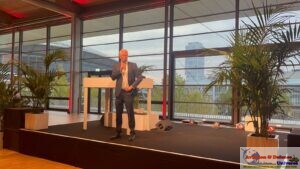
One of the day’s most closely watched conversations featured József Váradi, Chief Executive Officer of Wizz Air, in a keynote interview moderated by David Casey, Editor-in-Chief of Routes. Váradi offered a candid assessment of how fuel prices and geopolitical developments had changed the competitive dynamics of European aviation.
While airlines across the world grappled with elevated fuel costs, Wizz Air had secured much of its near-term fuel requirements at prices considerably below prevailing spot-market rates. Váradi described this position as “a huge competitive advantage” over airlines exposed to current market prices.
His remarks highlighted how fuel hedging had evolved from a financial risk-management instrument into an important element of airline competitiveness. Váradi expected the Middle East conflict to continue affecting aviation for some time. Consequently, Wizz Air had continued securing fuel supplies further into the future, accepting the possibility that it might pay more if prices subsequently declined.
The airline’s strategy reflected a calculated trade-off between price certainty and exposure to market fluctuations. Despite a relatively slow beginning to the summer season, Váradi reported that revenue performance had subsequently improved.
For Wizz Air, which had built its business around low fares, efficient aircraft utilisation and disciplined cost management, the challenge had been to maintain its competitive advantage without compromising its long-term growth plans.
The discussion also reinforced the wider difficulties confronting low-cost carriers as higher operating costs, aircraft availability constraints and geopolitical uncertainty complicated network expansion.
Lufthansa Group: Consolidation and the South Atlantic Opportunity
Another major highlight was the keynote conversation with Dieter Vranckx, Member of the Executive Board and Chief Commercial Officer of Lufthansa Group, moderated by Victoria Moores, European Editor and Bureau Chief of Air Transport World. Vranckx discussed the group’s consolidation strategy and its ambitions to strengthen its position in international aviation markets.
A major focus was Lufthansa Group’s proposed acquisition of a 44.9 per cent stake in TAP Air Portugal for €1.025 billion, following its selection by the Portuguese government on 14 October 2026. The transaction remained subject to regulatory approval.
Vranckx indicated that Lufthansa hoped to integrate TAP within approximately one to one-and-a-half years, drawing on its experience with ITA Airways. TAP’s existing membership of Star Alliance was expected to facilitate the process. The strategic significance of the proposed investment extended well beyond Portugal.
TAP’s established network across the South Atlantic, particularly its strong presence in Brazil, offered Lufthansa Group an opportunity to expand its connectivity between Europe and South America. The acquisition was expected to increase the group’s share of Europe–South America capacity to approximately 20 per cent.
The discussion illustrated how consolidation, airline partnerships and network integration had become important instruments for achieving growth in a market where organic expansion was increasingly constrained by aircraft shortages and operating costs.
State of the Industry: Rising Costs Threatened Aviation’s Growth
The Powerhouse Panel on the State of the Industry brought together senior representatives from global aviation and tourism organisations. Moderated by Dave Stroud, Managing Director of ASM, the discussion featured Mammen Tharakan, Director General of TIACA; Peter Cerdá, Vice President and CEO of IATA Americas and ALTA; Maribel Rodríguez, Executive Vice President, Destinations, World Travel & Tourism Council; and Antoine Rostworowski, Chief Strategy Officer of ACI World.
The conversation examined an industry in which passenger traffic continued to grow but profitability faced increasing pressure.
Cerdá warned that expensive fuel was making travellers more cautious about discretionary spending. He indicated that some airline executives had discussed fare increases of 20 per cent or more on certain routes.
Such increases raised concerns about affordability, particularly in price-sensitive markets.
Rostworowski revealed that ACI World had revised its global passenger growth forecast for 2026 downward from 2.7 per cent to 2.3 per cent. The revision reflected the combined impact of higher operating costs and a more challenging economic environment.
For airports and airlines, the consequences were significant. Routes that had previously been commercially viable could become difficult to sustain when fuel prices, airport charges and other operating expenses increased faster than passenger revenues. The panel also addressed the impact of government taxation on aviation.
Cerdá cited Mexico as an example, stating that taxes and charges could account for as much as 62 per cent of some airfares. The discussion underscored the tension between aviation’s contribution to economic development and the fiscal burdens imposed on the industry.
Taxation and Regulation: Was Aviation Becoming a Government Cash Cow?
The debate over taxation continued into discussions on aircraft technology and changing airline business models.
Aage Dünhaupt, Director of Communications at TUI Group, criticised the tendency of governments to treat travel as a source of revenue. He described travel as a cash cow for governments and also drew attention to passenger inconvenience caused by lengthy queues associated with Europe’s Entry/Exit System.
His observations reflected broader industry concerns about regulatory costs and their impact on passenger experience. For airlines, the issue extended beyond taxation alone. Every additional operational expense affected ticket pricing, route viability and the ability to maintain connectivity to smaller destinations.
The discussions demonstrated that aviation’s future growth would depend not only on airlines and airports improving efficiency but also on governments recognising the economic consequences of excessive charges and operational bottlenecks.
New Aircraft, New Networks: Technology Changed the Airline Business Model
The afternoon panel, New Aircraft, New Networks: How Technology Is Reshaping Airline Business Models, examined how aircraft innovation and digital technologies were influencing network strategies.
Moderated by Chris Sloan, Contributing Editor of Air Transport World, the session featured Sergej Bukovac, Head of Global Airline Consulting at Lufthansa Systems; Aage Dünhaupt of TUI Group; Alexandre Lefèvre, Vice President of Network Planning and Global Sales at Air Canada; Yves Renard, Head of Market Intelligence and Consulting at Airbus; and Theo Wensink, Head of Airline Marketing for the Middle East and Africa at Embraer.
The discussion explored how airlines had increasingly needed to match aircraft capabilities with specific market opportunities. Long-range narrowbody aircraft such as the Airbus A321XLR had created opportunities to operate thinner long-haul routes that might not support larger widebody aircraft.
Such aircraft offered airlines the possibility of developing new point-to-point connections while reducing the commercial risks associated with launching long-distance services. Similarly, smaller next-generation aircraft such as the Embraer E195-E2 had offered opportunities to align seat capacity more closely with passenger demand.
These developments were particularly relevant to markets where airlines wanted to introduce new routes or increase frequencies without committing larger aircraft. However, the availability of aircraft remained a fundamental constraint.
Manufacturing delays, supply-chain disruptions and maintenance-related groundings had forced carriers to become more selective in their expansion plans. The session also examined the growing convergence between traditional low-cost, hybrid and full-service airline models as carriers adjusted their strategies to changing market conditions.
Gulf Air: Aircraft Delivery Delays Threatened Future Expansion
Fleet availability emerged as another major concern through remarks by Gulf Air Chief Executive Officer Martin Gauss.
Gauss indicated that the Bahrain-based airline’s load factors, which were in the mid-80 per cent range, suggested that it had not ordered enough Boeing 787 aircraft to meet potential future demand.
He warned that an aircraft order placed in 2026 might not result in deliveries until 2034. The implications were considerable. Even if passenger demand recovered sharply, airlines without sufficient aircraft would struggle to translate that recovery into additional capacity and new routes.
Gulf Air’s experience also highlighted the operational consequences of regional geopolitical disruption. The airline had operated from Saudi Arabia while Bahrain’s airspace remained closed for 40 days and had rebuilt its network within six weeks. Gauss indicated that the carrier was finalising a ten-year fleet plan while assessing the risks of a sudden rebound in demand once regional tensions eased.
His remarks reinforced a recurring theme of the conference: airlines needed to plan for growth years in advance, even when the geopolitical and economic environment remained highly uncertain.
Artificial Intelligence: From Predicting Demand to Designing Routes
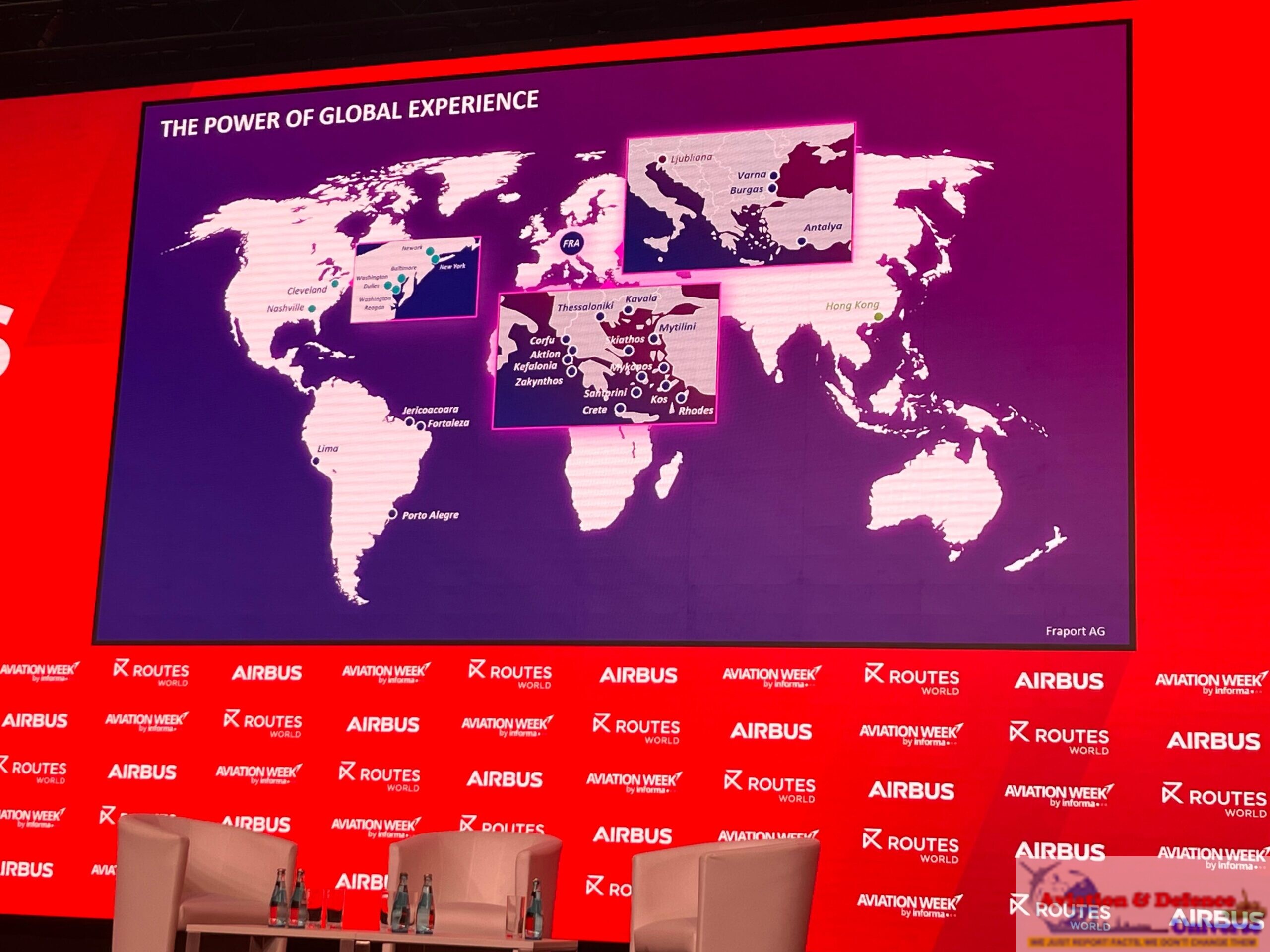
Artificial intelligence emerged as a major subject during the session titled What Role Will AI Play in the Future of Route Development? Moderated by Dave Stroud of ASM, the panel brought together Hasan Hamdan of Sabiha Gökçen International Airport; Diogo Bertussi of GOL Linhas Aéreas Inteligentes; Simone Schwab, Senior Vice President of Aviation and Cargo Development at Fraport AG; Remon Essers-Aliende Moscoso of Transavia; and Britany O’Bannon, Co-Founder and CEO of DOB AI.
The discussion examined how AI-driven analytics and richer data sources could transform the way airlines and airports evaluated potential routes.Traditionally, network planning had relied on historical traffic patterns, market studies, passenger demand forecasts and commercial judgement.
AI offered opportunities to analyse larger datasets, identify underserved markets and test route-development scenarios more rapidly.
Its potential applications extended to revenue management, operational efficiency, customer segmentation and destination marketing. For airports competing to attract airline services, predictive analytics could provide additional insights into passenger demand and market opportunities. However, the session also considered the limitations of AI adoption.
Data quality, transparency, integration with existing systems and the need for specialised skills remained important considerations. The central question was not whether technology would replace experienced aviation professionals, but how it could support faster and better-informed commercial decisions.
Inside the Network Planner’s Mind: Why Some Routes Never Take Off
The final discussion, Inside the Network Planner’s Mind, shifted attention from industry-wide challenges to the practical decisions that determined where airlines flew. Moderated by Edmond Rose, Director of Aviation Consulting at ASM Global Route Development, the session featured Samuel Ferrera, Network Officer at Wizz Air; Bojan Aranđelović, Deputy General Manager, Commercial and Strategy, at Air Serbia; Gonzalo Pernas, Head of International Network at SAS Scandinavian Airlines; and René Vallvé Palacios, Senior Manager of International Network Planning at Viva.
The audience-led format dispensed with conventional presentations and focused on the commercial realities of airline network planning. The session explored why seemingly attractive routes sometimes failed to materialise, why airlines withdrew services from certain airports and how carriers weighed fleet constraints, profitability, partnerships and political considerations.
The discussion highlighted that successful route development depended on much more than identifying passenger demand. Aircraft availability, connecting traffic, operating costs, competition and strategic priorities all influenced whether a route could be launched and sustained. For airport operators and destination authorities, understanding these considerations remained essential to attracting new airline services.
Routes World Awards: Celebrating Excellence in Global Connectivity
The second day also celebrated achievements in aviation route development through the Routes World Awards. Rome Fiumicino Airport emerged as the overall winner and secured the award in the category for airports handling more than 30 million passengers annually.
The airport had handled a record 51.3 million passengers in 2025. Shannon, Cagliari, Edinburgh and Brussels airports were recognised in their respective size categories. The Moroccan National Tourist Office received the destination award, while Transavia secured the airline award. Scoot’s Singapore–Vienna service was recognised as the first winner of the Route of the Year award.
The awards provided a positive counterpoint to the day’s discussions on rising costs and operational challenges, recognising organisations that had successfully translated route-development strategies into improved connectivity.
The India Connection: Lessons for a Rapidly Expanding Aviation Market
For India, the conversations in Frankfurt carried considerable relevance. Representatives from Air India, IndiGo and the Airports Authority of India attended Routes World 2026, reflecting the country’s growing engagement with the international aviation ecosystem. The challenges discussed in Frankfurt were closely connected to India’s own aviation expansion.
Middle Eastern airspace disruptions affected international route planning, particularly for airlines operating services to Europe and beyond. Higher aviation fuel prices created additional pressure on operating costs, while aircraft delivery delays complicated the ambitious fleet expansion programmes of Indian carriers. The discussion on taxation also resonated with India’s aviation sector, where state-level levies on aviation turbine fuel had remained a longstanding concern.
At the same time, technological developments offered opportunities. Long-range narrowbody aircraft could support new international point-to-point connections, while smaller efficient aircraft could improve the commercial viability of regional services. Artificial intelligence and predictive analytics could also help Indian airlines and airports identify underserved markets, optimise networks and improve operational efficiency. As India pursued stronger international connectivity and expanded its airport infrastructure, the lessons from Frankfurt demonstrated the importance of balancing growth ambitions with financial discipline, fleet availability and technological preparedness.
Aviation’s Future Would Belong to the Most Adaptable
Routes World 2026’s second day demonstrated that the future of aviation would not be determined by how many aircraft airlines wanted to operate or how many destinations airports hoped to connect. It would depend on how intelligently the industry managed uncertainty. Fuel prices could change overnight, geopolitical conflicts could close airspace, aircraft deliveries could slip by years and taxation could turn profitable routes into financial liabilities. Yet the discussions in Frankfurt also revealed an industry actively seeking solutions through fuel hedging, consolidation, aircraft innovation, artificial intelligence and more sophisticated network planning.
For airlines, airports and destinations, the challenge was no longer simply to grow, but to grow sustainably in an increasingly unpredictable world. Frankfurt’s message was unmistakable: aviation’s next great competitive advantage would not come from flying farther alone, but from planning smarter, adapting faster and connecting the world more efficiently.