






























- Further liberalisation of air transport could add an additional US$ 4.3 Billion in GDP and 450,000 jobs
- ASEAN Airports require up to US$ 341 Billion in investment through 2056 to accommodate future growth
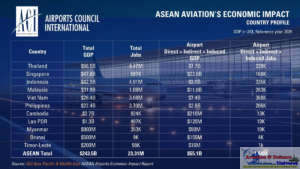 07 October 2026, Singapore: A new study by Airports Council International Asia-Pacific & Middle East (ACI APAC & MID), the first comprehensive assessment of the economic contribution of airports across ASEAN, quantifies the significant role aviation plays in supporting the region’s economic development. The study, Strengthening the ASEAN Single Aviation Market (ASAM) for Greater Connectivity within and beyond ASEAN, finds that airports and the air connectivity they enable supported 23.3 million jobs and contributed US$244 billion to GDP across ASEAN in 2025.
Airports have long been viewed as powerful instruments of regional integration and economic growth, connecting businesses to markets, facilitating trade and tourism, and supporting investment and employment across the wider economy. This role is particularly significant in Southeast Asia, where economies are diverse and geographically dispersed, making aviation vital to strengthening ASEAN’s competitiveness in an increasingly interconnected world. The ASEAN Single Aviation Market was introduced with this ambition in mind.
The study examines the connectivity, policy, infrastructure and implementation gaps that need to be addressed for ASEAN to realise the full potential of the Single Aviation Market, and provides recommendations to strengthen connectivity within and beyond the region.
The findings show that airport-related activity alone, including direct operations, supply-chain effects and household spending, supported 1.6 million jobs and contributed US$ 55 billion to ASEAN’s GDP in 2025. Airport-related activity is also estimated to have generated US$36 billion in tax revenues to government, comprising US$8 billion from airport activity and US$28 billion from its wider catalytic impact across 11 ASEAN States.
The economic contribution of aviation has been accompanied by significant growth in regional air connectivity. By reducing barriers to air services, expanding market access and enabling greater integration, ASAM has provided a platform for traffic and connectivity development. The study estimates that almost all ASEAN Member States recorded at least a doubling in scheduled seat capacity between 2004 and 2025, with most of the intra-ASEAN growth occurring between 2010 and 2015, coinciding with the signing of various ASAM-related protocols across the Member States. One visible result has been the growth of low-cost carriers, accounting for 51% of intra-ASEAN seats in 2025, compared with 29% in 2008, helping to expand access to affordable air travel across the region.
- Direct air connectivity across ASEAN increased by 358% between 2004 and 2025, with the resulting connectivity gains associated with approximately US$50.6 billion in GDP and 6 million jobs across the region.
- Vietnam, Indonesia and Malaysia recorded the largest total employment impacts from airport-related activity, at approximately 368,000, 335,000 and 282,000 jobs, respectively.
- For GDP, Singapore, Malaysia and Thailand recorded the largest total airport-related impacts, at approximately US$22 billion, US$11 billion and US$7.7 billion, respectively.
- An estimated 84.8 million international tourists arrived in ASEAN by air in 2025, generating approximately US$127 billion in tourism spending, around two-thirds of total international tourism expenditure in ASEAN.
- ASEAN airports handled more than 700 million passengers and almost 9 million tonnes of cargo in 2025.
Cost of inaction
The study also identifies further economic gains that could be enabled through full implementation. In an unconstrained scenario, full implementation of ASAM could generate approximately 6 million additional intra-ASEAN passengers, equivalent to an 11.6% increase over 2025 intra-ASEAN traffic. The associated economic opportunity includes approximately 15,000 additional aviation-sector jobs and US$600 million in GDP, together with a further 434,000 jobs and US$3.7 billion in GDP through tourism, trade, investment and other catalytic effects – bringing the total to almost 450,000 jobs and US$4.3 billion in additional GDP.
Stefano Baronci, Director General of ACI Asia-Pacific & Middle East said: “ASEAN States have made historic strides with the ASEAN Single Aviation Market (ASAM), demonstrating what the ASEAN Community can achieve when governments and industry fly together. As withany ambitious regional agreement, ASAM is a continuous journey, but there is still scope for improvement to unlock its full potential. In a fast-evolving macroeconomic environment, high-stakes scenarios demand strategic trade-offs. To fully realise the opportunities ASAM has created, States must address remaining challenges around market access and traffic rights, starting with further opening of air connectivity to secondary cities, so that more local economies can benefit from increased traffic.”
“Lagging airport infrastructure development is another core factor that limits the liberalisation process in Southeast Asia, affecting the ability of airlines to fully capitalise the opportunities created by ASAM. With traffic expected to more than double in the ASEAN region in the next decade, supporting sustainable funding for airport expansions is of vital importance,” Baronci added.
Capacity as a catalyst for growth
Further liberalisation of air transport policies alone will not deliver these gains. The study highlights that market liberalisation is necessary but not sufficient to translate greater market access into stronger connectivity. It must be matched by sufficient airport and airspace capacity, as well as enabling regulatory frameworks. In particular, ASEAN passenger traffic is forecast to more than double over the next decade, creating significant investment requirements across the region. ACI Asia-Pacific & Middle East estimates that approximately US$108 billion in airport investment will be needed by 2036 to accommodate this growth, followed by a further US$233 billion between 2037 and 2056 as the passenger traffic is estimated to reach 2.9 billion within the region. This represents a total investment requirement of approximately US$341 billion over the next 30 years.















































































-A4-Size-(2)_page-0001.jpg)