










- A Farewell from the Cockpit of Command: ACM AP Singh Defines IAF’s Next Mission
- Airpower Is the Cutting Edge of Military Strength Feels The Chief
- Always Ready, Always Evolving: IAF Marks 94 Years with a Future-Focused Vision
By Sangeeta Saxena
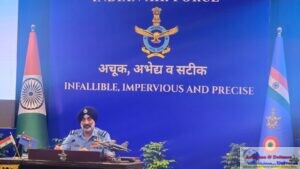
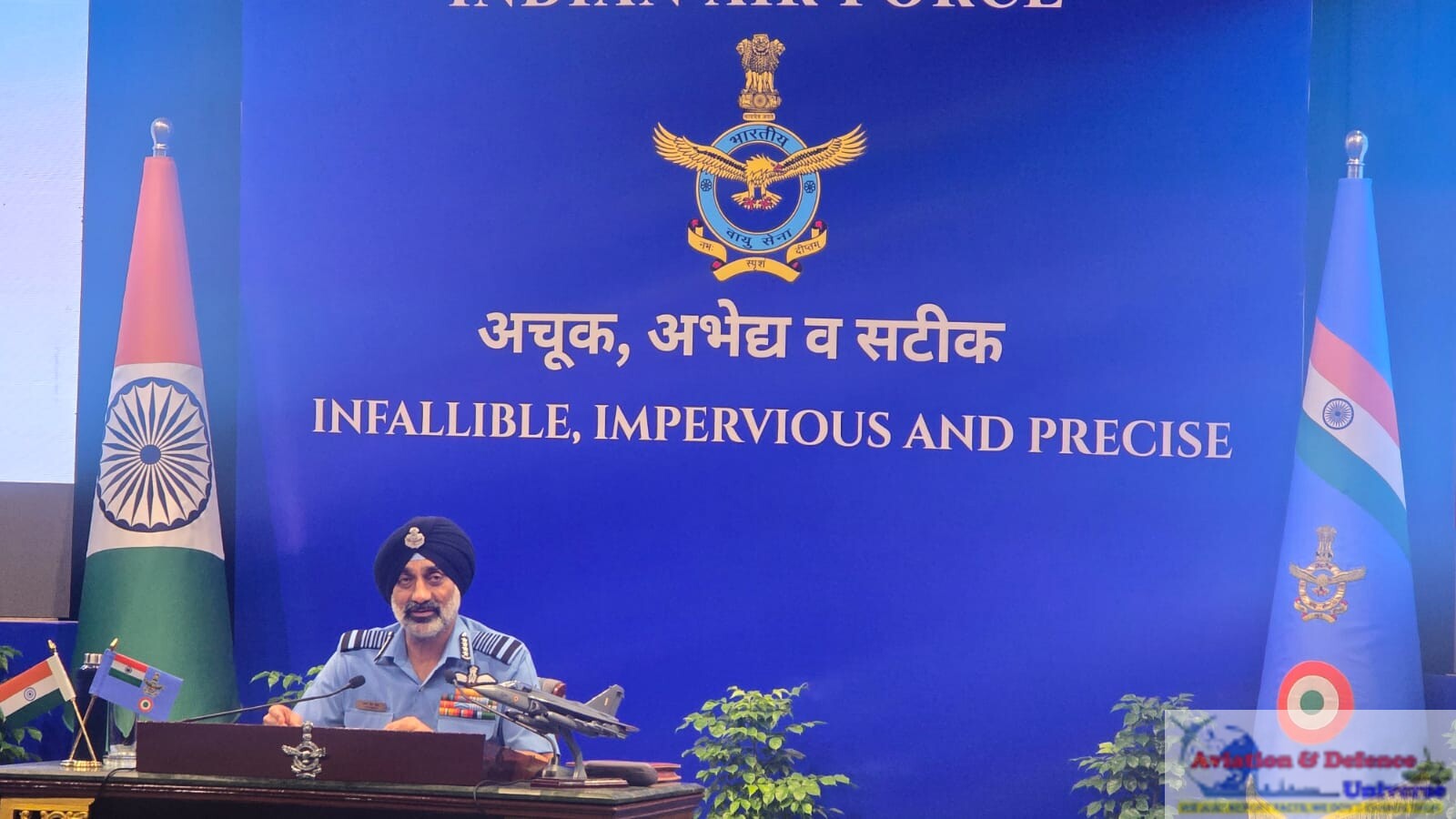
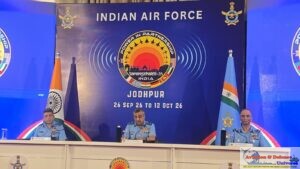
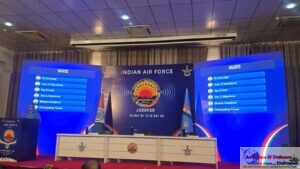
New Delhi. 03 October 2026. It was a press conference carrying the weight of both an anniversary and a farewell. As the countdown to the Indian Air Force’s 94th anniversary begins, Chief of the Air Staff Air Chief Marshal A.P. Singh presented an expansive assessment of the Service’s combat readiness, Operation Sindoor, dwindling fighter strength, indigenous programmes, fifth-generation aircraft, theatre commands, drones, space warfare and the changing character of aerial combat. But this was also his final press conference as the Air Chief before he superannuates on 31 October 2026—giving his words the resonance of a professional testament from a fighter pilot preparing to leave the cockpit of command. Air Chief Marshal A.P. Singh has served as Chief of the Air Staff since September 2024, leading the IAF through a period marked by operational deployment, rapid technological change and an intensified drive towards indigenous aerospace capability.
From Four Wapitis to a Network-Centric Force
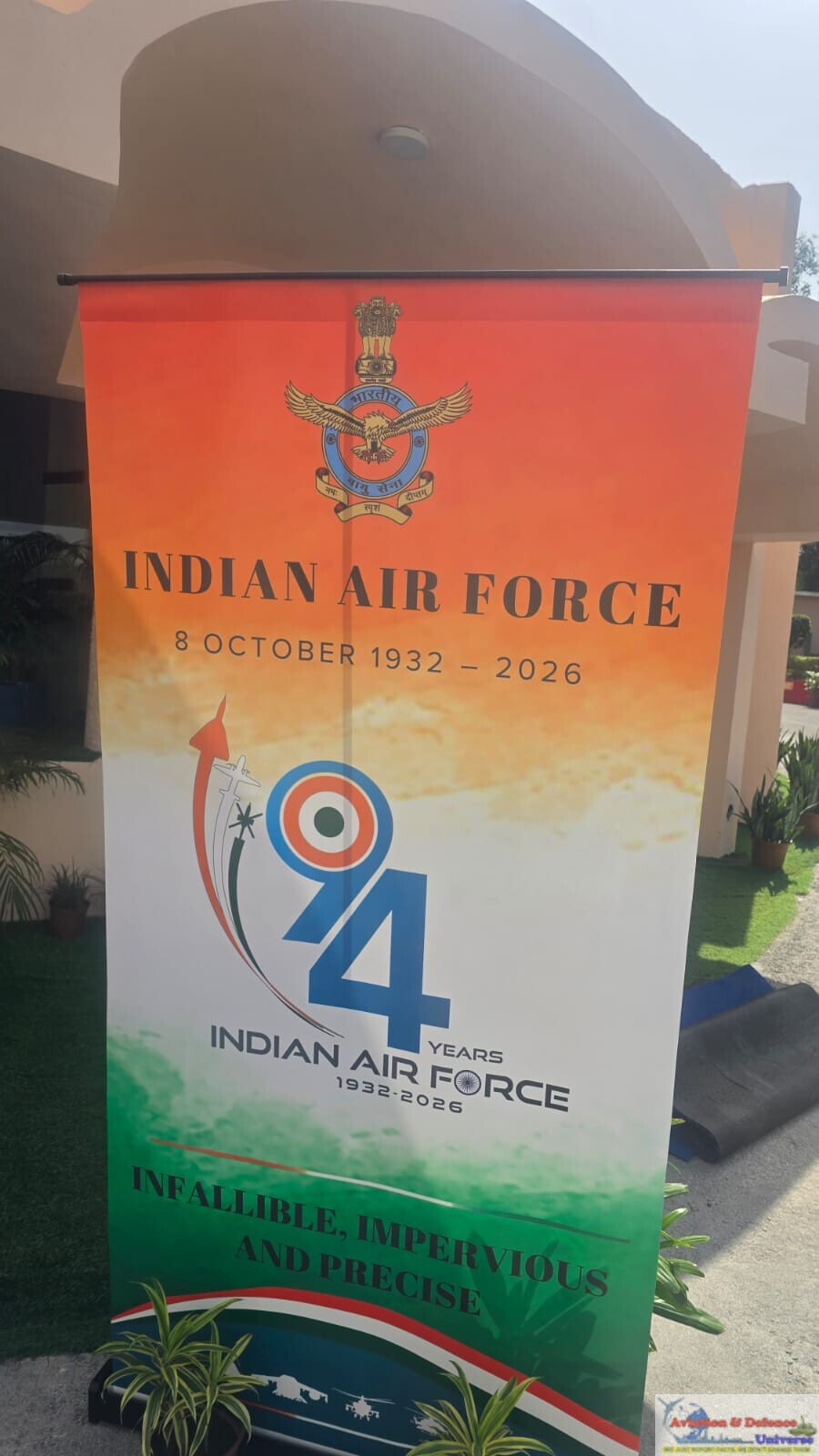 Opening the annual Air Force Day press conference, the Air Chief traced the IAF’s transformation from its modest beginnings to its present status as a modern aerospace force. “In the past 94 years, we have grown from a very modest beginning of four Wapiti aircraft into a network-centric force now capable of operating in multi-domain across the spectrum.” He emphasised that the Air Force’s responsibilities were not confined to conflict. “And not only just in time of war, but also in the time of peace, in giving HADR or meeting any other requirement that comes up.” Crediting earlier generations of air warriors for building the institution, he said, “All this is possible because of the vision and the sacrifices of our forebears, who led us, gave us the platform and helped us become one of the top air forces in the world.”
Media Builds Narratives but Must Guard Operational Secrets
Thanking the media for its sustained support, Air Chief Marshal Singh said its role had evolved beyond simply reporting events. “The role of media has changed a lot—from just reporting events earlier to now building narratives and bridging the gap between the military and the people of India.” He added that the media contributed significantly to bringing the country together through a whole-of-nation approach. However, he also sounded a clear warning against placing sensitive operational information in the public domain. “Sometimes we do tend to go beyond a certain line where confidential information—information that should not reach the enemy on a platter—is put out in the media.” Calling for restraint, he said, “My request to you all will be that we should refrain from that part and use the information that is available judiciously.”
Airpower Is the Cutting Edge of Military Power
Placing the IAF’s role within the prevailing global security environment, the Air Chief said current conflicts had reaffirmed the foundational importance of military strength. “The other elements of comprehensive national power of any nation rest on a strong military. Military power becomes the ultimate, and without adequate military power, any state remains vulnerable to coercion.” He argued that strategic autonomy depended upon credible military capability. “If we have to do things in our way, if we have to follow the path that we want to follow, we have to have a strong military.” Recent conflicts, he added, had demonstrated the centrality of aerospace power. “It is airpower which has come to the fore, which has come out as the cutting edge of military power. It is one instrument on which any nation relies to meet its objectives.”
The global demand for advanced fighters, long-range precision weapons, integrated air command-and-control systems and unmanned aerial systems reflected the growing concentration of military capability in the aerospace domain. “The Indian Air Force has been constantly improving its capability and capacity.” The IAF’s approach, he explained, was to combine specialised capabilities, adequate numbers, precision and autonomous platforms through a common network. “We believe in acquiring niche capability, acquiring the mass, the precision and also autonomous platforms on a common network.”
Chinese Fifth-Generation Fighters Remain a Concern
Asked about reports of China potentially supplying fifth-generation fighters to Pakistan, the Air Chief acknowledged the challenge. “It is a cause for worry—no doubt.” But he rejected the conclusion that an individual platform alone would decisively alter the regional balance. “Is it a situation which is a total no-go situation? I will not agree to that. We do have capabilities. It is not just one platform that matters so much.” The decisive factor was the aircraft’s integration with the wider combat network.
“It is the integration of that platform into your whole system.” He expressed confidence that India could counter the immediate threat while accelerating its own fifth-generation programme. “The platforms that we are buying and inducting, we will integrate them well. We should be able to ward off this threat for the time being, till they integrate it into their system very well.” For the longer term, he said, “We have to bring an aircraft of this generation soon. We have to push the programme. If it is getting delayed, then we have to take some other decision.”
Network-Centric Warfare Is the Final Goal
 On secure communications and software-defined radios, the Air Chief said modern combat required sensors, shooters and command systems to operate on the same network. “Net-centric warfare is very important. All the sensors, shooters, weapon systems, ground radars and airborne radars have to talk to each other.” He described the desired end state, “They have to be part of the same communication network, whether it is voice or data. That is the final goal that we are working towards.” He declined to reveal the precise operational status of secure systems. “A lot of things that I say here, I do not want them to come into the open—where we are and how much we have achieved.”
With a touch of operational ambiguity, he added, “If you think the SDR is not good or has not happened yet, it is better that way.” However, he offered an assurance, “We are moving in the right direction at a very, very rapid pace—much more rapidly than we had thought earlier.” He said substantial emphasis had been placed on network integration during the preceding year. “We are in a much better state than even when we were in Operation Sindoor, and we are going to be better each day.”
Manned Unmanned Teaming Moving Closer
 The IAF was also advancing manned-unmanned teaming, although a fully developed fighter-to-fighter-class arrangement remained some distance away. “Manned-unmanned teaming is a new concept in which work is going to happen on new-generation aircraft.” The concept was expected to form part of the AMCA ecosystem and interact with the Ghatak unmanned combat-aircraft programme. “MUM-T will come as part of AMCA, most likely. The Ghatak programme and the AMCA programme will merge somewhere, and MUM-T will be useful there.” A more immediate step would be to control unmanned platforms from an airborne command platform rather than exclusively from the ground.
“Controlling an unmanned platform from a manned platform is going to happen very soon. At the moment, we are controlling them from the ground. The same systems can be controlled from an airborne control centre.” He estimated, “That work is going on. It is going to happen in a couple of years, or maybe earlier than that.” The more advanced concept would take longer. “In the true MUM-T concept, we talk about a fighter aircraft or fighter-class aircraft controlling another fighter-class aircraft. That is some time away.”
Space Is a Continuum of the Air Domain
Air Chief Marshal Singh described space as an extension of the aerospace operating environment. “Space is a continuum of the air domain.” The IAF was working on space situational awareness and using space-based systems to improve communications, intelligence, surveillance and reconnaissance. “We are working towards space situational awareness and the use of space as an aid to our communication, an aid to our ISR and support towards our main operations.” He acknowledged that the weaponisation of space was a growing reality. “Weaponisation of space is a possibility, and it may already be happening in some areas. We are aware of that.” India had initiated work in this area, although it remained within the research stage. “We have started work towards that also, but that work is at the moment in the R&D stage, so I would not like to speak on that.” The IAF remained in continuous consultation with research and development agencies.
Low-Cost Drones Cannot Replace Conventional Airpower
 Reflecting on conflicts in which inexpensive drones and munitions had been used extensively, Air Chief Marshal Singh cautioned against applying one operational model universally. “Low-cost drones come in a certain situation. It is all situational—when we need what capability is different.” Such systems were valuable, but they had not independently brought prolonged conflicts to an end. “We are talking about wars using low-cost technology and drones, but those wars are not ending.” He contrasted that with India’s own operational experience.
“We were able to reach a situation where we ended the war within four days. It has to be used in the correct context.” Low-cost and high-end systems therefore had to complement one another. “Both things are equally important. We have to focus on both, and they have to be used together in a joint manner.”
A Farewell Message from the Chief
As the interaction drew to a close, Air Chief Marshal A.P. Singh acknowledged that this would be his final press conference before retiring at the end of October. “This also happens to be my last press conference because I am going to superannuate this month-end.” He used the occasion to thank the citizens of India for 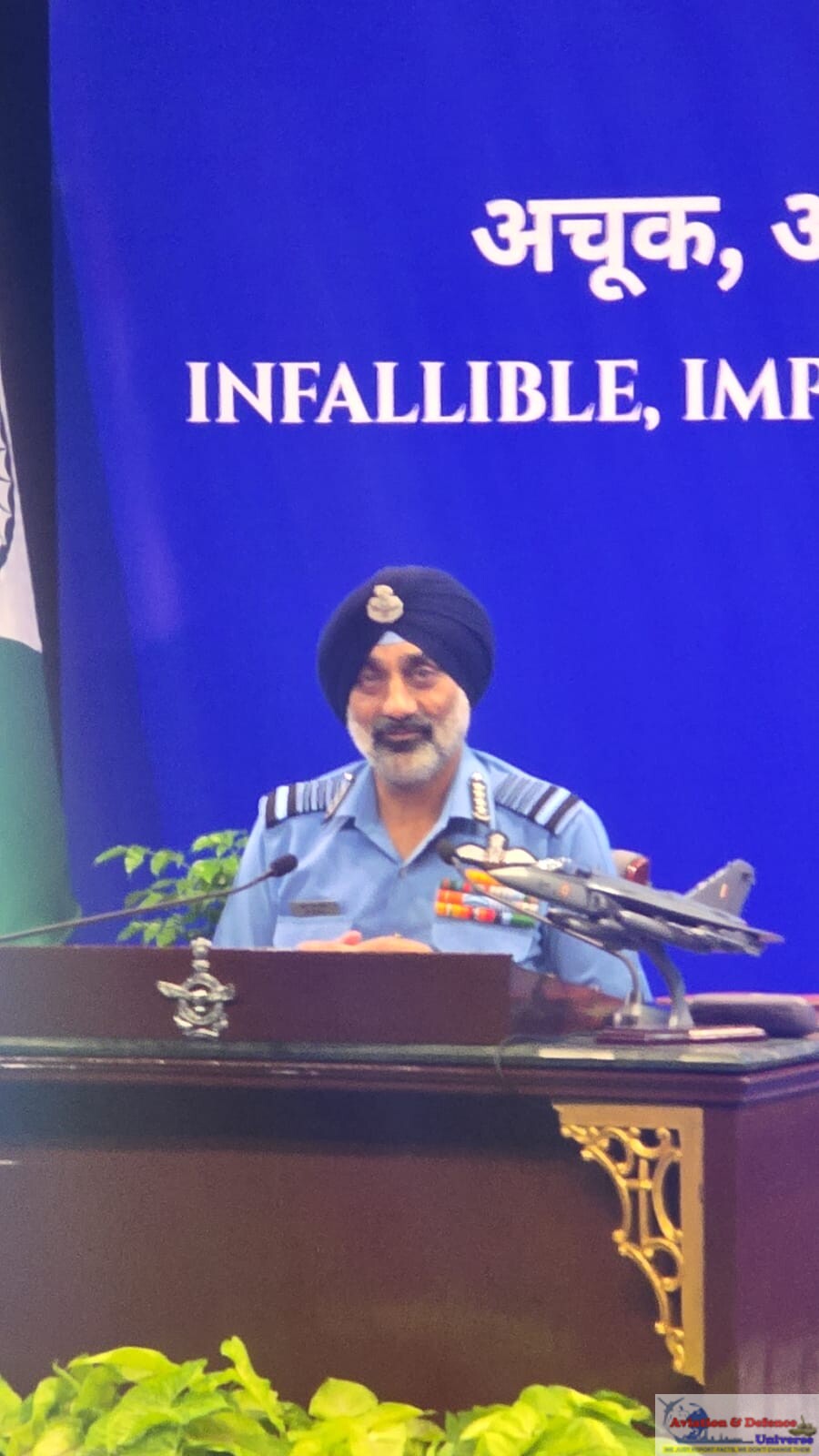 standing behind the Air Force. “I would like to personally take this opportunity, through you, to convey to all the citizens of the country that the Indian Air Force is very grateful for your support.” He added, “We have been able to do well, and it is all because of your good wishes and your support.” The Air Chief also thanked serving personnel and veterans for supporting him during his tenure. “Throughout the last two years of my being in this chair, the kind of support that I have received from each and every individual has been immense.” His final message returned to the importance of every air warrior, irrespective of rank or role. “Every individual is important. Everybody has a role to play.” He continued, “If all of us play our role well and meet the objectives set for each individual, there is no way that the Air Force can fail in anything that is given to us.” And then came the departing Chief’s simple exhortation, “Please continue at it, keep doing your job well and keep supporting us.”
For Air Chief Marshal A.P. Singh, the 94th Air Force Day press conference was more than an annual account of platforms, programmes and preparedness. It was his final public strategic balance sheet as Chief—frank about delayed deliveries and falling squadron strength, firm on the need for fifth-generation capability and indigenous engines, confident about Operation Sindoor’s lessons, and clear that airpower now sits at the heart of national military strength. When he superannuates on 31 October 2026, he will leave behind an IAF navigating the difficult distance between immediate combat readiness and long-term self-reliance. His farewell message, however, was rooted in the enduring strength behind every aircraft and weapon: the air warriors whose collective performance ensures that the Indian Air Force remains, in his words, “always ready.”








































































-A4-Size-(2)_page-0001.jpg)