















- Co-Design, Co-Develop, Co-Produce: India & Italy Rewrite Their Space Partnership
- Not What India Can Buy—But What India & Italy Can Build Together
- Trusted Supply Chains, Joint Technologies & Global Markets: India–Italy Space Agenda Expands
By Sangeeta Saxena
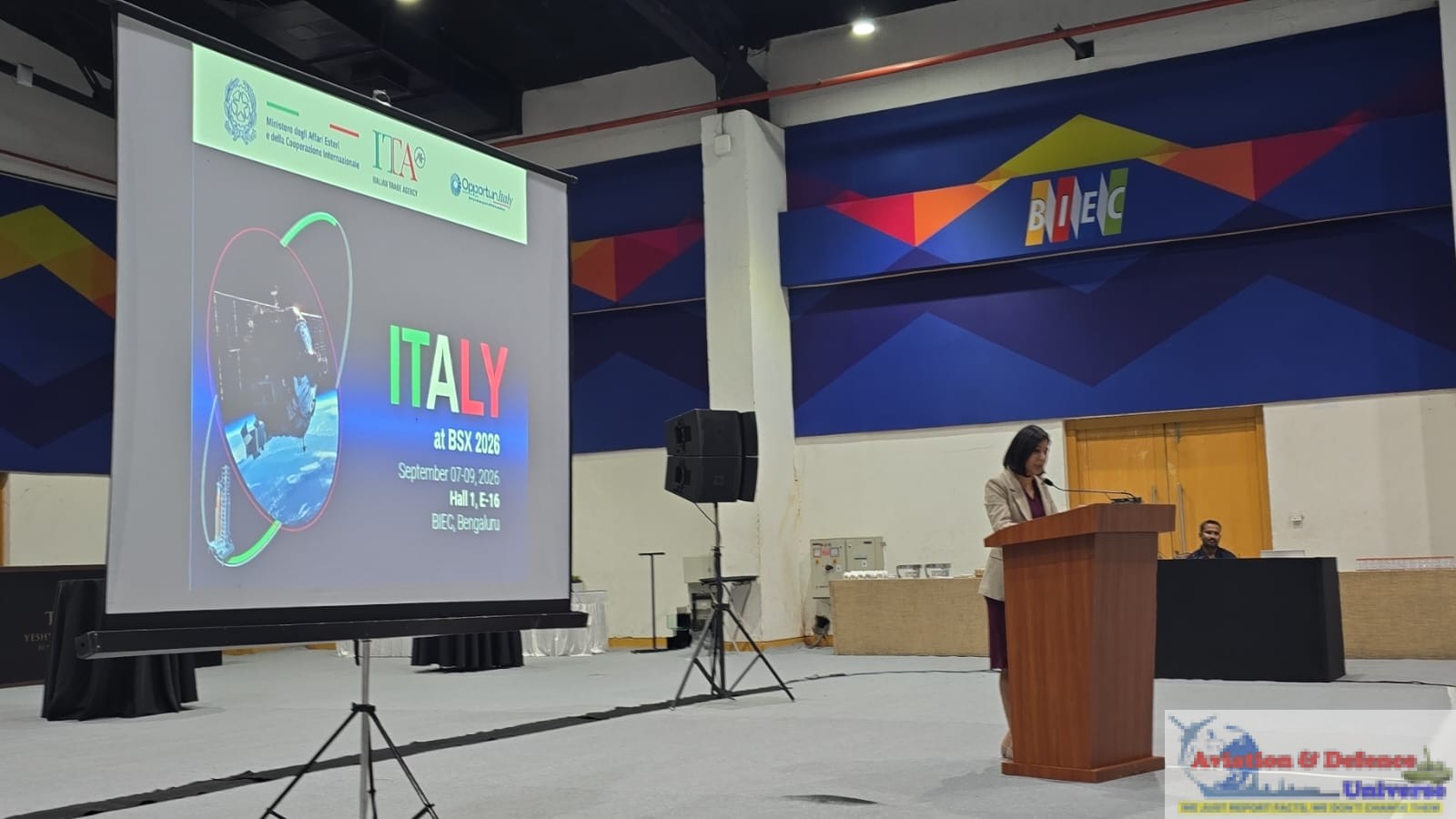
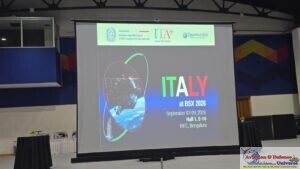
Bengaluru. 08 September 2026. The conversation has changed. Two years ago, when Italy and India sat across the table at Bengaluru Space Expo, the question was largely about what opportunities existed between their space ecosystems. At BSX 2026, the question was sharper: what can India and Italy actually build together? That shift—from exploring possibilities to identifying projects—defined an animated Italy–India space round table hosted by the Embassy of Italy, Consulate General of Italy in Bengaluru and the Italian Trade Agency (ITA) on the sidelines of Bengaluru Space Expo 2026. Bringing together Italy’s participating space companies, Italian diplomatic and scientific representatives, ISRO, Indian space institutions, industry, start-ups and investors, the discussion repeatedly returned to three words that could define the next phase of the relationship: co-design, co-development and co-production.
India’s private space ecosystem has expanded rapidly across launch, satellites, propulsion, Earth observation and downstream applications, while Italy brings an established industrial and technological base extending from major aerospace groups to highly specialised SMEs embedded in the wider European space ecosystem. The purpose of the evening was therefore not simply to ask what each side could sell to the other, but to identify complementarities capable of becoming partnerships.
Two Space Ecosystems, One New Strategic Ambition
Setting the strategic tone, Prof. Sergio Ledda, Scientific Attaché at the Embassy of Italy in New Delhi, argued that the elevation of India–Italy ties to a Special Strategic Partnership demanded a corresponding transformation in the way their companies cooperate. The old question of what Italy can offer India—or India can offer Italy—should give way, he suggested, to what Italian and Indian companies can do together. “Co-design, co-production should be the new terms that we can use between us,” he said. Using the analogy of a modern vehicle with two propulsion systems that must work in synchronisation, Ledda described the two ecosystems as engines whose respective strengths could be combined to achieve better performance. The emphasis was unmistakable: neither side should simply supply the other; they should integrate capabilities.
Electronics & RISC-V Open Another Door
Prof. Marco Re, Scientific Attaché at the Consulate General of Italy in Bengaluru, brought a more technical dimension to the discussion, identifying electronics and semiconductor technologies as promising areas for collaboration. He highlighted India’s investments in semiconductor manufacturing and drew particular attention to high-density and ultra-high-density interconnect technologies relevant to space electronics, where low power consumption, reliability and advanced computational capability are critical.
He also identified India’s growing work around RISC-V open architecture as an opportunity for bilateral cooperation and outlined work towards an Italy–India RISC-V Challenge, envisaging mixed teams involving companies and universities from both countries. Plans are also underway for Italian space-focused activities in India in December, in coordination with the Italian Space Agency, ISRO and research institutions.
Indian Industry Wants Collaboration to Get Real
Representing Indian industry, Apparao Mallavarapu, Chairman, CII National Committee on Space and Chairman & Managing Director, Centum Electronics, said the two countries already possessed a longstanding relationship in space, but the expanding emphasis on innovation, commercialisation and private-sector participation had created opportunities to take it much further.
Closer engagement between start-ups, research institutions and companies could generate joint technology development, knowledge exchange, market access and participation in international missions, he said. The space value chain—from Earth observation and satellite applications to exploration and connectivity—offered numerous entry points for collaboration.
“Bengaluru is the Natural Place for this Conversation”
Gian Domenico Milano, Consul General of Italy in Bengaluru, described the two countries’ space ecosystems as “strong” and “highly complementary”. India, he noted, offers scale, engineering talent, world-class institutions and a rapidly expanding private sector. Italy contributes advanced engineering, specialised technologies and an industrial ecosystem encompassing major corporations, SMEs, research organisations and innovative start-ups.
“The opportunity now is to connect this trend much more systematically,” he said. The elevation of bilateral relations to a Special Strategic Partnership gives that industrial ambition a larger political framework. Space, Milano stressed, is one of the areas in which this relationship should translate into technology cooperation, research, investment and innovation. The objective was not simply to bring technology to India. Complementary capabilities should instead generate joint development, joint manufacturing, research partnerships and access to wider markets. Governments, he reminded the gathering, can create strategic frameworks, but partnerships become real only when companies, institutions and researchers identify concrete projects and solve problems together. And there could hardly be a more appropriate location. “Bengaluru is the natural place for this conversation,” Milano said, pointing to its concentration of space institutions, companies, start-ups, researchers and talent. The Consulate, he added, wants to help turn these connections into durable, long-term outcomes rather than one-off meetings.
ISRO: Italy Has Been a Partner for Decades
For Dr. Gauri Shankar, Director, International and Interagency Cooperation, ISRO Headquarters, today’s industrial conversation rests upon a relationship stretching back decades. He recalled early India–Italy cooperation covering areas as varied as archaeology, agriculture and aerodynamic testing related to space capsule recovery. An ISRO–Italian Space Agency agreement signed in 2000 explicitly included space-industry cooperation. Italy, he said, has been a partner of India’s space programme since the early 1990s, bringing both a long space heritage and a modern ecosystem of agencies, industries, universities and research institutions.
The next phase could be even more consequential. Recent agency-level engagement has identified Earth observation, space exploration and heliophysics, while India’s Space Vision 2047 and future programmes offer opportunities not merely to Indian companies but also to Italian industry. With future programmes including India’s space-station ambitions, the Venus Orbiter Mission, Gaganyaan follow-ons and Chandrayaan follow-ons, Gauri Shankar saw Italy as a potential long-term partner not simply for ISRO but for the wider Indian space ecosystem.
Missing Piece: Academia
Dr. Vinod Kumar of IN-SPACe added another dimension: industry cooperation was gathering momentum, but academic collaboration needed to catch up. India has around 60 academic institutions incorporating space technology into their curricula, he noted, yet concrete faculty and student exchange programmes between the two countries remained limited. Greater university-to-university and research collaboration could connect fundamental research with industry’s ability to take technologies towards higher readiness levels. His message was also practical: companies should keep institutions informed when partnerships materialise, allowing government agencies to understand where collaboration is working and intervene when support is needed.
Italian Industry Puts its Capabilities on the Table
The conversation then moved from policy to products, technology and commercial opportunity, as representatives of the Italian companies outlined what they could contribute to India—and what they hoped to find here.
Small Satellites: 2NDSpace Looks to India’s NewSpace Companies
2NDSpace, represented by co-founder and CEO Davide Rastelli, presented its portfolio of subsystems and platforms for small satellites, including antennas, structures, solar panels, computers and power-distribution units. With more than 100 subsystem units delivered and existing Indian engagements, the company sees India’s rapidly expanding start-up ecosystem as an important market and partnership opportunity. Rather than suggesting India lacks capability, Rastelli emphasised complementarity, 2NDSpace wants to bring its flight heritage and mission-development experience to Indian companies building satellite-based services.
Big Telescopes, Ground Facilities & Deep-Space Capability
Dr. Gianpietro Marchiori, President of EIE Group highlighted expertise in astronomy, astrophysics, large telescope systems, ground infrastructure, test facilities and technologies relevant to space and defence. Its proposition to India was broader than selling a single product: combine Italian engineering and technological expertise with India’s capabilities and cost competitiveness to pursue projects together, including international opportunities. The company specifically identified possibilities around major astronomical projects, ground facilities, launch-related infrastructure, specialised payloads, optical communications and deep-space communications.
Leaf Space Sees India as a Ground-Station Opportunity
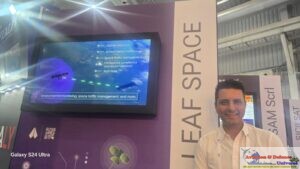
For Jay Dadlani of Leaf Space, India’s booming satellite industry creates another requirement: getting data back to Earth. The Italian ground-station-as-a-service company operates a global antenna network supporting more than 200 satellites and tens of thousands of passes every month. Its representative described India as one of the world’s fastest-growing space economies. As Indian companies put more technologies into orbit, ground connectivity becomes critical—particularly for latency-sensitive Earth-observation data. Leaf Space therefore sees India not only as a customer market but as a potential location for expanding its own antenna infrastructure, with Indian partners supporting operations on the ground. Such facilities could support Indian sovereign missions as well as global customers.
Leonardo Brings 60 Years of Space Heritage
Leonardo’s Space Division presented one of the broadest portfolios around the table. Roberto Pierdominici Managing Director said its capabilities span Earth observation, defence and intelligence, space connectivity, artificial intelligence and high-performance computing in the space segment, exploration technologies, robotics and atomic clocks. Leonardo is also investing in its own multi-sensor Earth-observation constellation and sees its decades of engineering heritage as a foundation for partnerships with Indian industry. The message was not simply about bringing established European systems to India, but about using those competencies to design solutions together.
Officina Stellare: Eyes in Space—and Laser Links to Bring the Data Home
Officina Stellare brought another increasingly important piece of the space architecture: advanced optics. The company specialises in end-to-end optical solutions for Earth observation and communications, including medium- to very-high-resolution optical instruments and laser communications. Its representative said demand in India is growing not only for higher-quality imagery but also for communications capable of moving that data rapidly, reliably and securely to the ground. The company is already working with Indian partners and sees opportunities with satellite platform providers, system integrators and mission operators, particularly as secure communications assume greater importance.
Italian SMEs See Earth Observation as a Joint Market
Representing a cluster of 11 Italian aerospace SMEs, Renato Aurigemma pf Società Aerospaziale Mediterranea (SAM) focused on Earth-observation services. India’s vast geography, the speaker argued, creates opportunities across water management, agriculture, environmental monitoring, disaster management and maritime applications. Rather than simply transplanting services already developed in Italy, the proposal was to work with Indian companies to adapt and jointly develop solutions for real Indian customers. The representative suggested that the two countries could create common demonstration programmes—bringing Italian companies, Indian companies and universities together around practical customer requirements, potentially supported through joint funding mechanisms.
Zoppas Industries: Keeping Spacecraft at the Right Temperature
With a relationship with India’s space sector dating back to the early 1990s, Arun Saligrama of Zoppas Industries brought thermal management to the table. Its heating and thermal-management systems are used in satellite and launch-vehicle applications. The company is exploring deeper cooperation with Indian industry particularly in electronics, harnesses, materials and engineering. Lighter materials and advanced material technologies could be another area where Italian and Indian capabilities combine for future programmes.
India Responds: Co-Design, Supply Chains & Market Access
The Indian side responded with an equally clear message: there is appetite for partnership, but it must become structured, frequent and practical.
One senior Indian intervention proposed identifying concrete problem statements on which companies from both countries could work together—whether eight, ten, twenty or more—and then creating a framework to match the right companies to those challenges. The interaction between the ecosystems, he argued, needed greater depth and frequency, potentially supported by an institutional mechanism capable of connecting hundreds of companies on both sides.
A second priority was dependable supply chains. Geopolitical turbulence and the experience of COVID-19 have demonstrated how quickly supply chains can become vulnerable. For strategic industries, dependability during a crisis can matter as much as technology itself. Could India and Italy identify their respective vulnerabilities and build trusted, resilient supply chains together?
The third opportunity identified was market access—using complementary capabilities not only for Indian and Italian requirements but jointly pursuing opportunities elsewhere in the world.
Space Debris: “There Are No Boundaries in Space”
Chiranjeevi Panitra, founder of Cosmos of Space, brought sustainability into the conversation. His company is working on space-debris removal and has already tested equipment in orbit. With global attention increasingly focused on removing spacecraft after end-of-life, he argued that space sustainability cannot be solved nationally. “There are no boundaries in space. We need to come together and solve this problem together,” he said. India could bring rapid development, frugal engineering and cost-effective solutions, while Italy contributes advanced technology and experience—a combination he believes could create globally competitive products.
Red Balloon Aerospace Looks Above the Airways
Dr. C.V.S.Kiran, co-founder and CEO of Red Balloon Aerospace, presented high-altitude platform stations as another potential collaborative frontier. The company is developing balloons, aerostats and airships, with communications and future 6G infrastructure among their potential applications. It has already demonstrated a superpressure balloon and is looking at platforms capable of carrying communications, ISR and other payloads.
Such technologies occupy the increasingly important layer between conventional aviation and satellites—and could provide another meeting point for Indian engineering and international partnerships.
Centum: “You Buy From Us, We Buy From You, Together We Sell to the World”
For Centum Electronics, the answer lay in sustained engagement. Dr. Vinod stressed that one-off meetings at large exhibitions would not be enough. Companies needed to remain “on the radar” of one another through more frequent interaction, building familiarity, understanding and respect for each other’s capabilities. Co-design, co-development and customisation for Indian requirements could create multiple possibilities. His formulation neatly captured the commercial potential, “You buy from us, we buy from you, together, we sell it to the world.” The objective should be to create the first one or two visible success stories—because success, he argued, would breed further collaboration.
Dhruva Space: Move from Co-Development to “Co-Solving”
Dhruva Space brought the perspective of one of India’s emerging full-stack space engineering companies. The company works across space, launch and ground segments and unveiled its AstroView Command Post, a mobile ground station aimed at defence applications, at BSX 2026. Dhruva is already engaging with Italian companies and disclosed that it had recently signed an MoU with an Italian partner, with details to be announced separately. But the company also flagged financing, export controls, regulation and ease of doing business as areas requiring attention if partnerships are to scale. Beyond co-design and co-development, Dhruva proposed another concept: “co-solving” real problems on the ground, using space technologies to create benefits ranging from Earth applications to human spaceflight.
Pawan Goenka: Cooperation is Bigger Than Competition
The evening gained an important intervention with the arrival of Dr. Pawan Goenka, who listened to the Italian companies outline their capabilities before distilling the opportunity into a simple equation. India’s private space sector has expanded dramatically. That means Italian companies that once had essentially one major Indian institutional customer are entering a market with hundreds of potential customers, partners—and inevitably some competitors. But Goenka saw far more complementarity than overlap. “There is some competition, some cooperation, but I think the cooperation is a bigger opportunity,” he said. Indian companies possess capabilities Italian businesses can use; Italian companies possess technologies Indian firms can value. The task now, he argued, is to make those engagements systematic and organised. And his assessment of Italy’s potential place in India’s global space partnerships was particularly significant.
“Italy is among the top three or four countries that I see today where we think cooperation is possible at a level much higher than what we have today,” Goenka said, describing BSX as an opportunity to get that process moving. The discussion even moved towards the possibility of Indian start-ups filling domestic technology gaps by working with Italian companies through joint-venture-style arrangements—an approach that received a positive response during the floor discussion.
From Aperitivo to Action
The round table eventually gave way, appropriately Italian-style, to an aperitivo—but the conversation it began is meant to continue long after the glasses are cleared. Because the most important outcome from the evening was not a product announcement or a contract signing. It was the emergence of a remarkably consistent vocabulary from almost every corner of the room.
Co-design. Co-development. Co-production. Co-manufacturing. Co-solving.
Add to that trusted supply chains, joint research, student and faculty exchanges, common demonstration projects, market access and jointly developed solutions for third countries, and the outline of a substantially deeper India–Italy space partnership begins to emerge. For Italy, India offers scale, talent, cost competitiveness and one of the world’s fastest-growing private space ecosystems. For India, Italy offers deep engineering heritage, specialised SMEs, advanced optics, ground systems, thermal technologies, Earth observation, electronics, robotics and access to the wider European technological ecosystem.
The diplomatic framework is already in place. The agencies have decades of history. The companies are now meeting each other. The technologies are increasingly complementary. The next test is delivery. If BSX 2026 demonstrated anything, it is that India and Italy no longer need another conversation about whether opportunities exist. They need to decide what they are going to build together—and start building it.







































































-A4-Size-(2)_page-0001.jpg)