


 18th BRICS Summit






















 Mumbai. 20 June 2026. Modern military operations increasingly depend on accurate positioning, navigation, timing, and intelligence gathering. However, in contemporary battlefields, adversaries are actively employing electronic warfare systems capable of jamming or spoofing GPS signals. This has created an urgent need for systems that can continue operating even when satellite navigation becomes unavailable.
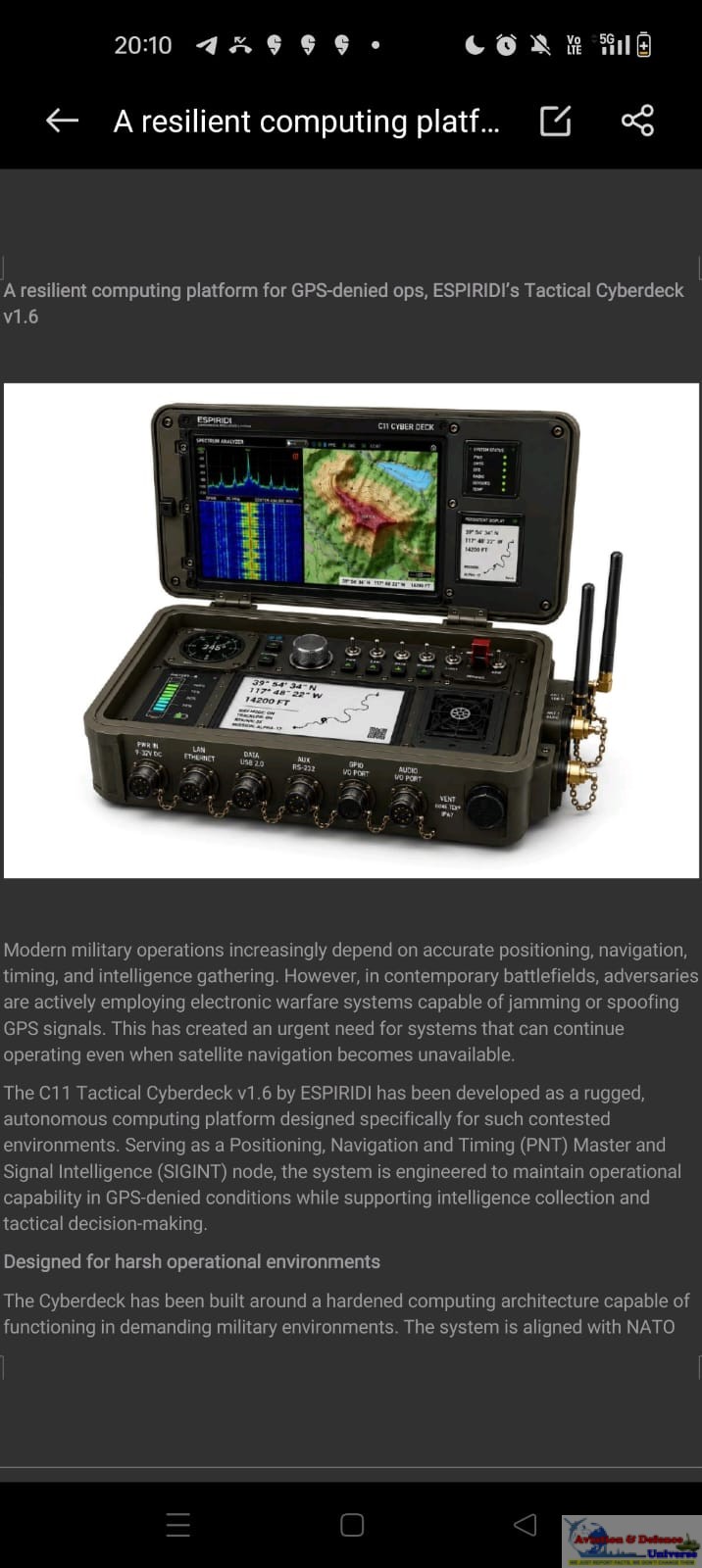
The C11 Tactical Cyberdeck v1.6 by ESPIRIDI has been developed as a rugged, autonomous computing platform designed specifically for such contested environments. Serving as a Positioning, Navigation and Timing (PNT) Master and Signal Intelligence (SIGINT) node, the system is engineered to maintain operational capability in GPS-denied conditions while supporting intelligence collection and tactical decision-making.
Designed for harsh operational environments
The Cyberdeck has been built around a hardened computing architecture capable of functioning in demanding military environments. The system is aligned with NATO STANAG guidelines and key military environmental and electromagnetic standards, ensuring that its design philosophy reflects defence-grade requirements.
At its core is a high-performance processing unit supported by 8 GB of industrial-grade memory and a hardened Linux operating system equipped with real-time processing capabilities. This enables the platform to process sensor inputs, intelligence feeds, and navigation data with minimal delay.
To ensure reliability during extended deployments, the system uses industrial-grade storage media designed for significantly longer operational life than conventional memory cards.
Security at the hardware level
Security remains a critical requirement for military computing systems. The Cyberdeck incorporates a dedicated Trusted Platform Module (TPM) that securely stores cryptographic keys and sensitive system credentials.
In the event of capture or compromise, operators can activate an emergency “Zeroize” function that immediately destroys stored encryption keys, preventing sensitive information from falling into hostile hands.
Operating without GPS
One of the most notable features of the Tactical Cyberdeck is its ability to continue providing navigation and timing information when GPS signals are unavailable.
Rather than relying solely on satellite navigation, the system combines multiple technologies to determine its position and maintain accurate timing.
An integrated Atomic Clock provides an extremely stable time reference, while a sophisticated inertial measurement unit continuously tracks movement and orientation. Advanced software algorithms process this information to estimate position even when external navigation signals are absent.
The system further improves accuracy through terrain-referenced navigation. By comparing its movement against pre-loaded digital terrain maps, it can continuously validate and refine its estimated location.
In addition, an integrated software-defined radio can identify and analyse ambient radio-frequency signals, using them as alternative reference points for navigation and positioning.
According to system specifications, positional drift can be limited to less than 0.8 per cent of the total distance travelled during GPS-denied operations.
Multi-layer display architecture
Recognising the importance of situational awareness, the C11 Cyberdeck employs a three-display architecture. The primary display is a high-brightness seven-inch screen designed for use in outdoor conditions. This serves as the operator’s main interface for navigation, intelligence, and mission management.
A secondary electronic paper display provides persistent map and intelligence information while consuming very little power. Even if the primary display is switched off, critical information remains visible.
A third compact display functions as a status monitor, providing real-time confidence indicators and navigation health information to the operator.
Intelligence collection and RF monitoring
Beyond navigation, the Cyberdeck also serves as a compact SIGINT platform. An integrated Software Defined Radio (SDR) enables monitoring and analysis of radio-frequency activity across multiple bands. This capability allows operators to detect, classify, and exploit signals of interest within the operational environment.
The system can also interface with tactical voice and data radios, creating a bridge between communications systems and intelligence networks.
For operations in highly contested electromagnetic environments, provisions exist for integrating advanced anti-jamming antenna technologies.
Power and thermal resilience
Military equipment must operate reliably under extreme environmental conditions. To support this requirement, the Cyberdeck employs a Lithium Iron Phosphate battery system known for its safety, durability, and long operational life.
The platform accepts a wide range of input voltages, enabling integration with military vehicles and field power systems. Thermal management is achieved through a machined aluminium chassis that acts as a passive heat sink, eliminating the need for vulnerable cooling fans while improving reliability.
Additional protection mechanisms guard against overheating and electrical surges.
Rugged mechanical design
The system’s physical design reflects its intended deployment in operational theatres. Constructed from CNC-machined aircraft-grade aluminium, the enclosure provides exceptional durability while maintaining manageable weight.
Unlike conventional portable computers, the Cyberdeck eliminates the traditional keyboard. Instead, operators interact through a rugged rotary controller, navigation controls, and protected switches.
This keyboard-less architecture significantly improves environmental protection, enabling the enclosure to achieve IP67-level resistance against dust and water ingress.
A new approach to battlefield resilience
As electronic warfare capabilities continue to evolve, military forces worldwide are seeking systems that can operate independently of vulnerable external infrastructure.
ESPIRIDI’s Tactical Cyberdeck v1.6 represents a practical response to this challenge. By combining autonomous navigation, resilient timing, intelligence collection, and ruggedised computing into a single platform, it demonstrates how future battlefield systems can continue functioning even when traditional GPS and communications networks are disrupted.
For defence forces operating in increasingly contested electromagnetic environments, such resilient and self-sufficient platforms are likely to become an essential component of future military operations.


















































































-A4-Size-(2)_page-0001.jpg)