
















- A new sonar manufacturing and sustainment facility in Western Sydney will boost national security, advanced manufacturing, export growth, jobs, and Australia’s future undersea warfare capability.
- The multimillion- Australian dollar facility was jointly funded by Thales Australia and the Commonwealth to enable end-to-end manufacture and sustainment of complex towed array sonar systems for submarines, surface ships and autonomous maritime systems.
- Local sustainment of high-quality sensors means more time in the water for Australian assets, allowing more persistent surveillance and detection of threats.
- Thales towed array sonar system has an unrivalled capacity to detect, track, and identify quiet underwater objects – such as submarines or torpedoes.
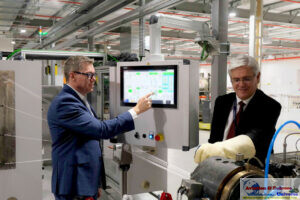
A new sonar manufacturing facility within Thales Australia’s Western Sydney advanced manufacturing complex, opened this week by the Minister for Defence Industry Pat Conroy, will become a hub for the design, manufacture, integration and sustainment of advanced undersea acoustic systems.
Thales Australia and the Commonwealth of Australia jointly invested in the multimillion-dollar facility at Rydalmere, which has been built within the wider Thales Australia Acoustics Centre of Excellence and will be a critical piece of the sovereign supply chain for the Thales towed array sonar system onboard the Hunter Class Frigates.
The hall is 100 metres long and is designed to facilitate the end-to-end manufacture of towed array sonar systems that act as the ‘ears’ of submarines, surface ships and autonomous maritime systems.
For more than three decades, the Rydalmere facility has supported the Royal Australian Navy with world-class sonar technologies that enhance anti-submarine warfare (ASW), maritime surveillance and undersea domain awareness, including on the Collins Class submarine.
The new facility boosts this Australian-made deterrence by ensuring end-to-end sovereign manufacturing capability for next-generation towed array sonar systems that support submarines and surface combatants, and thin-line towed arrays for uncrewed maritime systems serving both Australian and export markets.
It also enables the local sustainment of acoustic systems, maximising deployment times for Australian intelligence, surveillance and reconnaissance (ISR) activities and reducing the need for lengthy offshore maintenance periods.
In particular, the towed array facility will deliver:
- Hunter Class Frigate Program Towed Array Sonars enabling long-range submarine detection and tracking while enhancing fleet survivability and maritime domain awareness.
- Collins Class Submarine Sonar System, built upon more than 35 years of collaboration between Thales Australia, the Royal Australian Navy and Australian defence science organisations.
- BlueSentry®, a Next-Generation Autonomous Surveillance Capability which combines advanced thin-line fibre-optic towed array sonar technology with uncrewed maritime platforms.
The facility is expected to create dozens of direct engineering and advanced manufacturing jobs in Western Sydney over coming years, as well as roles for our supply chain partners, contributing to national security and the protection of Australian fleets and defence personnel.
Pat Conroy MP, Minister for Defence Industry declared: “Through this new co-invested manufacturing facility, Australia is strengthening national security, creating high-value jobs and establishing a sovereign centre of excellence for advanced acoustic systems that will support both Australian Defence and export opportunities for decades to come.”
Jeff Connolly, CEO, Thales Australia and New Zealand declared: “The capabilities developed and manufactured at Rydalmere demonstrate Australia’s ability to deliver sovereign undersea warfare technology, from the Collins Class submarine fleet of today to the Hunter Class frigates and autonomous BlueSentry surveillance systems of the future.” and“Thales Australia is proud to design and deliver high-quality sensors that return best-quality data, allowing for quicker and better decision that relate to national security.”