













 Hunter businesses are being connected directly with major Defence Primes and senior Defence leaders as part of efforts to secure more contracts, investment and skilled jobs for the region.
Australia’s defence industry contributed $12 billion to the national economy in 2024/25 and directly employed 63,500 people across 5,165* businesses and Hunter Defence Task Force Chair Tim Owen AM said the Hunter was well placed to secure a greater share of this investment.
“Our focus is on connecting local small and medium businesses directly with major Defence Primes and Defence leaders so they can understand what capabilities are needed, how procurement works and where opportunities are emerging. The annual Hunter Defence Conference is one of the key ways we do this,” Owen said.
“For the Hunter, defence is about people and opportunity. The Hunter’s economy is constantly diversifying. We can lead in the energy transition, support workers transitioning from other sectors, and grow advanced manufacturing capability all while contributing meaningfully to Australia’s security. These are complementary opportunities that build on the Hunter’s skilled workforce, infrastructure and industrial base.”
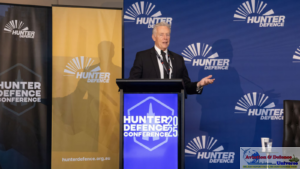
The 2026 Hunter Defence Conference will bring SMEs together with Defence leaders, major Primes, government and international representatives. Delegates will hear directly about capability requirements, procurement priorities and emerging opportunities across Defence. The program will also examine AUKUS, sovereign capability, maritime programs, artificial intelligence, financing and international industry connections.
Speakers include the Hon Jay Weatherill AO, Australia’s High Commissioner to the United
Kingdom, and the Hon Arthur Sinodinos AO, former Australian Ambassador to the United States, alongside senior leaders from the Australian Navy, Army and Air Force.
The conference follows Hunter Defence’s recent engagement with European businesses at the Farnborough International Airshow, where the region was promoted as a location for defence companies to invest and establish operations.
Major defence investment is already underway with KONGSBERG Australia building a guided weapons manufacturing and maintenance factory at Williamtown, supported by an Australian Government commitment of up to $850 million.
KONGSBERG Australia Managing Director John Fry said the Hunter was selected following an assessment of more than 40 potential locations across Australia.
“The Hunter stood out because of its skilled workforce, established manufacturing capability, proximity to RAAF Base Williamtown and the Port of Newcastle, and access to education and research through the University of Newcastle and TAFE NSW,” Fry said.
“It provides the right environment to establish and grow an advanced defence manufacturing
operation, supported by a strong local supply chain and a region where people want to live and work.”
Ahead of the Hunter Defence Conference, KONGSBERG and another locally based Defence Prime, BAE Systems, will host an Industry Connect Day for more than 50 SMEs interested in joining its Australian and international supply chains.
“The Industry Connect Day will give local businesses a clearer understanding of our requirements and help identify where their capabilities could contribute to KONGSBERG’s supply chain,” Fry said.
KONGSBERG’s decision to establish at Williamtown demonstrates the role the Hunter’s growing defence and aerospace precinct can play in attracting international investment and connecting major companies with regional suppliers.
Newcastle Airport CEO Linc Horton said the Hunter offers a compelling proposition with its existing Defence infrastructure, industrial capability, education and research expertise underpinned by strong transport connections and a quality lifestyle that makes the Hunter one of Australia’s most attractive places to live, work and invest.
“Astra Aerolab being located opposite RAAF Williamtown provides an environment for industry to engage defence and aerospace, creating an ecosystem that has the potential to span the full supply chain spectrum,” Horton said. “Our region has the work force with generational skill sets to support the ongoing development of a defence industry within the Hunter in line with the
Commonwealth’s ambitions for enhanced sovereign capability.”
Hunter Defence is also working with the Department of Employment and Workplace Relations and the Net Zero Economy Authority to examine how workers transitioning from mining and other traditional industries could move into the defence industry.
“The Hunter has thousands of workers with transferable skills in engineering, manufacturing, maintenance, logistics and technical trades,” Owen said.
“Connecting those workers and local businesses with a growing defence industry will help retain skills in the Hunter, diversify our economy and create secure, long-term jobs.”



























































-A4-Size-(2)_page-0001.jpg)