










- Hyderabad-based startup among the top 120 deeptech ventures selected for the Government of India’s flagship global showcase as Indo-French collaborations take shape
 Nice, France / Hyderabad, India, June 23, 2026: TakeMe2Space, the Indian space tech company building AI-first orbital data centre infrastructure in Low Earth Orbit, was among the leading deeptech ventures showcased at Bharat Innovates 2026, the Government of India’s flagship global accelerator programme inaugurated in Nice by Prime Minister Narendra Modi and French President Emmanuel Macron.
Selected as one of just 120 startups from a pool of more than 3,000 applicants, TakeMe2Space featured prominently in a summit where space took centre stage alongside AI and semiconductors. The strong investor turnout, with more than 50 global investors from over ten countries, underlined how central deeptech, and orbital infrastructure in particular, has become to India’s innovation agenda. As global demand for in-space computing and orbital data centres accelerates, companies like TakeMe2Space have found themselves at the heart of the conversation.
The company describes its inclusion as the outcome of a demanding, well-grounded process. Space was one of thirteen priority themes the programme set out to champion, shaped by inputs from key ecosystem stakeholders. “The process was rigorous and credible. Bharat Innovates drew on inputs from key ecosystem stakeholders. For the space vertical, that included IN-SPACe, alongside the investor community. Space was one of thirteen priority themes the programme set out to champion, which itself tells you how central deeptech has become to India’s innovation agenda. Being part of that cohort is a meaningful marker of where we stand,” said Ronak Kumar Samantray, Founder and CEO of TakeMe2Space.
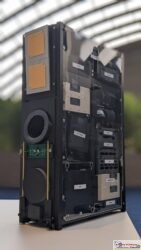
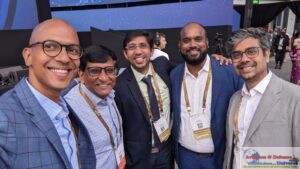 TakeMe2Space’s relationship with IN-SPACe extends beyond the programme. The company is developing StarSense, an AI-powered star tracker backed under IN-SPACe’s Technology Adoption Fund. A star tracker is a critical optical navigation instrument that determines a spacecraft’s orientation by reading star-field patterns; StarSense embeds AI directly into the sensing and processing pipeline to hold accuracy in challenging orbital conditions such as radiation-induced noise and dense or partially obscured star fields. It is being built in two variants, a lightweight configuration for CubeSats and academic missions, and a higher-precision version for larger spacecraft, as a flight-qualified subsystem for future missions.
While the programme is not itself an investment vehicle, the visibility it generated has moved several investor conversations forward. The company most recently raised USD 5 million in seed funding led by Chiratae Ventures, with participation from Unicorn India Ventures, Artha Venture Fund and SeaFund, to expand its satellite constellation and scale OrbitLab, its in-orbit AI lab.
The summit also opened concrete partnership avenues, both international and domestic. “Yes, we’re working with a French launch aggregator for our upcoming launches, and a French sensor manufacturer as well. Beyond that, the platform has opened up real collaboration opportunities with fellow Indian startups, each disrupting in their own domain; there’s genuine value in having so many of us under one roof. We’ll be making announcements across all these fronts at the appropriate time,” said Samantray.
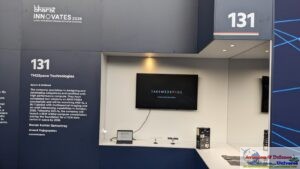 For TakeMe2Space, the programme’s central benefit was exposure, both to global capital and to cross-sectoral collaborators. “Visibility was the central aim of the event, across domains, with each participant leveraging it in their own way. For us, the value is in heightened visibility for cross-sectoral collaboration and access to global investors. And the blend of formal sessions and informal settings, the networking dinners in particular, is where a lot of that connection actually happens,” said Samantray.
The choice of Nice as host city, and the government-to-government weight behind the event, positioned the summit as an entry point into European markets. “The immediate opening is Indo-French: the intent to deepen that bilateral relationship creates France-specific opportunities for us, and by extension, access to the broader EU market, and vice versa for European players looking at India. It’s early to point to specifics, but this is the important, and often the toughest, first step. Bringing everyone under one roof, giving it the weight of a major government-to-government event inaugurated by both nations’ leaders, and providing a genuine platform to showcase, that’s what accelerates these things,” said Samantray.
































































-A4-Size-(2)_page-0001.jpg)