



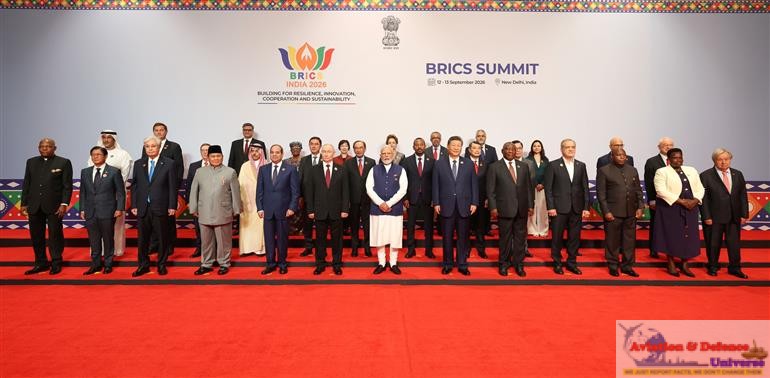
 18th BRICS Summit























- India Draws the Line on the Indus: Cooperation Cannot Be a One-Way Street
- The Indus Reckoning: Why New Delhi Says the Old Water Equation Cannot Continue
- No Business as Usual on the Indus: India’s Water Diplomacy Enters a New Era
By Jai Kumar Verma
 New Delhi. 06 August 2026. For more than six decades, the Indus Waters Treaty survived wars, military confrontations, diplomatic freezes and some of the darkest moments in India-Pakistan relations. Signed in 1960 in a stated spirit of goodwill and cooperation, it became one of the world’s most enduring water-sharing arrangements. But the terror attack at Pahalgam, changed New Delhi’s calculus. India’s decision to place the treaty in abeyance was not an overnight reaction to a single incident but the culmination of years of frustration over security concerns, disputes over hydropower projects and unsuccessful attempts to modify a treaty India increasingly regarded as inequitable and outdated.
On 22 April, 2025, armed terrorists struck the Baisaran Valley near Pahalgam in Jammu and Kashmir, killing 26 civilians in the deadliest attack on Indian civilians since 26/11. The attackers, linked to The Resistance Front (TRF), a proxy of the Pakistan-based Lashkar-e-Taiba, singled out victims by religious identity, targeting Hindu tourists. The massacre was not random violence; it was a calculated act of terror with a cross-border signature, and it demanded a response that went beyond condemnation.
India’s response was swift and multi-pronged: the expulsion of Pakistani diplomats, diplomatic downgrade as India reduced staff from Pakistan High Commission in New Delhi from 55 to 30 officials, Operation Sindoor’s airstrikes on terror camps across the border, and most consequentially for the long term, placing the Indus Waters Treaty (IWT) in abeyance. After a brief but intense exchange of fire that included drones and missiles, a ceasefire was reached on 10 May 2025. Yet the treaty has remained suspended since. This was not an impulsive act but the culmination of years of frustrated Indian attempts at renegotiation. Water is not a gift to be extended unconditionally, it is a covenant built on trust. When a state repeatedly weaponises terror against its neighbour, it forfeits the moral standing to demand cooperation on shared resources. A treaty cannot survive as one-sided goodwill in the face of persistent hostility.
Background: The Treaty in Brief
India and Pakistan signed the Indus Waters Treaty in 1960, after nine years of talks, with help from the World Bank. The deal gave India control of three smaller rivers — the Ravi, Beas, and Sutlej — while Pakistan got the bigger rivers: the Indus, Jhelum, and Chenab. This treaty has lasted for almost 65 years. What’s remarkable is that it survived two wars between India and Pakistan, in 1965 and 1971, along with other major flashpoints like the Kargil conflict and the 2008 Mumbai attacks. Even when relations were at their worst, both countries kept honouring the water-sharing arrangement.
This long history is why the 2025 suspension feels different — it broke a pattern that had held even through actual wars. There’s also an older complaint that adds context to India’s frustration: India contributes a much bigger share of the total river water in the Indus basin, yet the treaty gave it only the three smaller rivers, while Pakistan received most of the water. Many in India have long seen this as an unfair deal that already favoured Pakistan — making it easier to argue that India showed patience for decades, even before the current tensions. Critics in India have long argued that the treaty’s water split, favours Pakistan disproportionately — with roughly 80% of the Indus basin’s total flow allocated downstream to Pakistan against India’s 20% share, a ratio some Indian parliamentarians called excessively generous even at the time of signing in 1960.
India’s stated grievances
In 2023, India invoked a provision within the treaty to formally request a bilateral modification but Pakistan refused. This wasn’t India’s only attempt: it was actually the fourth such request since January 2023, with India citing demographic shifts, growing clean-energy needs, and unresolved security concerns tied to Kashmir. Far from an impulsive rupture, this was a multi-year diplomatic effort which Pakistan repeatedly declined to engage with substantively.
In 2024, India called off all meetings of the Permanent Indus Commission (PIC), insisting the two countries first meet to discuss modifying the treaty. This wasn’t a snap decision either, the last PIC meeting had already been held back in May 2022, meaning India had spent nearly two years pressing, unsuccessfully, for talks before escalating.
The Legal Battle — India’s Procedural Case
At the heart of this dispute sit two hydroelectric projects: Kishanganga (330 MW) on a Jhelum tributary, and Ratle (850 MW) on the Chenab, both located in Jammu and Kashmir. Pakistan has long argued their designs violate the treaty’s water-flow constraints and reduce downstream availability. This disagreement dates back to 2017, but in 2022 the World Bank controversially appointed both a Neutral Expert and a Court of Arbitration to examine the same questions simultaneously.
India’s objection was not a matter of convenience but of law: running two forums on identical technical questions directly breached the treaty’s own sequencing, and risked producing contradictory rulings on the same dispute — an outcome the treaty’s architects had explicitly sought to prevent. New Delhi flagged this flaw from the outset, refusing to appoint arbitrators or appear before a body it considered improperly constituted from day one. In June 2025, the Court rejected India’s objection and reaffirmed its own jurisdiction; India rightly dismissed the ruling as illegal.
Nearly a year later, in May 2026, the Court ruled on pondage limits in Pakistan’s favour — and India rejected that too, holding firm that a tribunal it considers illegally constituted has no authority to bind it, irrespective of outcome. India’s objection to the Court’s jurisdiction predates any ruling against it — a sequence that reflects principle, not post-hoc obstruction. A nation contesting a flawed process before knowing its outcome cannot fairly be accused of merely rejecting inconvenient verdicts.
What India Has Actually Done vs. Pakistan’s Rhetoric
For all the alarm Islamabad has generated, India’s actual conduct has been measured. New Delhi has suspended data-sharing, Permanent Indus Commission meetings, and dispute engagement — but it has not diverted, dammed, or blocked the western rivers. Pakistan, meanwhile, has warned that any interruption of flow would be “an act of war,” even while denying any role in Pahalgam. The contrast is telling: one side has taken calibrated, legally grounded steps in response to a documented terror attack, while the other has reached for the language of war over measures it has not even faced yet. If Pakistan’s objection were truly about water, its response would match the scale of India’s actions — not pre-empt a crisis that hasn’t occurred.
Pakistan’s Water Problems — A Crisis of Its Own Making
Pakistan’s water crisis did not begin in April 2025. Decades of chronic underinvestment have left the country with live storage capacity far short of what the Indus basin requires, forcing it to run on razor-thin reserves even in normal years. Its irrigation network in Punjab and Sindh loses enormous volumes to canal seepage and poor conveyance infrastructure, while groundwater is extracted with virtually no regulation — a slow-motion depletion crisis entirely of Pakistan’s own making.
Compounding this is political paralysis: interprovincial disputes between Punjab and Sindh over water-sharing have stalled critical projects like the Kalabagh Dam for over three decades. None of this can be attributed to India, which has not physically diverted, dammed, or blocked a single drop from the western rivers since the suspension. Pakistan’s water insecurity is the product of its own governance failures — India’s suspension has, so far, changed nothing on the ground.
India’s Developmental Case
As the upper riparian state, India retains the sovereign right to develop run-of-river hydropower — including Kishanganga and Ratle — within the technical parameters the treaty itself always permitted. This is not a new claim staked out in the heat of 2025; it reflects a right India has asserted for decades. Jammu and Kashmir, in particular, has long argued that the treaty capped its hydropower and irrigation potential for six decades, holding back a region that could have benefited enormously from its own rivers.
That restraint was not cost-free. India controlled rivers carrying roughly 20 percent of the Indus basin’s water, while Pakistan received rights to the remaining 80 percent — an asymmetry that stifled development in Indian regions for generations, yet India honoured the treaty regardless. Domestically, initiatives like the Jal Jeevan Mission demonstrate that India’s water governance is neither absent nor selective; New Delhi is expanding access at home even as it refuses to underwrite a hostile neighbour’s chronic mismanagement.
India’s Ambassador to the US, Vinay Mohan Kwatra, put this argument most forcefully in a Newsweek article, noting that the treaty’s own preamble declared it was signed “in a spirit of goodwill and friendship” — goodwill, he wrote, that Pakistan spent half a century dismantling through the wars of 1965, 1971, and 1999, and decades of cross-border terrorism from Parliament 2001 to Pahalgam 2025. He argued Pakistan had also repeatedly blocked India’s efforts to modernise the treaty and develop its hydropower potential. Rejecting Pakistan’s framing of India as a “water aggressor,” Kwatra pointed to Islamabad’s own record: of the water Pakistan receives, only about 40 percent reaches its farms, with more than 30 percent lost in transit and the remainder draining unused into the sea. Rather than fixing this “dismal water productivity,” he stated, Pakistan prefers conferences blaming India.
At its core, this is not a story about water — it is a story about what a treaty signed “in a spirit of goodwill and friendship” can survive, and what it cannot. Six decades of wars, diplomatic freezes, and border skirmishes failed to break the Indus Waters Treaty. What finally did was a massacre of unarmed tourists in a Kashmir meadow, carried out by a group with well-documented links across the border. India’s response — measured, procedurally grounded, and consistent since April 2025 — reflects not impulsiveness but the exhaustion of patience built over years of blocked renegotiation and unheeded warnings.
India has not diverted a river, dammed a tributary, or weaponized water against 240 million Pakistanis, despite holding every technical capability to escalate further. What it has done is refuse to subsidize, through six decades of one-sided compliance, a neighbour that meets goodwill with terror. Pakistan’s water anxieties are real, but they are compounded by its own governance failures, not manufactured by New Delhi. The path back is neither mysterious nor difficult: credible, irreversible action against terrorism, not threats of war. Until then, India’s position stands on solid legal and moral ground — a proportionate correction, not an act of aggression.
(Jai Kumar Verma is a Delhi-based strategic analyst and Life Member of United Services Institute of India and member of The Manohar Parrikar Institute for Defence Studies and Analyses. The views in the article are solely the author’s. He can be contacted at editor.adu@gmail.com)












































































-A4-Size-(2)_page-0001.jpg)