


















- From iDEX to TPCR: CENJOWS Workshop Aims to Empower Defence Innovators
- Navigating India’s Defence Ecosystem: CENJOWS Organises Two-Day Industry Workshop
- Helping Start-ups Enter Defence: CENJOWS to Host Industry-Oriented Capacity Building Programme
By Sangeeta Saxena
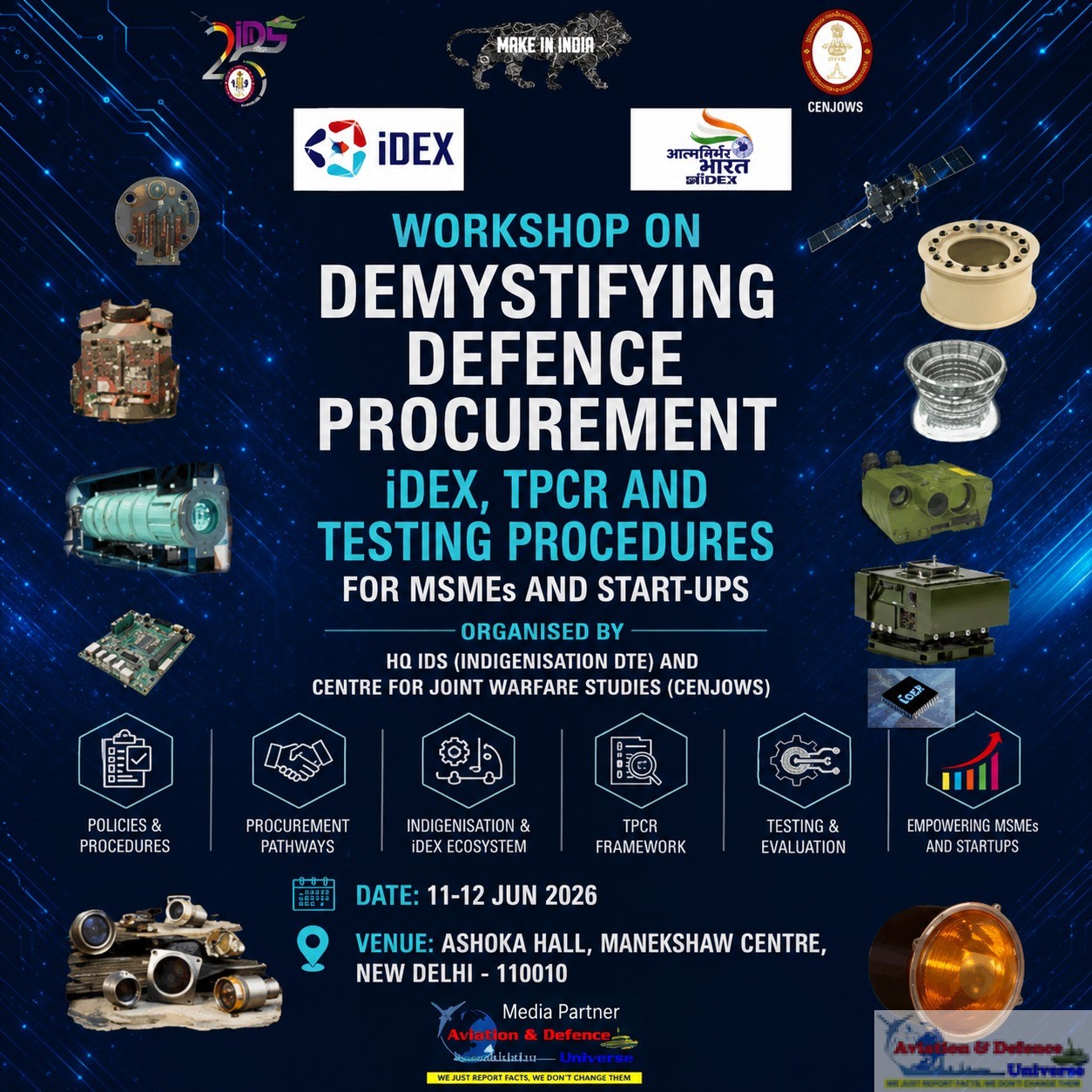
New Delhi. 02 June 2026. As India accelerates its drive towards defence self-reliance and indigenous capability development, understanding the complexities of defence procurement, innovation pathways, testing procedures, and certification mechanisms has become increasingly important for MSMEs and start-ups. Recognising this need, the Centre for Joint Warfare Studies (CENJOWS) will organise a two-day workshop titled “Demystifying Defence Procurement, iDEX, TPCR and Testing Procedures for MSMEs and Start-ups” on 11–12 June 2026. The programme aims to provide practical insights into the defence acquisition ecosystem while creating a direct interface between industry stakeholders, policymakers, acquisition experts, testing agencies, and military users.
The workshop will commence with an inaugural session featuring addresses by the Director General of CENJOWS and the Deputy Chief of Integrated Defence Staff (Policy Planning & Force Development). A keynote presentation by Maj Gen A.K. Channan (Retd.) will provide an overview of India’s indigenous defence capability-building efforts, followed by a session on revenue procurement parameters.
The first day is dedicated to helping industry participants understand the defence acquisition framework. Maj Gen Rohit Gupta (Retd.) will provide a detailed overview of the proposed Defence Acquisition Procedure (DAP) 2025/2026 and explain procurement categories, with particular focus on challenges faced by industry representatives. The session will be followed by a presentation on key aspects of Requests for Proposal (RFPs) and an exclusive industry query resolution session led by Maj Gen C.S. Mann, ADG Acquisition Branch.
The second session of Day One will concentrate on indigenisation initiatives and defence reforms. Participants will receive detailed briefings on government schemes supporting self-reliance, positive indigenisation lists, Swavlamban initiatives, and opportunities available under the Atmanirbharta framework. Sessions will also cover the Competency Mapping Portal, the SRIJAN platform, import substitution opportunities, and intellectual property rights protection through Raksha Gyan Samiti initiatives.
These discussions are expected to provide MSMEs and start-ups with a clearer understanding of how to align their capabilities with the requirements of India’s defence ecosystem. The second day of the workshop will begin with an extensive examination of the Innovations for Defence Excellence (iDEX) ecosystem. Vivek Virmani, DDG iDEX and COO of Defence Innovation Organisation (DIO), will lead discussions on how iDEX serves as a catalyst for India’s defence start-up ecosystem. Topics will include DISC, Open Challenges, SPRINT initiatives, grant structures, milestone-based funding mechanisms, and evaluation processes.
Participants will also gain insights into prototype development cycles and the critical transition from prototype creation to procurement, covering both iDEX and MAKE categories. These sessions are particularly relevant for start-ups seeking to convert innovative technologies into deployable defence solutions. A major highlight of the workshop will be its comprehensive focus on testing and certification systems, often regarded as one of the most challenging aspects of defence product development. Experts from DGQA, the Army Design Bureau, EME, the Indian Air Force, and specialised testing agencies will explain testing and evaluation procedures for military products. Topics include technical trials versus user trials, NCNC demonstrations, MET trials, airworthiness certification, environmental testing, EMI/EMC compliance, and user evaluation processes.
The workshop will also address common compliance gaps and strategies for reducing certification timelines. Representatives from DRDO will discuss research and development collaboration opportunities, Transfer of Technology (ToT) mechanisms, and Technology Development Fund (TDF) provisions available to industry. The final session, titled “TPCR and Beyond,” will focus on Technology Perspective and Capability Roadmaps (TPCR) and their significance for defence innovation. Experts will explain the TPCR structure, service-specific requirements of the Army, Navy, and Air Force, as well as Technology Readiness Levels (TRL 1-9), TRL gates, and rolling updates.
A panel discussion involving venture capitalists will provide participants with valuable perspectives on funding opportunities and commercialisation pathways. The workshop will conclude with an extended industry query session and closing remarks by the Assistant Chief of Integrated Defence Staff (Training & Integration). A distinguishing feature of the workshop is its emphasis on practical engagement rather than theoretical discussion. According to the programme notes, industry participants will be encouraged to raise questions throughout the sessions, and speakers have been specifically requested to focus on addressing industry challenges and requirements.
The CENJOWS workshop comes at a critical juncture as India seeks to strengthen its defence-industrial base through greater participation of MSMEs and start-ups. By bringing together acquisition experts, military practitioners, testing agencies, policymakers, DRDO representatives, and industry stakeholders, the programme aims to simplify complex procurement and certification processes while creating greater awareness of opportunities within India’s defence ecosystem.
For emerging defence innovators, the workshop offers a rare opportunity to gain first-hand insights into procurement procedures, iDEX mechanisms, testing frameworks, and future capability requirements—knowledge that could prove instrumental in transforming innovative ideas into operational military capabilities.


















































































-A4-Size-(2)_page-0001.jpg)