















- Faces the Press: Supply Chains, Air Force One, Ghost Bat, Starliner and India’s P-8I on the Table
- Boeing’s New Battle Plan: Execute Better, Build Faster and Partner Locally
- Goes Beyond the Platform: Lifecycle, AI and Autonomy Drive Its Farnborough 2026 Pitch
By Sangeeta Saxena
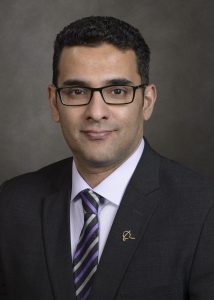
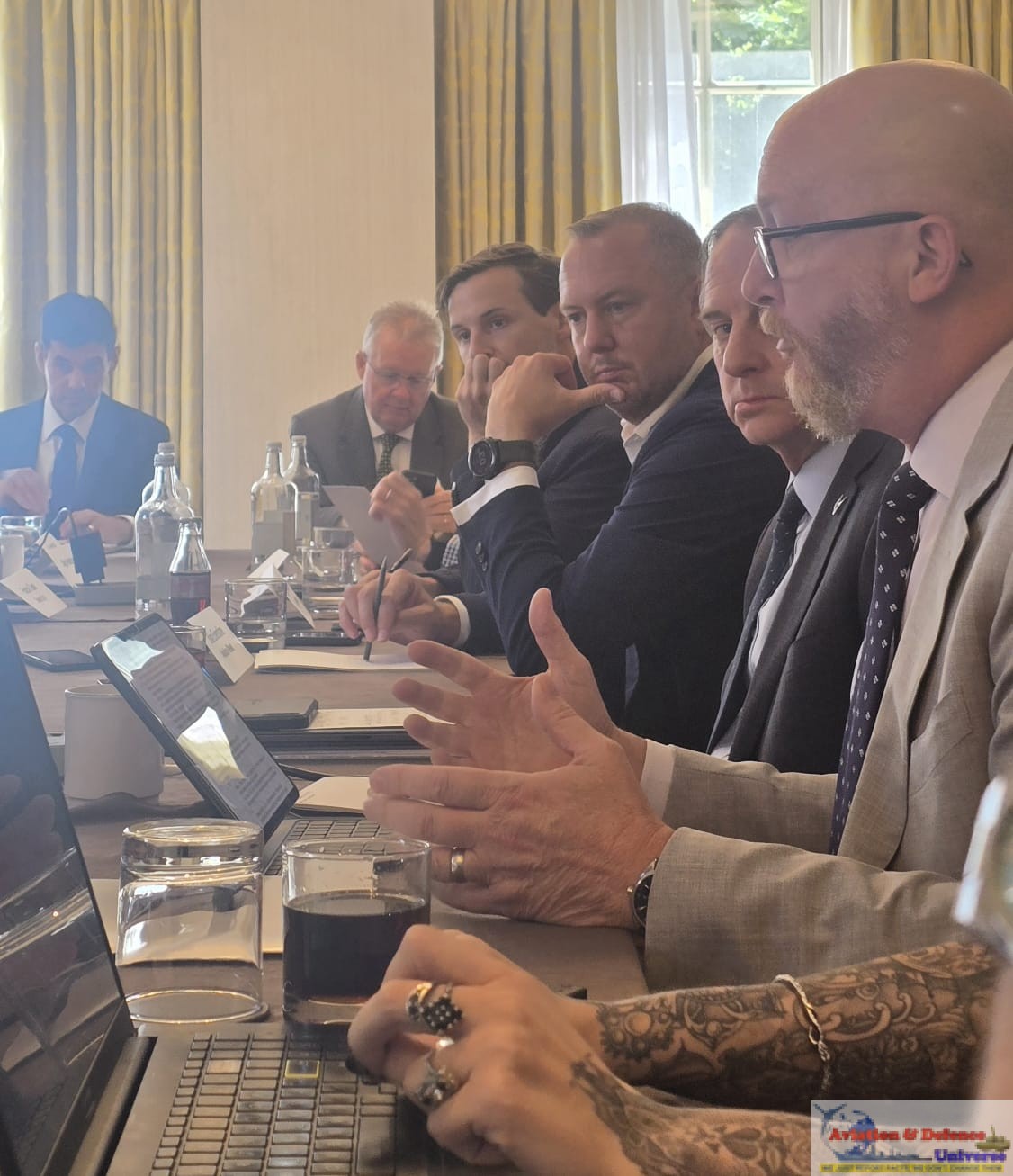
London. 19 July 2026. On the eve of the Farnborough International Airshow 2026, Boeing offered a sweeping look at the future of its defence, space and services businesses, as two of its most senior leaders sat down with a select group of international journalists at JW Marriott Grosvenor House in London.
Steve Parker, President and CEO, Boeing Defense, Space & Security and Chris Raymond, President and CEO, Boeing Global Services, fielded questions spanning virtually every major pressure point confronting the global aerospace and defence industry today — supply-chain fragility, surging production requirements, autonomous combat aircraft, Air Force One, the E-7, P-8 Poseidon, KC-46 Pegasus, T-7A Red Hawk, MQ-25 Stingray, PAC-3 production, European industrial sovereignty, F-47, Starliner and Boeing’s opportunities in India.
The conversation revealed a Boeing intent on presenting itself not simply as an aircraft manufacturer, but as a company increasingly focused on the entire lifecycle of military capability — from concept and development to production, sustainment and modernisation. It also offered a clear message ahead of Farnborough: Boeing believes execution, industrial partnerships, open architectures, autonomy and the ability to manufacture at scale will determine who wins the next generation of global aerospace and defence programmes.
Parker: Boeing’s Strength Lies in the Full Product Lifecycle
Opening the roundtable, Parker said one of Boeing’s distinguishing characteristics was its understanding of the complete product lifecycle — from concept and development through production, sustainment and modernisation. He pointed to Boeing’s broad portfolio and its growing “family of systems” approach, arguing that the company was beginning to “show up differently” with customers and stakeholders. The emphasis, he said, remained on execution, innovation and strengthening trust. For Boeing’s defence business, Parker summed up the current position in one word: momentum.
He said the company was continuing the progress made over the previous year, with safety, quality, programme execution, development programme excellence and engineering excellence at the centre of its strategy. These priorities were particularly important as several programmes approached major development and production milestones.
On the T-7A Red Hawk, Parker highlighted progress towards production and the delivery of the first two Engineering and Manufacturing Development aircraft for use by the US Air Force’s Air Education and Training Command at Randolph Air Force Base in Texas.
Turning to the KC-46 Pegasus, he said Boeing had recently signed an agreement aimed at strengthening mission readiness through a collaborative sustainment support process. He also highlighted progress on the Remote Vision System 2.0, saying the first phase of flight testing had been completed and had validated the cameras, control and processing hardware, keeping the programme on track towards certification.
Parker also highlighted progress on the MQ-25 Stingray, Boeing’s autonomous carrier-based aerial refuelling aircraft, which had completed two successful flight tests and was progressing towards low-rate production. He described the programme as an important step towards integrating the first autonomous system into a US Navy carrier air wing.
Boeing, Parker stressed, was also investing heavily in the infrastructure required for future programmes. He pointed to billion-dollar investments in advanced digital aerospace design and manufacturing facilities in St Louis and a $200 million investment in Huntsville, Alabama, to expand PAC-3 production capacity, workforce capability and supply-chain resilience.
The MQ-28 Ghost Bat, meanwhile, was positioned as a major symbol of Boeing’s autonomous future. Parker said the aircraft would make its first Farnborough static appearance after participating in a multinational joint-force exercise in the Pacific.
For Parker, however, the importance of the MQ-28 extended beyond the aircraft itself. It was about demonstrating how artificial intelligence, autonomy and human-machine teaming could transform future operations by bringing crewed fighters and uncrewed Collaborative Combat Aircraft together.
He also made clear that a broad portfolio did not mean Boeing would pursue every competition. Explaining the decision not to bid the T-7 for the US Navy’s Undergraduate Jet Training System requirement, Parker said the Navy’s requirements would have demanded too many modifications and tied up engineering and manufacturing resources needed for higher-priority programmes, including the F-47. The decision, he said, reflected a more disciplined Boeing — one focused on execution, technology and strategy.
Raymond: The Aircraft Is Only the Beginning
Chris Raymond placed Boeing Global Services firmly within that lifecycle strategy. He explained that the services business supports both government and commercial customers through parts and distribution, training, digital tools, aircraft modifications and maintenance worldwide. Its purpose, he said, was to ensure full-time enterprise-level focus on the aftermarket even as Boeing continued designing, developing and producing new aircraft.
Raymond said Boeing was bringing lifecycle and sustainment thinking much earlier into new aircraft competitions. The T-7 was a good example, he noted, because Boeing regarded it as a complete training system rather than merely a training aircraft. He also highlighted the P-8 Poseidon as an example of capability development continuing while an aircraft remains in production. Boeing was investing heavily in support and upgrades, including work in Jacksonville, Florida, associated with new US Navy capability.
At the other end of the lifecycle was the C-17, which was no longer in production but would remain operational for decades. Boeing was therefore looking beyond maintenance towards modernisation, including studies related to the aircraft’s future flight deck. Raymond identified customer responsiveness, safety culture and modernisation as key priorities for Boeing Global Services. The company was looking to reduce proposal and contracting timelines while investing in leadership development and training.
He also outlined Boeing’s use of what he called the “three A’s” — automation, analytics and AI — but cautioned against technology for technology’s sake. The objective, he said, was to identify applications that produced real operational value.
One example was the use of drones and algorithms for advanced C-17 inspections in San Antonio. Inspection data could be used to identify corrosion, missing fasteners and other maintenance requirements earlier, allowing teams to prepare before an aircraft entered deep maintenance and potentially reduce the time it remained unavailable to the customer.
Supply Chains: “You Have to Have Intimacy”
Responding to how Boeing could ramp up production when commercial and defence demand were simultaneously increasing and suppliers across the aerospace ecosystem were already stretched, Parker said that Boeing’s supply chain extended across thousands of suppliers and that one of the most important lessons was the need for visibility far beyond Tier 1 suppliers. “You have to have intimacy into the supply chain,” he said.
That meant understanding throughput, staffing, capital requirements and engineering turnaround times throughout multiple supplier tiers. Boeing, he said, was also prepared in some cases to put its own funding behind supplier expansion. The company was simultaneously looking at second and third sources where supply chains remained fragile.
Parker cited PAC-3 production as an example of the strategy working, saying throughput had increased significantly and would rise again as Boeing invested in facilities, people, tooling and suppliers. Raymond added that supply-chain pressures were particularly complex because parts had to support production lines, modification programmes and aftermarket requirements simultaneously. The industry was also still dealing with the consequences of COVID-era disruption and the relocation of some industrial activities following Russia’s invasion of Ukraine. The solution, he argued, depended heavily on partnership and trust. In some cases, Boeing could provide suppliers with longer-term certainty or help invest in additional capacity.
Can the MQ-28 Carry Meteor?
Asked about the presence of an MBDA Meteor missile alongside the MQ-28 display and whether this signalled serious integration discussions or was simply airshow marketing, Parker declined to comment specifically on Meteor but pointed to the speed with which Boeing had integrated the AIM-120 onto the Ghost Bat, saying the work had been completed in approximately seven months. He attributed that speed to the MQ-28’s open architecture. The next configuration, he said, would be internal-weapons-ready and capable of carrying two AIM-120-sized air-to-air weapons or four Small Diameter Bomb-sized munitions internally.
Boeing on the E-7’s Future
Asked about the E-7 following mixed recent international outcomes and questioned both its prospects for new business and Boeing’s strategy for supporting existing operators, Parker strongly defended the platform, describing its airborne command-and-control capability as unmatched. He pointed to the E-7’s operational use and argued that the aircraft possessed a technology roadmap capable of sustaining it for decades. Raymond highlighted Boeing’s experience supporting E-7 operations in Australia and its growing support infrastructure in the United Kingdom. He described Australia and the UK as examples of Boeing’s approach of building local capabilities around major aircraft fleets rather than simply delivering platforms.
In a follow-up on aircraft undergoing modification, Parker said Boeing was taking lessons learned from Royal Air Force E-7 work into the two US aircraft and indicated that the programme was positioned to move forward with further modifications.
Air Force One Remains on Track for 2028
A question on the VC-25B presidential aircraft programme focused on the contrast between Boeing’s lengthy modification effort and the faster work associated with the aircraft donated by Qatar for potential presidential use. Parker clarified that Boeing had provided engineering support to L3Harris on that project, but declined to make direct comparisons between the aircraft. On Boeing’s own VC-25B programme, however, he was unequivocal: the programme remained on track for 2028. He said Boeing had closed out the engineering work following an intensive active-management process and had moved into aircraft modification, with testing of the first aircraft expected to begin the following year. The priority, he stressed, was delivering two safe and fully operational aircraft meeting all technical and security requirements.
Asked separately about restrictions on share buybacks and dividends, Parker said Boeing was not undertaking share buybacks and instead was investing its own capital and R&D resources in expanding production capacity.
PAC-3 Production Accelerates
Asked about PAC-3 production, Parker said Boeing had significantly increased output and intended to raise production further. He linked the increase directly to investment in additional facility capacity, workforce recruitment and training, new tooling and close management of the supply chain. Later, asked about the funding framework supporting future PAC-3 expansion, Parker said he believed funding would ultimately come because of the operational demand for the capability. His clearest indication of Boeing’s confidence was simple: the company had already invested and was producing ahead of its contracted requirements.
Europe, Sovereignty and a Different Boeing Model
Questioned on how Europe’s growing emphasis on sovereign defence capabilities and indigenous sixth-generation programmes affected Boeing’s ability to compete, Parker said Boeing had been closely watching the shift and was changing how it approached European opportunities. For the UK’s future trainer requirement, he cited Boeing’s partnership with BAE Systems around the T-7 as an example of competing with a stronger emphasis on British jobs and local industrial participation. He also pointed to the MQ-28 model, where open architecture could provide customers with greater sovereignty over the systems they integrated.
Raymond said industrial participation and geopolitics had always been fundamental to major international defence campaigns. Winning, he said, required the right capability, support from the warfighter, an appropriate industrial partnership and favourable geopolitical conditions. He pointed to Boeing’s growing local presence in markets including the UK, India, Australia, Japan and Canada, saying Boeing Defence UK had grown from five employees to more than 2,100. The objective, he said, was to combine the right equipment with an industrial participation plan capable of building genuine local capability.
Boeing on the MQ-28
Another journalist followed up on the VC-25B before challenging Parker on competitors’ claims that the MQ-28’s position could be questioned on autonomy and mass-production capability. Parker dismissed the competitive commentary and pointed instead to operational demonstrations. He said the MQ-28 had already accumulated hundreds of flight hours and demonstrated its capability in major exercises. More importantly, he argued, the real story was not simply the aircraft but its autonomy and artificial intelligence. He cited a weapons demonstration in Australia in which an advanced fighter, an AESA radar, an E-7 Wedgetail and an autonomous MQ-28 worked together to close the kill chain, with the autonomous aircraft using its algorithms to manoeuvre into an advantageous position and conduct the engagement. Boeing, he added, had deliberately made the architecture open from the outset.
Parker also argued that Boeing’s manufacturing experience gave it an important advantage if large-scale production was required. “I believe nobody can scale it better than the Boeing company,” he said. He declined to predict specific future international sales but said Boeing was responding to significant global interest and remained focused on continuing to mature the aircraft.
What Next for Starliner?
Asked whether Starliner could fly again soon and whether the spacecraft had a future beyond Boeing’s existing NASA commitments. Parker said Starliner was ready and Boeing was working with NASA to provide the information needed for the agency to determine the launch schedule. The company, he said, had spent the previous 12 to 18 months focused heavily on root-cause corrective action following the previous mission and had tested a range of improvements. The next Starliner mission would be uncrewed, followed subsequently by crewed flights.
Looking further ahead, Parker said he saw continuing opportunities associated with the International Space Station and the evolution of commercial human spaceflight. He also emphasised Boeing’s focus on national-security space, including the X-37B and satellite programmes, while highlighting the company’s work on NASA’s Artemis programme. His immediate priority for Starliner, however, remained straightforward: get the spacecraft flying again and achieve a successful mission.
Cost Pressures and the F-47
Another journalist questioned Parker about rising programme costs and how Boeing could prevent the F-47 from following the cost trajectory seen on some legacy programmes, Parker distinguished between cost and price, pointing out that programmes such as the KC-46 had been contracted more than a decade earlier under fixed-price arrangements that had resulted in substantial losses for Boeing.
He acknowledged inflationary pressures across the aerospace industry but said Boeing was simultaneously trying to remove costs from its platforms because products that became unaffordable would ultimately become difficult to sell. He also pointed to continuing demand for programmes including the KC-46.
Asked about future KC-46 capability upgrades, Parker identified survivability, connectivity and communications as areas of focus, while acknowledging that an original equipment manufacturer should not expect automatically to receive every future upgrade contract.
Boeing Ready for the Next Big Decision
On being questionned whether Boeing should “brace for impact” when the US government made its next major programme decision, Parker said he welcomed a decision whenever it came and insisted Boeing was positioned to execute multiple major programmes simultaneously. When Boeing bid for the programmes that evolved into the F-47 and the other major fighter opportunity, he said, it did so knowing that it would have to be capable of executing both. “If I can’t execute one of these programmes, I wouldn’t bid it,” he said.
Parker pointed to Boeing’s multibillion-dollar investment in St Louis, including around one million square feet of new infrastructure across multiple facilities, as visible evidence of the company’s preparation. “If we get the nod, we’ll be very humble and we’ll get to work straight away. We’re ready to go,” he said.
MQ-25: “Let’s Get to the Carrier”
Asked about the next steps for the MQ-25 Stingray, Parker said the aircraft had demonstrated considerable maturity during its early flight-test activity. Eight aircraft were already in flow at Boeing, he said, while the programme’s milestone progress enabled movement towards low-rate production. The immediate priority was accelerating testing and moving towards carrier operations.
Discussing the programme’s challenges, Parker said many earlier difficulties had been associated with COVID-era disruption. The present focus was on flight testing, subsystem qualification and airworthiness. The challenge of carrier aviation, he noted, was not simply landing on a carrier but operating safely within the complex system of aircraft and activity surrounding a carrier air wing. The ultimate objective was to transfer the aerial-refuelling burden from F/A-18 Super Hornets to the MQ-25, freeing the fighters for their primary strike and combat missions.
Drones Become Maintenance Tools
Raymond expanded on Boeing’s use of drones for C-17 inspections, explaining that the original concept had evolved considerably. Rather than selling drone inspections as an external service, Boeing increasingly viewed the technology as an internal productivity and safety tool.
A drone could inspect the upper surfaces of an aircraft without requiring personnel to work at height and could help identify corrosion, missing fasteners and other issues as soon as an aircraft arrived. Combined with algorithms capable of comparing images with historical inspection data, the system could help maintenance teams anticipate work, prepare parts and potentially shorten turnaround times. Raymond said Boeing was still quantifying the exact time savings but that the improvements had been significant enough to earn strong support from the US Air Force and other stakeholders.
India’s P-8I and KC-46 Status Quo
Parker was asked about the status of India’s proposed follow-on P-8I Poseidon acquisition, the reported escalation in cost, and Boeing’s offer of KC-46 aircraft to meet the Indian Air Force’s aerial-refuelling requirement. Parker said his understanding was that the Indian government was considering the P-8I decision and that Boeing expected a decision shortly. “We are very excited for the potential increase in the Poseidon fleet,” he said, adding that India’s existing P-8I fleet was “performing magnificently well.” On the KC-46 leasing question, Parker said he had no update to provide.
T-7’s UK Prospects
On being asked how much indigenous British content Boeing might offer with the T-7 for the Royal Air Force requirement and whether the US production timeline could affect the aircraft’s ability to meet the UK’s aggressive schedule, including the need to replace the Red Arrows’ aircraft, Parker declined to reveal details that could compromise Boeing’s competitive strategy. He did, however, push back against recent reporting around the T-7 production timeline, saying the information being discussed publicly was not new and had already been known for some time. The broader message remained that Boeing intended to pursue the UK opportunity through its industrial partnership model, with its British partner taking a leading role in the campaign.
As the doors closed on Boeing’s pre-Farnborough media roundtable, one message stood above the individual programme updates: the company wants the world to judge it increasingly by execution. From expanding PAC-3 production and accelerating autonomous systems to modernising decades-old aircraft, building new digital factories and embedding lifecycle support into programmes from their inception, Boeing is attempting to connect its enormous industrial breadth into a more disciplined whole.
For Steve Parker, that means being selective about competitions, investing ahead of demand and proving new technologies through operations rather than promises. For Chris Raymond, it means ensuring that aircraft remain relevant, available and capable long after they leave the production line.
The questions from the international press corps also demonstrated the complexity of the environment Boeing faces. Customers want more capability, faster delivery, stronger domestic industrial participation and greater technological sovereignty — often while supply chains remain stretched and budgets remain under pressure.
Boeing’s answer appears to be a combination of global scale and increasingly local execution: open architectures for sovereign capability, international industrial partnerships, deeper supplier engagement, artificial intelligence and autonomy, and investment in the capacity required to manufacture at scale.
With the MQ-28 Ghost Bat making its Farnborough presence felt, the T-7 seeking international opportunities, the E-7 and P-8 remaining central to Boeing’s global defence portfolio, the MQ-25 advancing towards carrier operations, and the F-47 representing the company’s ambitions at the highest end of future air combat, Boeing arrived at Farnborough 2026 with much more than aircraft to display. It arrived with a proposition: that the future of aerospace and defence will belong not merely to those who can design the next platform, but to those who can build it at scale, integrate it into a family of systems, sustain it for decades and continually reinvent what it can do.
































































-A4-Size-(2)_page-0001.jpg)