


• The test marks a step forward in developing and commercialising a critical subsystem for precision landings of its reusable spacecraft.
  • Unlike conventional dumb parachute drops that only reduce descent speed, PADS achieves precision landings within a 100-metre radius of a designated location.
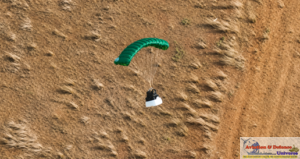
New Delhi and Chennai, 12th November 2026: Inbound Aerospace, an IIT Madras incubated startup developing a reusable spacecraft, successfully completed an aerial drop test of the indigenously developed Precision Aerial Delivery System (PADS); a first for a private Indian entity.

PADS is a critical subsystem of the reusable spacecraft being developed by Inbound Aerospace, slated for a 2028 launch. It is a smart parachute deployment system capable of autonomous guidance and precise landings. The precision drop test, a first by any Indian startup, is part of a broader set of subsequent tests planned from up to 30 km or the edge of space.

While Inbound Aerospace develops its reusable spacecraft modelled on a lifting-body design to solve the return leg of orbital logistics, PADS enables a controlled, safe descent to a pre-designated landing site once the spacecraft re-enters Earth’s atmosphere. Unlike conventional unguided parachute drops that only reduce descent speed, PADS will achieve precision landings, delivering payloads within a 100-metre accuracy range that is being further refined.

Beyond being an integral subsystem of the reusable spacecraft’s retrieval mechanism, PADS also has individual applications in emergency response, aerial defence logistics and safety systems, where precision delivery of payloads is a critical capability. Currently, such systems are imported from the USA or Europe. PADS delivers payloads accurately using onboard GPS navigation and autonomous GNS systems in GPS-denied environments. It can steer payloads and alter its flight path in real time to account for diverse geographies, weather conditions and inaccessible terrain.

Currently available in two variants: PADS Modular, which can carry payloads of 10–200 kg, and PADS 2K, designed for heavier payloads of 200–2,000 kg. Both variants can be deployed from altitudes of up to 7,000 metres above mean sea level. The same system is also being commercialised as a drone safety and recovery system.

As commercial space activity grows, with the global space economy currently valued at US$550–600 billion and ISRO planning the Gaganyaan mission and multi-module assembly for Chandrayaan-4, precise payload recovery post-re-entry is emerging as a critical capability. Other factors accelerating demand are the scheduled deorbiting of the International Space Station (ISS) by 2030 and the transition of microgravity-based research and manufacturing from government-led scientific experimentation to commercial high-value applications in pharmaceuticals, advanced materials, semiconductors and medical technologies.