Statement from IMOD: Israel and Greece have signed the massive “Achilles Shield” agreement








By: BAE Systems Spokesperson
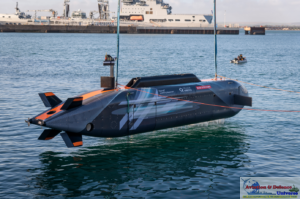 How do you protect thousands of miles of critical underwater infrastructure, such as gas or electricity pipelines?
Meet Herne®, our new autonomous underwater vehicle, designed to patrol silently beneath the waves for weeks at a time. Herne has a large mission bay designed to support a number of missions, from surveillance through to anti-submarine warfare and more.
The demonstrator vessel has now sailed in both Canada and the UK, proving it can operate autonomously in the depths accurately, while making its own decisions on how best to complete the mission safely and responsibly. With further planned improvements, the intention is for the production vessel to be capable of ranges of thousands of kilometres, including periods of ‘hibernation’ on the sea floor while it waits for further instructions or scans for enemy vessels.
As a BAE System Spokesperson, explained: “Herne is designed to operate entirely on its own, but also to raise the alarm to humans on the loop if it finds a threat. We’re fitting it with advanced AI identification so that it can accurately predict whether an object it detects is a threat, along with over the horizon communication systems so that it can tell commanders what it’s found and ask for direction. The large mission bay makes it even more useful, as it could carry effectors such as small rover vehicles, allowing it to disable explosives, remove eavesdropping devices or disable mines.
“We have an incredible team who took the demonstrator vessel from whiteboard to water in just 11 months. Not only did we bring our own decades of experience in submarine design and engineering, but we teamed up with specialist Canadian company Cellula Robotics to reach this demonstration phase. In what was a highly accelerated programme, we worked alongside Cellula to bring the whole capability to life.”
Putting together the first demonstrator vehicle was a rapid process, as BAE Systems spokesperson told us: “In order to move quickly, we designed everything in a digital engineering environment, making it much easier to collaborate with Cellula Robotics. The first time we integrated the systems and the platform was just a few weeks before the first trial and customer demonstrations, so it really put our design to the test and I’m glad to say everything worked! It is a credit to our team and Cellula’s that we were successful.”
The autonomous ‘brain’ on Herne is called Nautomate® and is already proven on our Pacific 24 autonomous surface boat, which was the first uncrewed military vessel to achieve the Lloyd’s Register Unmanned Marine Systems Certification. Nautomate is an advanced and highly configurable autonomy solution, which can be enhanced through plugins. Examples of plugins are remote weapons systems, surveillance sensors and vessel arrest systems.
The team is working hard to make further enhancements to Herne to ensure it is tuned to deliver a wide range of tasks for customers around the world.








































































-A4-Size-(2)_page-0001.jpg)