
















- Space is the New Classroom: A Million Minds Touched by Space Kidz India
- From Balloons to the Moon: How Dr. Srimathy is Reimagining Space for Girls
- Breaking Barriers in the Final Frontier: Space Kidz India’s Mission ShaktiSAT
- One Dollar to the Moon: A Global Call for Space Inclusivity by Dr. Srimathy
By Sangeeta Saxena
Chennai Trade Centre. 08 October 2025. At AeroDefCon 2025 in Chennai, amidst a sea of aerospace giants and defence innovators, one story stood out not just for its ambition but for its heart. ADU sat down with Dr. Srimathy Kesan, the trailblazing Founder and CEO of Space Kidz India, who has turned scientific curiosity into a global movement. From launching India’s lightest satellite to mentoring a million children across 108 countries, her journey is a testament to passion, persistence, and purpose. In this inspiring conversation, she speaks to ADU about her vision for space education, gender inclusion, and a moon mission powered by girl power.
 ADU. Tell us about the origins of Space Kidz India and your journey.
Dr. Srimathy Kesan. I started Space Kidz India with the aim of sowing the seeds of scientific thinking and space curiosity in young minds. In 2009, I became an ambassador for NASA, ESA, and GCTC space camps, which gave me the platform to take over 3,500 students to international research centres. But I didn’t want it to be mere educational tourism. I wanted the spark to translate into hands-on learning and innovation.
ADU. When did the actual launch activities begin?
Dr. Srimathy Kesan. Our first balloon satellite was launched in 2015. Back then, there was no precedent, no ecosystem — even small components had to be imported. It was expensive and challenging, but I was determined to make this accessible for every child in India. We’ve now done 27 space missions, including 19 balloon launches and 3 suborbital missions. One payload built by us was launched by NASA, and we also won the IDEX challenge recently.
ADU. AzadiSAT was a landmark moment. Could you tell us about that?
Dr. Srimathy Kesan. Yes. On the 75th year of Indian Independence, we launched AzadiSAT with payloads developed by 750 rural girls across India. They were trained online during COVID, and we sent them the kits and sensors in their local languages. These girls integrated the payloads themselves. It was historic. We launched it onboard SSLV D1, and we have now successfully launched 5 orbital satellites.
 ADU. What do these satellites do?
Dr. Srimathy Kesan. These are mainly communication satellites. One of our key tests was on carbon fibre polymers as a lightweight alternative to aluminium. We’ve also experimented with LoRa-based communication and ham radio frequencies — all while involving students in building and understanding the technology.
ADU. What’s the gender ratio among the students you reach?
Dr. Srimathy Kesan. Out of the one million students we’ve reached so far, around 36% are girls. That’s a good start, but we want to do more. That’s why our upcoming Mission Shakti Saturn is an all-girls satellite mission to the moon — involving 12,000 girls from 108 countries.
ADU. That sounds phenomenal. How are you managing such a large international initiative?
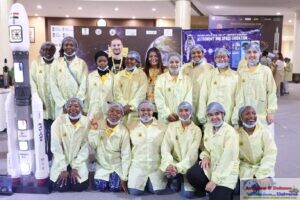
Dr. Srimathy Kesan. We’ve built a 21-module curriculum co-created by professors from the US, Europe, and India, delivered through a Zoho platform. Girls from humble backgrounds in countries like Lesotho, Grenada, and Saint Lucia are already enrolled. In February-March, we will bring one girl from each country to India to build two payloads — one for Low Earth Orbit, the other to ride as a piggyback to the Moon with iSpace.
ADU. Why the Moon?
Dr. Srimathy Kesan. The Moon represents resilience and light amidst darkness, just like a woman’s life. It’s symbolic. Men may dream of Mars, but the Moon belongs to all of us — especially the girls who’ve never been told they could dream of space.
 ADU. How are you funding this mission?
Dr. Srimathy Kesan. Through a global initiative called One Dollar to the Moon. We want everyone to feel responsible. One dollar may seem small, but it creates emotional investment. Every girl involved becomes a national hero in her country.
ADU. What’s next on your mission roadmap?
Dr. Srimathy Kesan. We’re also building a mascot — a girl baby holding a CubeSat, symbolising the future. It’ll carry 108 country flags and will be dropped on the moon. We’ve even proposed this to the Prime Minister. The idea is to replace toy kitchen sets with space sets for girls.
ADU. What is your long-term vision?
Dr. Srimathy Kesan. To build Shambhala — India’s first Space Research Park. A hands-on interactive city of learning with simulators, rocket gardens, and electric rockets. It should be a place where children from any state or country can build, test, and launch.
ADU. What makes this effort unique?
Dr. Srimathy Kesan. No one else in the world has done this — not even developed countries. We’re putting India on the map not just as a space power, but as a space educator. We want to inspire the next Abdul Kalam from every village.
 ADU. How are you keeping peace and accessibility at the core of your mission?
Dr. Srimathy Kesan. Space is not just about technology. It’s about empathy, unity, and accessibility. Until the last child — regardless of geography — can access space science, our job isn’t done. We work with women ambassadors in each of the 108 countries who bridge us with students, governments, and educators.
ADU. What about your short term plans?
Dr. Srimathy Kesan. Short term will be very short for I plan to make a big announcement by the day ends today. It will be a launch of a dream I want to fulfill with kids of India to march ahead as warriors of peace because the next battlefield must never be space — it must be protected. And the next warriors will be builders of peace, not destroyers. The stars are watching — and we’re answering.
From launching satellites to launching dreams, Dr. Srimathy Kesan is redefining what space means for the next generation. Space Kidz India is not just a platform — it’s a revolution with pink jackets and cosmic ambitions. India and the world have found not just a space scientist, but a space storyteller, educator, and visionary. In an era where the stars seem far, Dr. Kesan is building staircases — one payload, one girl, one dream at a time.
As told to Sangeeta Saxena









































































-A4-Size-(2)_page-0001.jpg)