






















- From AI to Dog Patrols: How the Indian Air Force Is Tackling Wildlife Hazards
- Let the Engines Roar, Let the Birds Soar: IAF’s Unique Approach to Aviation Safety
By Sangeeta Saxena
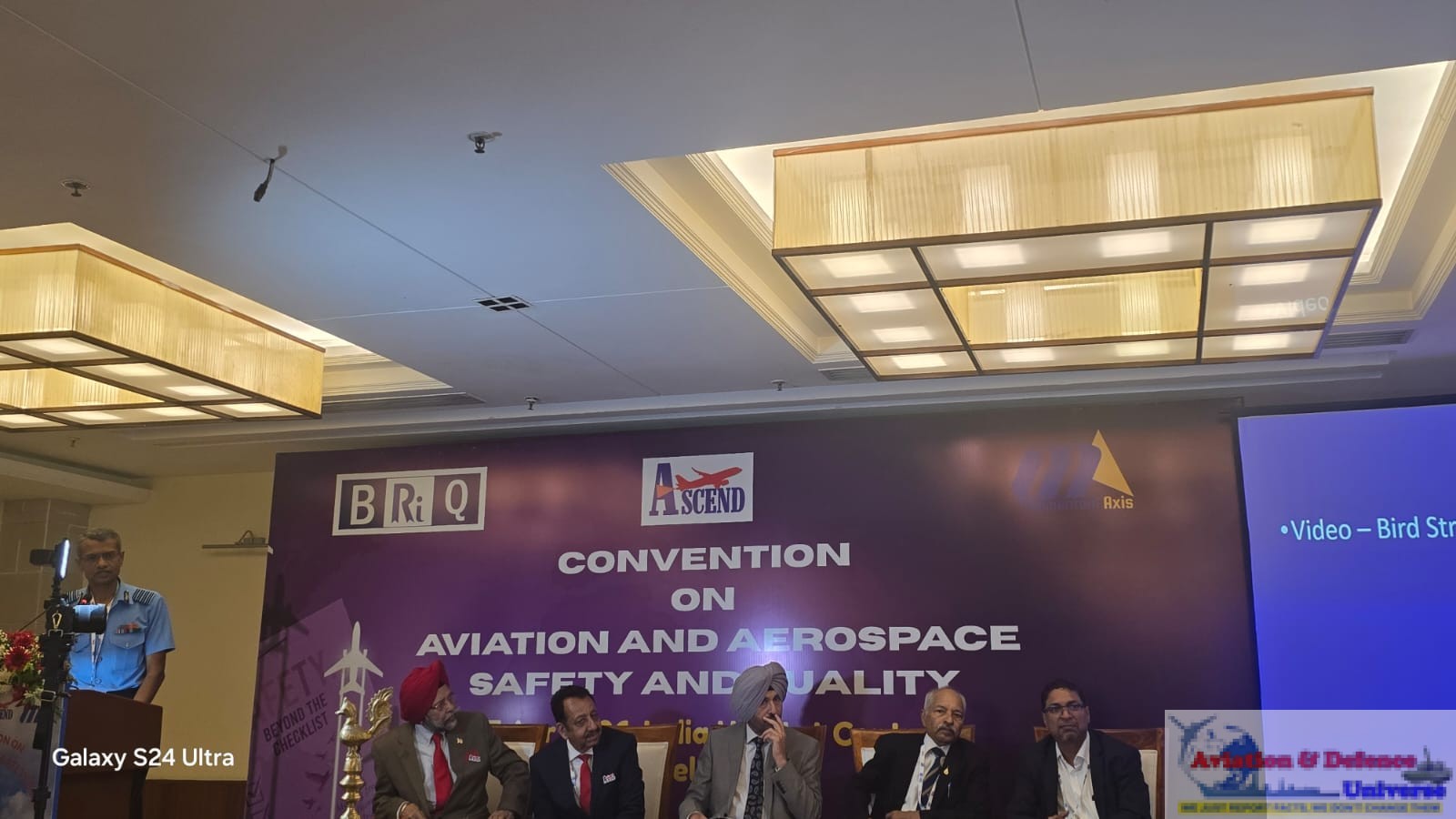
New Delhi. 17 April 2026. Safety remains the centre of aviation ecosystem, yet paradoxically, it is often the most overlooked aspect in strategic and operational discussions, overshadowed by conversations on capability, expansion and technology. While aviation is one of the safest modes of transport, this record is sustained only through constant vigilance, rigorous standards, and a culture that prioritises safety above all else—something that can never be taken for granted. Recognising this critical gap, the Convention for Aviation & Aerospace Safety and Quality, organised by Gp Capt Sushil Bhatia, has brought the issue to the forefront, creating a dedicated platform to examine safety challenges in the Indian context. By fostering dialogue among industry leaders, regulators, and operators, the convention aims to align India’s aviation practices with global benchmarks and ensure that safety is not treated as a compliance requirement, but as a continuous, evolving commitment.
Addressing a session on aviation safety, Gp Capt (Dr.) Srinidhi from the Indian Air Force (IAF), delivered a compelling and technically rich presentation on the growing threat of bird strikes and wildlife hazards to military aviation. Drawing from operational experience, research, and innovation within the Indian Air Force (IAF), the address highlighted the scale of the problem and the comprehensive measures being undertaken—from ecological studies to artificial intelligence—to mitigate risks and enhance flight safety.
Opening with a striking real-world example, Gp Capt Srinidhi emphasised the unpredictability and danger of bird strikes, stating, “Bird strikes are very common, much more common than what we expect. But, they can have disastrous effect.” Highlighting the scale of the issue, he pointed out the increasing frequency of such incidents, stating that “the number of bird strikes is much bigger” than the growth in aviation activity.
Bird strikes remain one of the most persistent and underestimated threats to aviation safety worldwide, affecting both civil and military operations. As air traffic increases and urban environments expand into natural habitats, the interaction between aircraft and bird populations has grown significantly, leading to higher risk levels. Even a single bird strike can cause severe engine damage, structural failure, or forced emergency landings, resulting in substantial economic losses and potential loss of life. The challenge is compounded by the unpredictability of bird movement, seasonal migration patterns, and the presence of waste and water bodies near airfields. Globally, aviation authorities and air forces are increasingly adopting a combination of ecological management, advanced radar systems, AI-based prediction models, and behavioural deterrence techniques to mitigate this risk, but the “bird menace” continues to demand constant vigilance, innovation, and coordinated action across stakeholders.
Introducing the Indian Air Force’s unique response, he said, “we are the only Air Force in the world which has men in uniform manning the wildlife hazard management.” He elaborated on the establishment of the IAF’s Ornithology Cell, guided by the philosophy, “let the engines roar, let the birds soar.” The approach, he explained, is rooted in both ecological and operational considerations, with the aim of achieving “economically sustainable, ecologically sustainable” solutions. The speaker emphasised the complexity of the problem, noting that “this is a complex problem which has got multifarious dimensions to it.” He highlighted the multidisciplinary approach adopted by the IAF, stating, “we have studied bats, insects and grass. I cannot produce a solution with just by understanding birds.”
 One of the most innovative solutions described was the “meat tossing module” used during Republic Day flypasts. He explained how “we pull away the birds from the actual path of Republic Day fly pass” through carefully calibrated ecological interventions. The precision of such operations was underscored with the observation that “the window available for us is around 20–22 minutes”, requiring exact coordination. On research and innovation, he highlighted the IAF’s commitment, noting that “the Indian Air Force is so committed, we supported a full-fledged PhD” on the subject.
He also emphasised the use of advanced technologies, stating that the IAF has initiated AI-based solutions to “predict the bird hazard one week from now, one month from now.” The role of industry collaboration was highlighted through initiatives like the iDEX challenge, where the Air Force is “throwing challenges after challenge” to develop innovative solutions.
On data-driven approaches, he revealed the scale of research involved, noting that “1 million bird were accounted in 18 different airfields”, demonstrating the need for AI-driven analysis. He also highlighted advancements in DNA barcoding, stating that the IAF has achieved “more than 80% identification” of bird species involved in incidents.
Innovative field solutions were also discussed, including the use of dogs to deter birds, where “just their sheer presence pushes away the ground birds.” Despite progress, he acknowledged ongoing challenges, particularly in developing effective deterrent systems, noting, “we want the sound effect to be produced where the bird is and not where we stand.”
Wildlife hazards pose a significant and evolving challenge to aviation safety worldwide, extending beyond bird strikes to include risks from mammals, reptiles, and even insects in and around airfields. Animals on runways or in flight paths can cause collisions, engine ingestion, or pilot distraction, potentially leading to catastrophic consequences. The problem is amplified by expanding urbanisation, habitat disruption, and climate-driven changes in animal behaviour, which increase the likelihood of wildlife encroaching on aviation zones. Effective mitigation requires a holistic approach that combines habitat management, surveillance technologies such as radar and AI-based monitoring, trained response teams, and coordination with environmental agencies. As air traffic continues to grow, managing wildlife hazards has become a critical aspect of ensuring operational safety, demanding constant vigilance, scientific understanding, and sustainable coexistence strategies.
Concluding his address, Gp Capt Srinidhi emphasised the seriousness of the issue, stating, “wildlife strike is a serious hazard.” He reaffirmed the IAF’s commitment, noting, “Air force is ready to put in any amount of effort to find solutions.” The address by Gp Capt (Dr.) Srinidhi offered a comprehensive and insightful look into one of the most underappreciated challenges in aviation safety—wildlife hazards. By combining operational experience, scientific research, and technological innovation, the Indian Air Force has developed a unique, multi-layered approach to mitigating bird strike risks. From AI-driven predictive models to ecological interventions and industry partnerships, the IAF’s efforts reflect a commitment to both safety and sustainability. As aviation operations continue to expand, such integrated approaches will be essential in ensuring mission readiness while safeguarding lives and assets.










































































-A4-Size-(2)_page-0001.jpg)