
















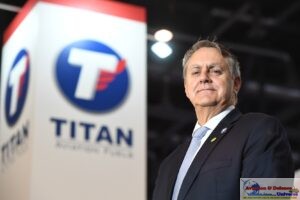
 Friedrichshafen, Germany / 22 April 2026 – Geneva-based TITAN Aviation Fuels® is drawing urgent attention to the growing aviation fuel supply challenges across Europe, while outlining the company’s actions to support operators during a period of significant market strain, at AERO Friedrichshafen 2026.
“Right now, the biggest concern across the industry is simple: availability,” says Daniel Coetzer, CEO of Titan Aviation Fuels Sarl. “Suppliers are under real pressure to deliver on contracts that, in some cases, are no longer feasible given current market conditions. This is already creating shortages, and with Europe entering its peak summer season, the situation could become significantly more challenging.”
A large portion of Europe’s jet fuel supply is imported as refined product from the Middle East. Ongoing geopolitical and maritime security risks threaten the stability of these supply routes.
“If the security of shipping lanes cannot be guaranteed in the coming months, we expect further disruptions,” Coetzer adds. “That has serious implications for business and general aviation, especially as suppliers prioritize fuelling commercial scheduled flights.”
Despite widespread disruption, Titan Aviation Fuels has maintained consistent supply to its customers, reinforcing its core commitment to reliability. The company is leveraging advanced technologies, including artificial intelligence (AI)-driven systems, to optimize its international supply network and anticipate disruptions before they impact customers. At the same time, the company emphasizes that technology complements, rather than replaces, the human relationships at the heart of its operations.
“We use AI to create a smoother, more predictable supply environment,” Coetzer explains. “But we never remove the human factor. Our relationships with customers and suppliers remain the most important component of our business.”
Alongside supply concerns, the industry continues to adapt to the ReFuelEU Aviation regulation and the gradual introduction of Sustainable Aviation Fuel (SAF).
“After a difficult start, we’re now seeing better alignment across the industry,” says Coetzer. “There is broader acceptance of the 2% SAF mandate – even at airports where SAF is not physically available in the fuel supply.”
Administrative complexity remains a key issue, particularly around compliance reporting, but Coetzer expects meaningful improvements in 2026 as processes become more standardized.
Titan is actively contributing to the development of a robust SAF ecosystem. As a proud member of the International Sustainability & Carbon Certification (ISCC), the company works closely with partners to ensure both the growth of the SAF market and the integrity of sustainability certification.
To support customers, Titan has also developed an internal application to efficiently process and manage SAF certificates, simplifying compliance and improving transparency.
“Our goal is to make SAF adoption as seamless as possible for our customers,” Coetzer exlains. “That means not only securing supply but also ensuring that certification and reporting are handled effectively.”
“This is a defining moment for aviation fuel supply in Europe,” Coetzer concludes. “There are real challenges ahead, but also an opportunity to build a more resilient and sustainable system. Titan is committed to being part of that solution.”
Come meet Titan Aviation Fuels at AERO Friedrichshafen 2026 at A2-103.


















-A4-Size-(2)_page-0001.jpg)