






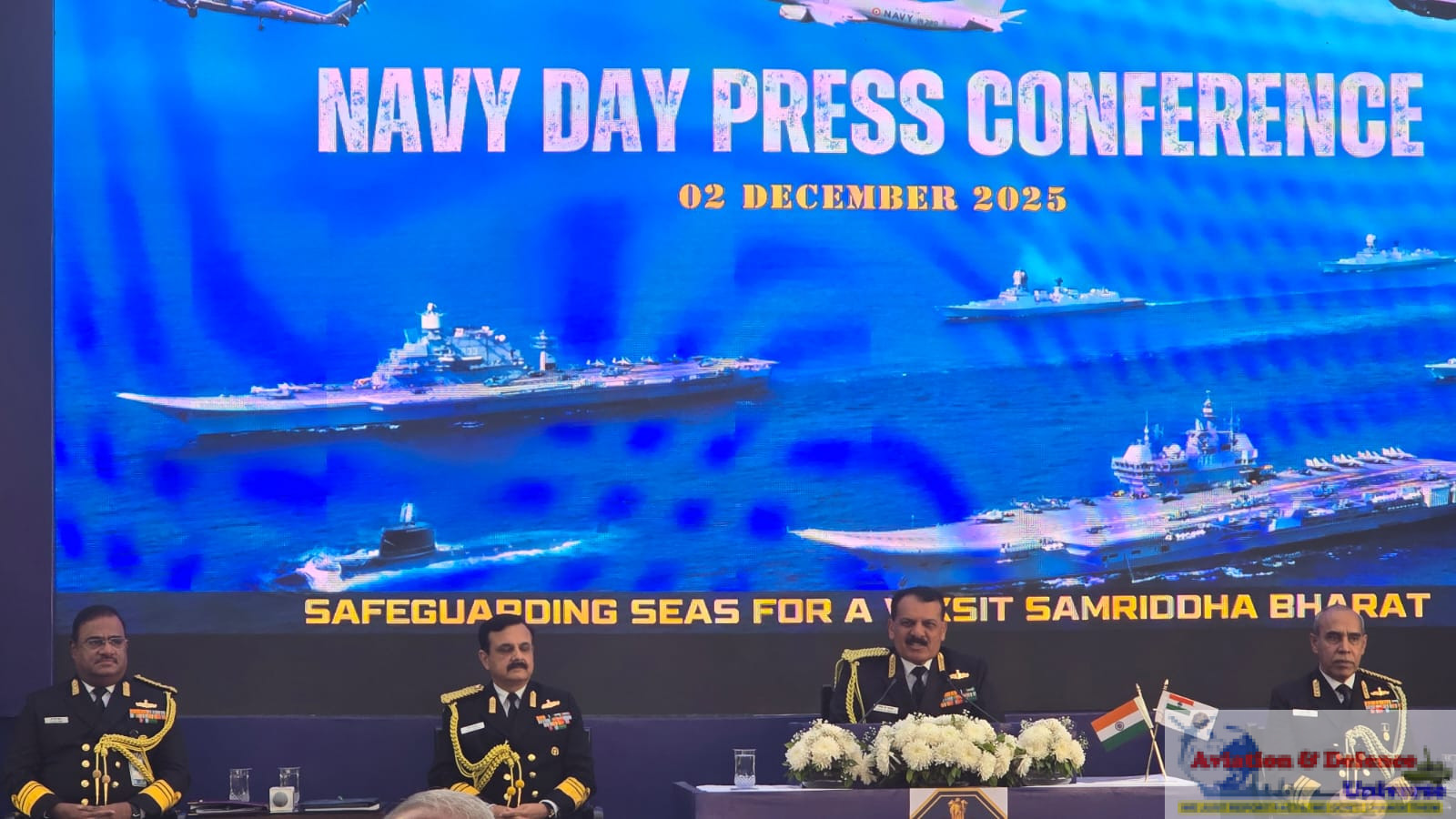
- Indian Navy Chief Fields Tough Questions on Carriers, Russia and Women Submariners
- Power Projection, Partnerships and Propulsion: What the Navy Chief Revealed Before Navy Day
By Sangeeta Saxena
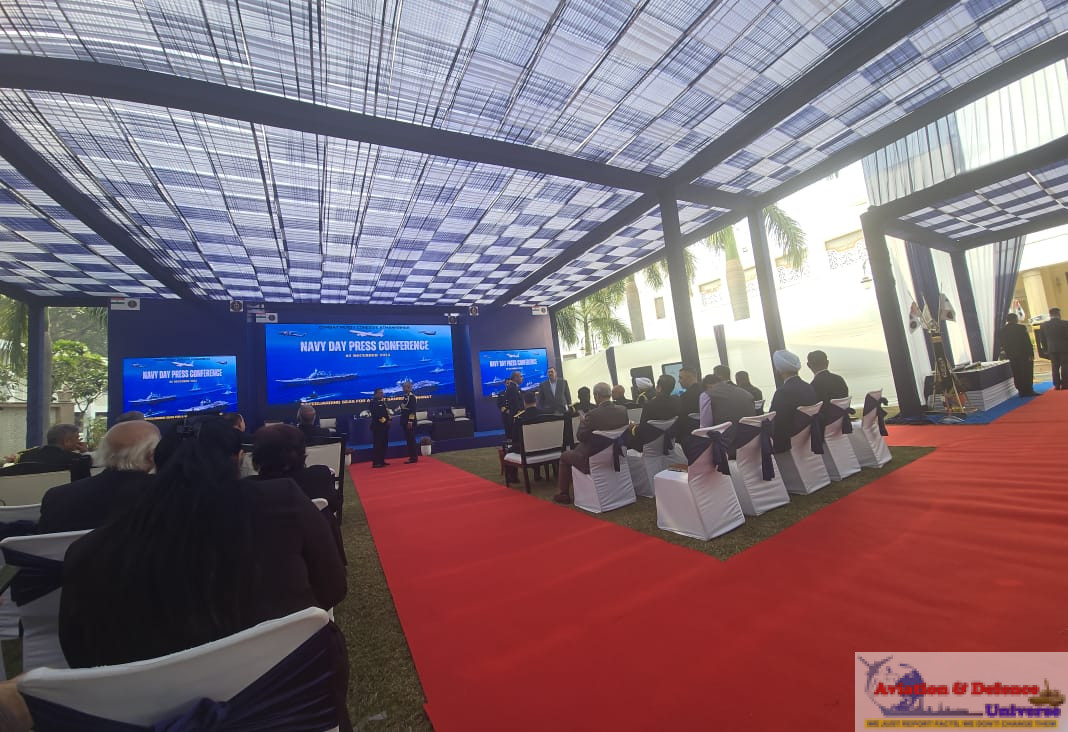
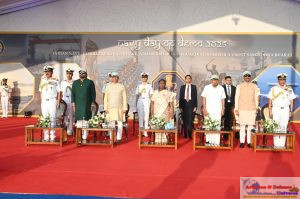
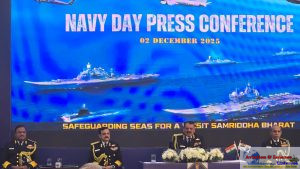
New Delhi. 02 December 2025. On the eve of Navy Day, the Indian Navy’s top leadership faced a lawn packed with journalists at the Kota House Naval Mess in the national capital, where the Chief of the Naval Staff (CNS) led an unusually long and wide-ranging media interaction. The exchanges—sometimes sharp, sometimes humorous—spanned geopolitics, aircraft carriers, indigenous submarine plans, women in combat roles, start-ups, technology, the Indo-Pacific, and lessons from the ongoing maritime Operation Sindoor. The mood oscillated between good-natured banter and hard strategic questioning, reflecting both the media’s appetite and the Navy’s willingness to engage.
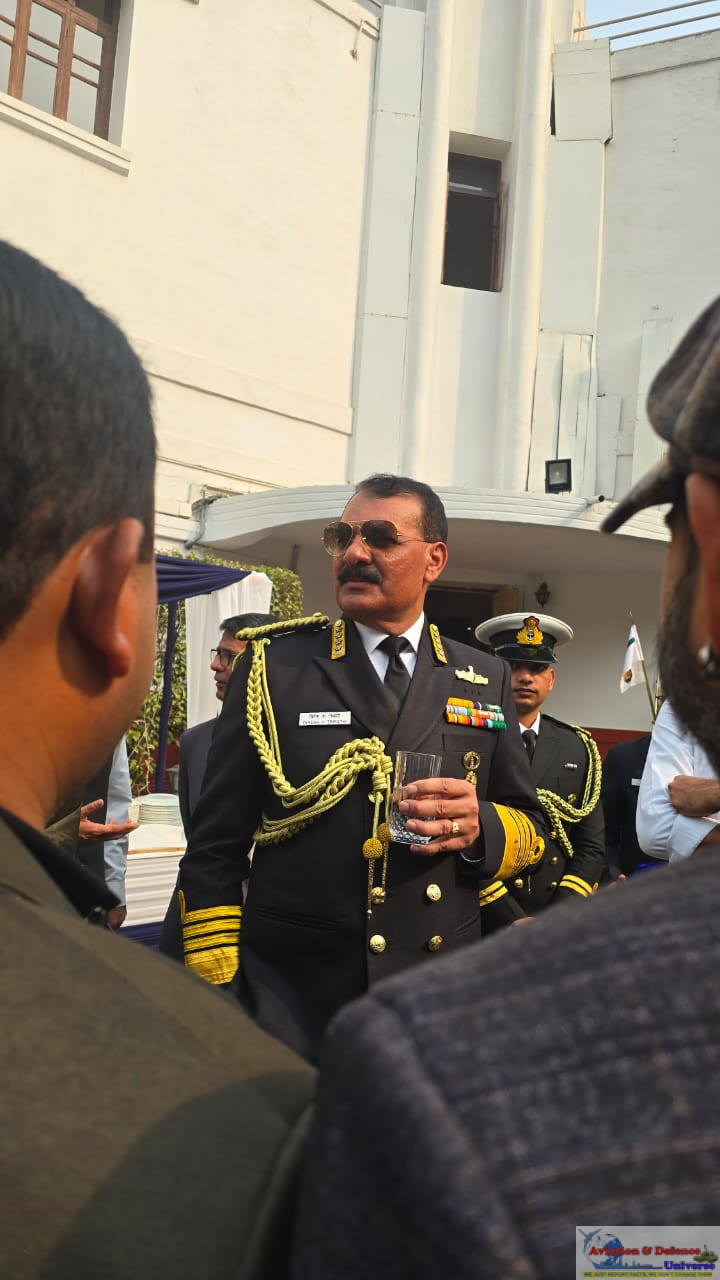 The session opened with questions on India’s delicate balancing act between Russia and the United States. As reporters quizzed the CNS about Moscow’s planned reciprocal agreement with India and Washington’s unease over Indo-Russian ties, he remained firm in asserting India’s long-standing position.
India, he emphasised, would continue to exercise “strategic autonomy” and pursue “issue-based convergences” without prejudice or pressure from any side. He avoided speculation about President Putin’s upcoming visit, simply noting that maritime topics might arise and that the media would likely learn of the outcomes “earlier” than he would.
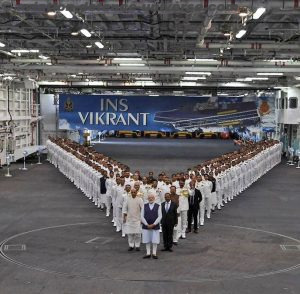
The future of India’s aircraft carrier fleet emerged as a dominant theme. Questions referenced historic plans for multiple carriers and concerns over China’s rapidly expanding fleet. The CNS clarified that India would remain a two-carrier Navy in the near term, primarily because INS Vikramaditya is approaching the end of its service life. However, India’s long-term aspiration remains unchanged. “Our vision is still to have a three-carrier Navy—one on each coast and one in reserve for maintenance and contingencies, ” he said and further explained that carrier procurement involves multi-ministry decisions and remained confident that the “requisite answers” would eventually align with India’s strategic needs.
The Navy Chief confirmed that the submarine leased to Myanmar is performing well, with Indian assistance limited now to refresher training. On nuclear attack submarines (SSNs), he reiterated that indigenous construction is progressing as planned, though such platforms “cannot be built overnight.” India expects to induct SSNs by the middle of the next decade, and in the interim has arrangements in place for one SSN from a “friendly foreign partner.” The conventional submarine programme, P-75(I), is at a decisive stage. “It is at a very advanced CNC stage. Contract conclusion should happen quickly.” When asked about women submariners, the CNS described it as an operational challenge—but not a conceptual one. “It is the last bastion because of space constraints. It is only a matter of time. Many navies already have women submariner,” he stated. Highlighting the ongoing gender-neutral initiatives: induction of women fighter and helicopter pilots, gender-neutral language and a broader cultural shift within the service, he confirmed Navy’s gender neutral stance.
 Addressing concerns about delays in the Seahawk helicopter programme, the CNS insisted deliveries are proceeding as scheduled. Fifteen aircraft have already arrived, a second squadron is being commissioned, and the maintenance facility will follow contract stipulations. He described the platform as a “major capability enhancer” for the fleet.
Operation Sindoor which involved assertive posture in the northern Arabian Sea, drew considerable media attention. The CNS confirmed that the operation remains active, focusing on maritime domain awareness (MDA). He revealed that Pakistan’s Navy “never came out” during the operation and noted a measurable short-term economic impact due to reduced merchant traffic to Pakistani ports. On alleged Chinese involvement, he was categorical, “No, we did not notice any active support by China.” He also spoke of internal task forces studying operational lessons, though specifics remain classified while the operation continues.
The interaction showcased the Navy’s expanding role in India’s defence-tech ecosystem. Acknowledging start-ups’ concerns about delayed orders, the CNS assured that the Navy and MoD are streamlining processes and shifting from a “buyer-seller” model to one of “co-creation.” On propulsion—which has been a critical dependency—the Chief outlined significant progress in indigenous diesel engines under Make-I, indigenous gas turbines (24–36 MW) and integrated electric propulsion for future ships. He described propulsion as a “weak link” India is now determined to fix.
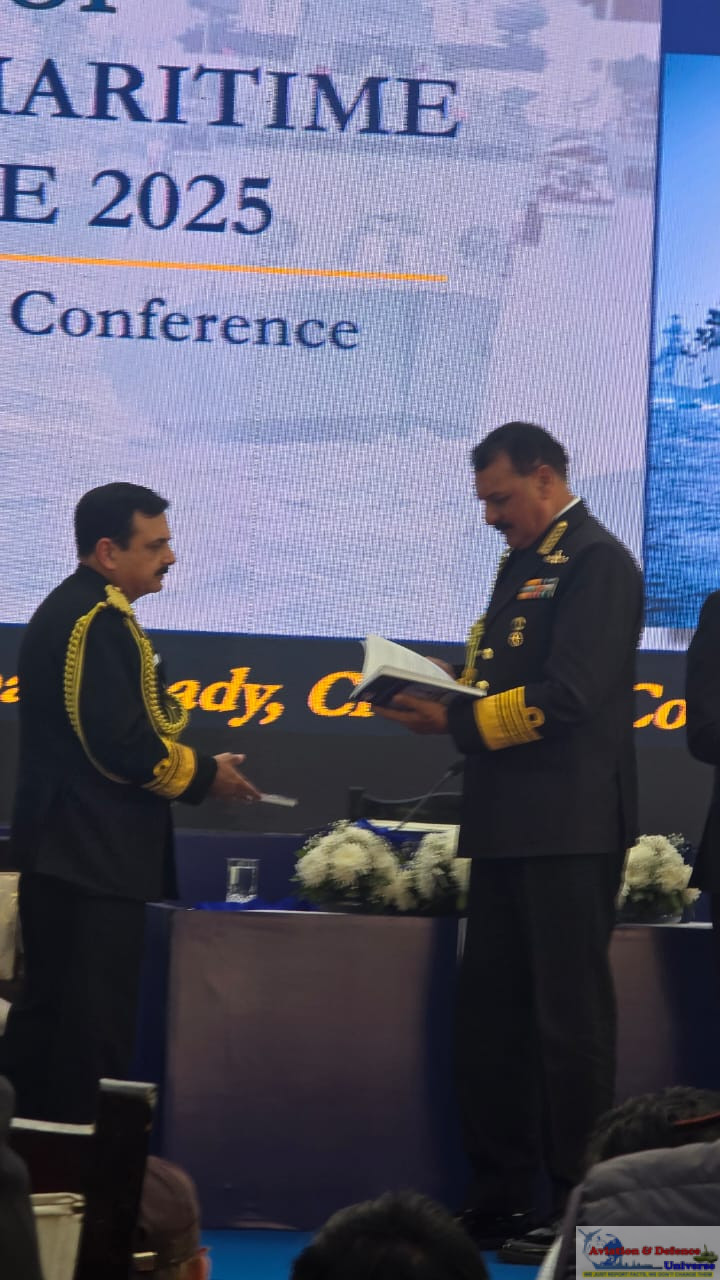 Addressing concerns about Chinese research vessels in the Indian Ocean Region (IOR), he highlighted that such movement in the high seas is lawful—but stressed that the Navy maintains complete situational awareness. The Indo-Pacific, he said, is central to India’s interests, and the Navy remains ready to operate wherever national maritime interests dictate—whether the Mediterranean, western Pacific, or Fiji. Repeatedly emphasising technology as the backbone of maritime power, the CNS noted that modern warships incorporate nearly every advanced technology available in India. He recalled that the Navy was the first service to mandate B.Tech degrees for all officers, re-confirming its belief in technical proficiency. On jointness, he framed the Defence Minister’s recent comments on “changing mindsets” as a reminder that service-specific thinking must give way to integrated operations—an evolution already underway.
The Navy Day press interaction revealed a service that is confident, adaptive and firmly aligned with India’s strategic vision. Across subjects—from aircraft carriers to SSNs, gender inclusion to start-ups, the Indo-Pacific to indigenous propulsion—the CNS projected a Navy that is modernising quickly while learning continuously from its operational experiences.
The underlying message was unmistakable: India’s maritime interests are expanding rapidly, and the Navy intends to protect them “anywhere, anytime, anyhow.” As Navy Day approaches, the interaction offered a rare glimpse into the thinking of a force balancing high technology, regional complexity, and an era of renewed maritime competition.



























































-A4-Size-(2)_page-0001.jpg)