





















- Flightpath to the Future: India’s Civil Aviation Ecosystem Comes into Focus
By Sangeeta Saxena
New Delhi. 28 October 2025. Indian aviation ecosystem is charting a flight path and Aviation India & South Asia Summit & Exhibition 2025 is all set to become a runway for showcasing the region’s ascendance as an aviation powerhouse. Organised by Times Aerospace in association with the MRO Association of India, the two-day summit will gather over 800 delegates and 50 exhibitors under one roof in New Delhi’s Aerocity. It is poised to become the definitive platform for high-level dialogue, technology showcases, business networking, and strategic policy shaping in the aviation and aerospace sectors of India and South Asia.
 With the theme “Shaping the Pathway for Indian Aviation,” the summit aims to provide a panoramic view of the country’s dynamic commercial aviation ecosystem. From Maintenance, Repair, and Overhaul (MRO) services and business aviation, to airport infrastructure, pilot training, sustainability, and aerospace manufacturing, this event will be a convergence of visionaries, CEOs, regulators, OEMs, and service providers—united in their mission to elevate Indian and regional aviation to new heights.
Business and general aviation in India is entering a phase of strategic transformation, emerging as a vital pillar of the nation’s broader aviation ecosystem. With the government’s continued focus on regional connectivity through the UDAN scheme and the rise of Tier-2 and Tier-3 cities as economic hubs, non-scheduled and charter operations are becoming essential enablers of accessibility, convenience, and economic productivity. The demand from corporate travellers, high-net-worth individuals, and institutional users for flexibility and time efficiency is driving the growth of charter services, air taxis, and fractional ownership models. Simultaneously, advances in aircraft technology, operational digitalisation, and improved regulatory frameworks are empowering operators to expand their reach and improve cost efficiency.
India’s general aviation sector also plays a crucial role in bridging connectivity gaps, supporting medical evacuation, aerial survey, disaster relief, and tourism services. However, its true potential lies in being recognised as a critical infrastructure asset rather than a luxury segment. The ongoing liberalisation of MRO and FBO regulations, development of dedicated general aviation terminals, and incentives for fleet modernisation are expected to attract new investments and partnerships. As the Aviation India Summit 2025 convenes key stakeholders, the spotlight on business and general aviation will highlight its transformative role in shaping a more connected, agile, and resilient air network for a new era of Indian aviation.
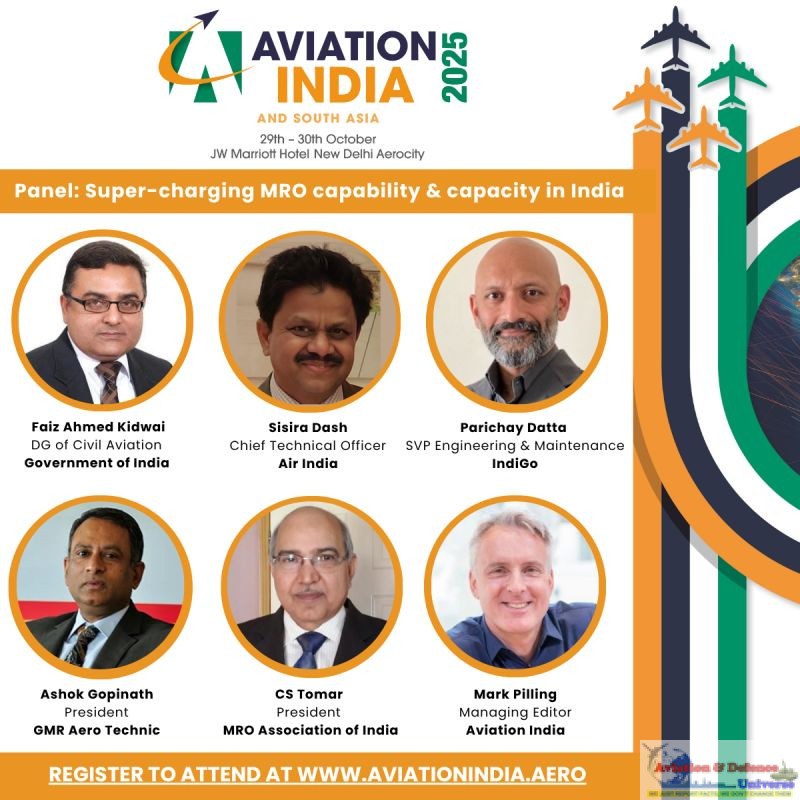 India’s Maintenance, Repair, and Overhaul (MRO) sector is rapidly emerging as a strategic pillar of its aviation ecosystem, vital for reducing dependence on foreign MRO hubs and retaining valuable foreign exchange. With over 1,500 commercial aircraft projected to be in operation in the country over the next two decades, India has both the scale and need to build robust domestic MRO infrastructure. The government’s progressive steps—rationalised GST on MRO services, permission for 100% FDI, and creation of MRO hubs in SEZs and airport ecosystems—are driving greater private participation. This transformation is catalysing a shift from traditional maintenance outsourcing to an Atmanirbhar Bharat-driven model where Indian MRO providers can offer competitive turnaround times and comprehensive service portfolios for both narrow-body and wide-body aircraft.
Simultaneously, Indian MROs are diversifying their capabilities to service not just commercial fleets, but also defence platforms and business aviation, creating a dual-use advantage. Partnerships between OEMs, airlines, and Indian MRO firms are enabling advanced skill development, tooling, and adoption of global best practices. The presence of key players like AIESL, GMR Aero Technic, Horizon Aero, Max MRO, Indamer, and AI Engineering Services Ltd., among others, is reshaping India into an MRO hub for South Asia and beyond. As the Aviation India Summit 2025 convenes industry leaders, infrastructure planners, and policy-makers, the focus on MRO will underline its pivotal role in enhancing fleet availability, reducing costs, and building a globally competitive aviation services ecosystem rooted in self-reliance and technological excellence.
 As India’s aviation sector continues its steep upward trajectory, the demand for skilled pilots, ground crew, and technical personnel has surged exponentially. Bridging this talent gap is a pressing challenge that calls for immediate investment in state-of-the-art training infrastructure, global curriculum alignment, and harmonised regulatory standards. From regional airline growth to private jet operations and international routes, the need for highly trained and safety-conscious flight crews is more critical than ever. The Aviation India Summit 2025 will delve into the strategic importance of building robust pipelines of aviation talent—spanning commercial pilot training, simulator-based programs, and advanced crew resource management (CRM) initiatives.
Government policy is now firmly aligned to support this imperative. Initiatives like the UDAN scheme, the opening of flying schools under the PPP model, and the recognition of pilot training academies as priority infrastructure have laid the foundation for capacity-building. Industry leaders, training organisations, and aviation regulators will come together at the summit to explore pathways for India not just to meet domestic demand, but to emerge as a global hub for pilot training. As aviation moves towards next-gen aircraft, automation, and AI-based operations, India’s human capital strategy must adapt swiftly. Investing in pilot training is not just about filling cockpits—it’s about building a safe, sustainable, and world-class aviation ecosystem.
 India’s rapid ascent as one of the world’s fastest-growing aviation markets has placed airport infrastructure at the heart of national transformation. The Aviation India Summit 2025 will spotlight the country’s ambitious push to build next-generation airports that match global standards in efficiency, passenger experience, and sustainability. From greenfield mega-hubs like Jewar and Navi Mumbai to regional terminals under the UDAN scheme, the government and private sector are working in tandem to expand capacity and enhance connectivity. With traffic recovery exceeding pre-pandemic levels and over 150 million passengers projected annually, India’s airport ecosystem is evolving into a modern, technology-driven network designed to meet the aspirations of a new Bharat.
A key focus will be the development of regional air connectivity through upgraded infrastructure in Tier-2 and Tier-3 cities. Seamless multimodal integration, digital air traffic management (ATM), smart airport technologies, and eco-friendly designs are redefining how India builds and operates airports. Industry leaders, airport operators, and policymakers will convene at the summit to discuss regulatory reforms, investment models, and PPP frameworks that can unlock the full potential of aviation-led regional development. The future of India’s airport infrastructure lies not just in adding runways, but in reimagining the airport as a growth engine for commerce, tourism, logistics, and sustainability.
 As the aviation sector continues to expand, sustainability has become a central pillar in shaping its future. Aviation India Summit 2025 will explore the urgent need for decarbonisation and environmental responsibility through discussions on Sustainable Aviation Fuel (SAF), carbon offsetting mechanisms, and airport electrification. The summit aims to highlight policy frameworks and innovations that support India’s commitment to net-zero emissions, in alignment with global climate goals. With international benchmarks evolving rapidly, India’s aviation sector is poised to lead in pioneering solutions that reduce its environmental footprint while supporting high growth.
The conversation around green airports will focus on infrastructure that is energy-efficient, waste-conscious, and future-ready. From solar-powered terminals to intelligent water and waste management systems, the transition to sustainable airport ecosystems is already underway in India. Sessions will feature success stories from major Indian airports that have achieved or are targeting carbon neutrality, while addressing how smaller regional airports can adopt scalable green practices. With the government and industry both backing initiatives like electric ground vehicles and greenfield airports designed with climate resilience in mind, the summit will provide a roadmap for India’s aviation ecosystem to thrive responsibly.
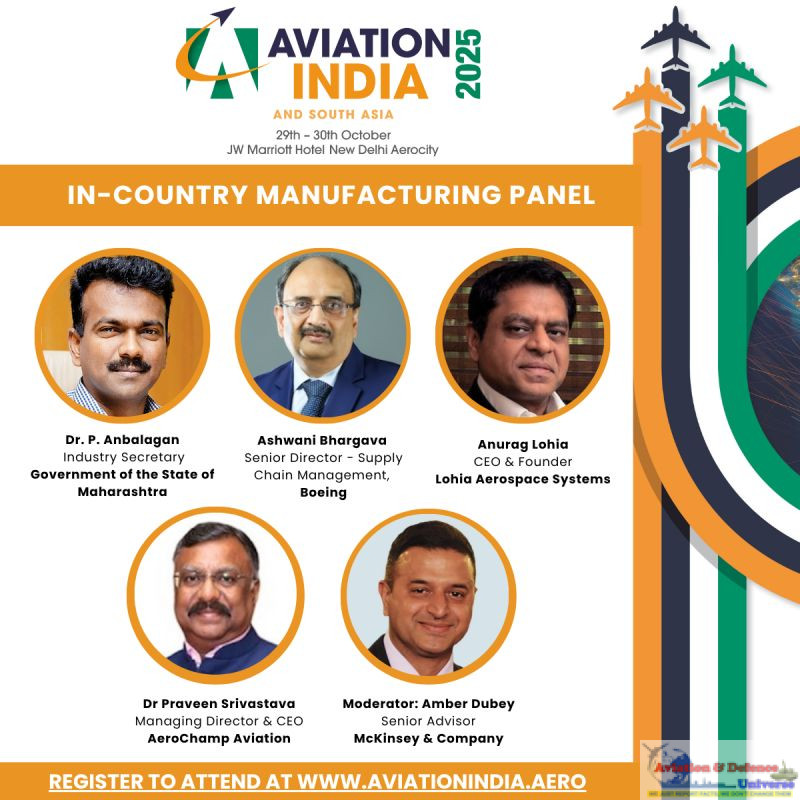
India’s aerospace manufacturing landscape is undergoing a transformative shift, driven by the clarion call of “Aatmanirbhar Bharat” and the government’s focus on boosting local production capabilities. Aviation India Summit 2025 will spotlight how India is leveraging its engineering talent, policy support, and innovation ecosystem to become a global manufacturing hub for aerospace components, systems, and platforms. From civil aircraft parts to complex avionics and cabin interiors, Indian manufacturers are increasingly integrating into the global aviation supply chain while also serving the growing domestic demand. The Production-Linked Incentive (PLI) scheme, defence corridor initiatives, and relaxed FDI norms are enabling a more competitive environment for OEMs and Tier 1 suppliers to expand operations in India.
 The summit will feature leading Indian aerospace firms and global OEMs who are collaborating with local partners to enhance indigenisation, co-development, and co-production efforts. The sessions will explore the development of aerostructures, engine components, landing gear systems, and digital manufacturing technologies, as well as the importance of quality assurance and certifications like DGCA, FAA, and EASA. With Indian carriers placing record aircraft orders and MRO demand on the rise, strengthening local aerospace production and integrated supply chains will be key to reducing import dependency, generating employment, and achieving true aviation self-reliance. This track at the summit aims to chart the roadmap for India’s ascent as a global force in aviation manufacturing.
Aviation India 2025 is not going to be just another industry gathering—it is a strategic platform where policy will meet practice and innovation will meet investment. As India prepares for its centenary of civil aviation in 2032 and aspires to become a top aviation hub, the conversations and connections at this summit will help steer that journey. From air taxis to AI-powered maintenance, from regional routes to green runways—the future is being written here. India is ready to lead. The world is ready to land. Let the conversations begin.