














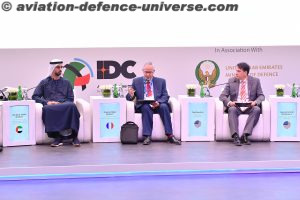
 Abu Dhabi, UAE. 19 February 2023. The International Defence Conference hosted a broad range of high-caliber speakers from the government and the private sector, addressing key issues in the defence and security space. To an audience of government, academia and corporates, the speakers discussed the potential economic and social consequences of several aspects of technology including the future of defence operations, latest updates and developing talent and managing human capital.
Session 1: “Promise and Peril – the social and economic impacts and risks of widespread adoption of new technologies such as AI, neuro, & biotechnology and extended reality”
This panel explored the social and economic impact and risks associated with the widespread adoption of new technologies such as artificial intelligence, neuro and biotechnology. These technologies certainly offer new efficiencies and opportunities, but they are also introducing new social uncertainty, risks and tensions. That will in turn, create new missions, requirements and dilemmas for defensive security communities.
So what are those technologies that will play an important and impactful role in the future? The human experience as a human society? Is it artificial intelligence? Is it gene biotechnology?
Each one of these technologies is going to bring new capabilities, but also new challenges. H.E. Omar Sultan Al Olama, Minister of State for AI, Digital Economy and Remote Work Applications, UAE commented, “The limitations are the challenges you have with false positives. Ethical decision-making with a high level of competence is unfortunately not to the degree of a very well trained human being, but with time we’re going to see that as we feed the systems with more and more data, they’re going to be able to give us a better output compared to what we have today.”
 AI offers a lot of in terms of efficiency, better decision-making, and perception. However, in the end, the man in front of the machine makes the final decision. Therefore, training people is key. According to John W. Nicholson Jr, Chief Executive, Lockheed Martin Middle East, ‘AI is not about replacing human decision making but rather enhancing human decision making.’ Al is very good at detecting anomalies and this allows the human to come in and verify what needs to be done.”
H.E. Omar Sultan Al Olama said that there are many challenges we need analyse. “These systems do not have the same level of empathy and thinking as humans. It is important that the decisions made are not too extreme or offensive.’
Threats are becoming more and more complex and unpredictable. Roy Donelson, Chief Executive, Raytheon MENA says, “One thing that we do is make sure that our operators understand the systems and explain the algorithms and the AI to ensure trust in the system…we want our operators to never have a doubt that the air defence systems will work.”
What are the new dynamics that the defence industry must address? John W. Nicholson, “Many technologies are out there and AI is one of them… you have directed energy hypersonic. The list goes on…how these are integrated…could be the key in the future. Our goal is to deter conflict… to ensure that the capabilities that we and our partners have are so good that no one would want to risk conflict with us.”
 How do we stay in control of the technological development and mitigate the rest, whether in the civilian world or the military world, there’s not going to be a perfect match, but what are some of the things that we can currently do to stay in control?
H.E. Omar Sultan Al Olama, “I think the only answer is more cooperation, more dialogue… there are certain consequences today that do not allow for dialogues to happen and we know that but we need to constantly push one to ensure that we are able to work together to collectively care about the future of humanity.”
John W. Nicholson Jr, “Collaboration is going to be critical as we go forward.” Investing education and awareness is also critical, “I really think the education of those that use AI will enable them to…advance it to the next level.”
François-Régis Boulvert, “We are at a turning point in changing the way we interact with young people… for me; humans need to stay at the centre of the decision.”
H.E. Omar Sultan Al Olama, “I just hope that we have a lot more of these dialogues and engagements, where we bring multiple stakeholders from around the world to share best practices and knowledge and to present to the world case studies of what can and can’t be our future.” Furthermore, “…don’t underestimate the level of imagination that bad actors have. They will think about using all of these tools to create as much harm as possible. And the only way that we will be able to truly ensure that we eradicate this nature is for us all to work together.”
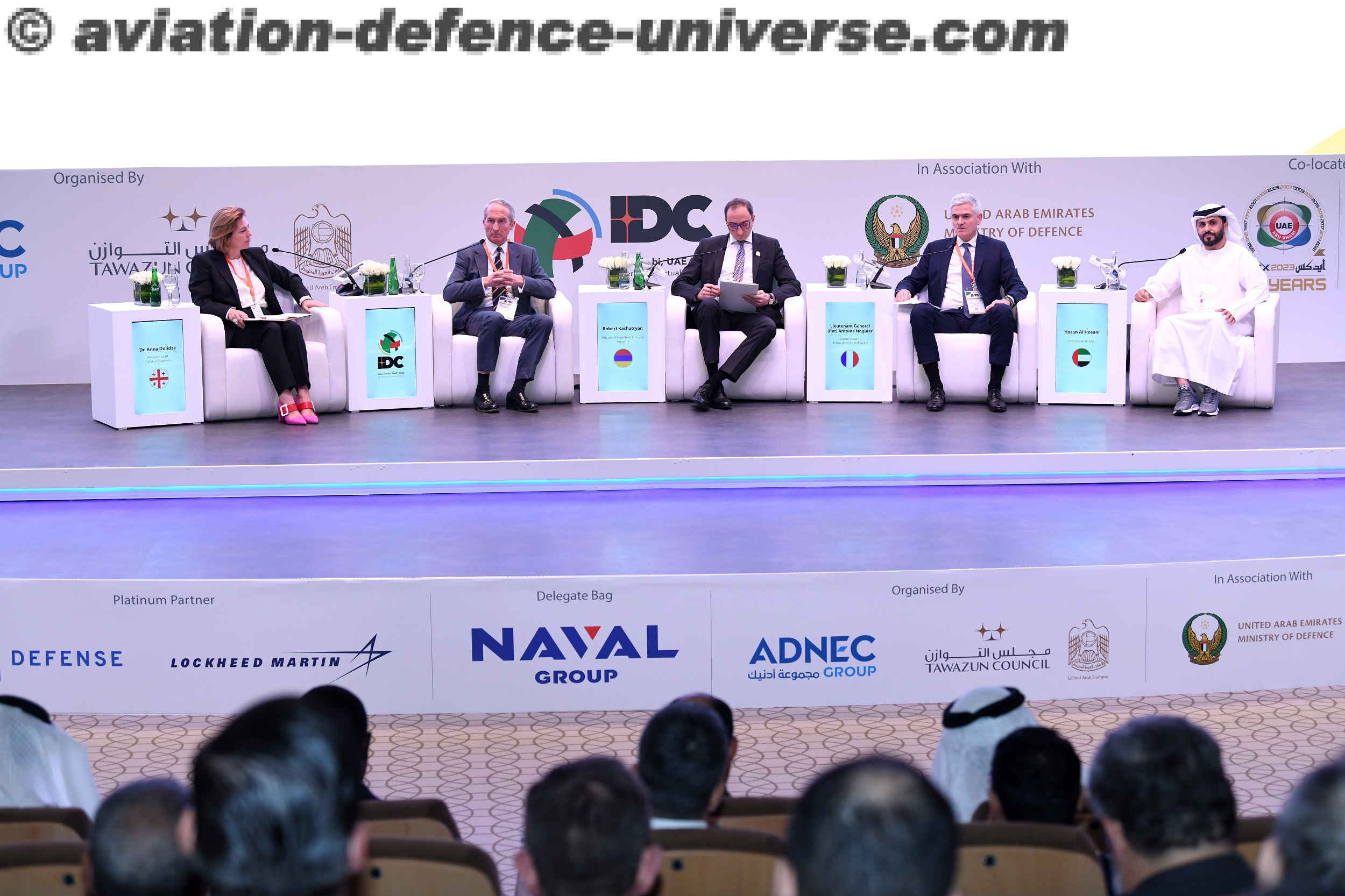
 Session 2: Keeping Pace –how the increasing incorporation of advanced technologies in the workplace is changing approaches to talent development and human capital management. The panel explored and investigated the aspects of the creation and development of human resources and how the human capital will be capable of grasping the opportunities brought by technological progress as well as responding to the challenges that technological advancements bring.
The session speakers included: James Anthony Morse (President, Rabdan Academy), H.E. Robert Kachatryan (Minister of High Tech Industry in Armenia), Antoine Noguler (Head of Strategy at Airbus), and Mr. Hasan Alhosani, Chief Executive Officer of Bayanat.ae.
James Morse outlines the challenges the education institution is trying to navigate in this emerging field. Mr. Morse said: “As technology continues to evolve, skills of analysis, creativity, critical thinking of leadership are really going to be very important and enduring themes that we need to make sure are covered by education. The future operating environment is definitely going to have a far greater involvement from the private sector, and technology offers great opportunities in education and training.”
H.E. Robert Kachatryan defined the development of the high-tech sector as a top priority for Armenia. H.E. said: “Our overarching objective is to see Armenia as a place where high-value scientific products are produced and consumed within a wider economy, and for that goal to be achieved, we are committed to ongoing investment in human capital, which will establish science and business linkages, functioning networks, and collaborations that are the main pillars of the policies that we are developing.”
 Antoine Noguler elaborated on how he, as a leader, is coping with some of the challenges of needing to grasp technological development and how that translates to human resources. Noguler said, “We need to make sure we can overcome this challenge. In big company like Airbus, we need to have not only the top leadership’s willingness and strategy in place but we also need to make sure we can develop the necessary technology.”
Hasan Al Hosani discussed how the defence sector is always leading the research and development process in many aspects, and the usage of technologies is becoming very significant. He commented: “We require artificial intelligence to do deep analysis, generate multiple layers of insights, and then provide these findings to humans so that one can add conviction and personal knowledge and experience to this decision-making process. The human workforce has to evolve and move from lower-tier processing jobs to focusing on upskilling and multiskilling and focusing on higher-level tasks.”
 Session 3: Tech at the Forefront –the impact of emerging technologies on modern operations and the future of warfare
Major Gen. Staff Mubarak Ghafan Aljabri, AUSEC for Support and Defence Industries, Ministry of Defence, UAE: The UAE has put in place plans and future strategies to realize the country’s digital transformation. Our leadership has a clear vision on where it wants to be in terms of deploying disruptive technologies. We are working to identify strategic partners, user requirements, human capital and training requirements to succeed in deploying technologies. Regarding AI and machine learning, these technologies are generating huge amounts of data that allow us to analyze, plan and utlize it in the right time to protect and defend our nation and execute our missions.
Vice Admiral Brad Cooper, Commander of U.S. Naval Forces Central Command, said: “We believe a key element to enforcing security is through deterrence and being able to stop something from happening in the first place, and being able to respond if it happens. And that’s where the power of AI and unmanned systems can be so meaningful for individual countries. This can be possible through the power of collaboration and partnerships with world-wide providers of these technologies. Our goal by the end of this year is to grow our unmanned fleet with our partners to about 100 platforms patrolling around the region.”
 H.E Dong Joon Yoo, Deputy Minister of Military Force and Resource Management, Republic of Korea: It is important to realize the importance of commercial technology and to keep up with the changes in the environment around us. It is also essential to rebuild systems to make sure that they are able to adapt to changes.
Professor Major General (Ret) Adam Findlay, Professor of Practice, Defence and Regional Security, Griffith Asia Institute, Griffith University: There’s a couple of technologies that we’re seeing in Australia which are very important for the future of warfare. The first is robotics and autonomous systems. We are seeing an evolution on the battlefield right now, with ISR systems and increased accuracy.
There is a centrality to humans that we’re applying these technologies for. There has been a lot of evidence where we’ve applied technology and the human has to adapt to the technology. However, we need to flip that around.
 Session 4: The next Frontiers – the human instinct to explore beyond the current dimensions of the terrestrial and physical world and expand the human footprint in both space and digital domain
Nikos Papatsas, Senior Partner, EFA Group, “Our generation is living in a more interesting generation for space. We live in the fourth generation where space has become very important…governments and industry have to come together.”
Anna-Karin Rosén, CEO, SAAB, “We live in a time where space exploration is going in such an interesting direction, and we have the tools to maximise utilising them. Artificial intelligence is going to be a big deal for both defensive space and the commercial use of space because it will allow us to do the impossible.”
Palmer Luckey, Founder/Inventor, Oculus VR, Anduril Industries, USA said, “The number one thing that most governments can do is to create opportunities for companies with new technologies and new ways of doing things to successfully compete against the companies that have existed for a very, very long time.”
Nikos Papatsas commented, “Navigation is number one and this is something that all governments are very interested in protecting as an asset in space…number two is communication and thirdly, the sensors are very important, whether we are talking about radar sensors or electro optical sensors. These are the most important capabilities that one needs to have in order to protect assets.”