







- Reaffirm Strategic Defence Partnership at 22nd Military Cooperation Commission Meeting
- Trust and Technology: India, Russia Map Future of Defence Ties During High-Level Talks
- Russian Defence Industry Ready to Strengthen India’s Atmanirbhar Drive, Says Belousov in Delhi
By Sangeeta Saxena
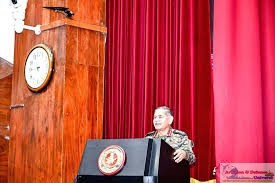
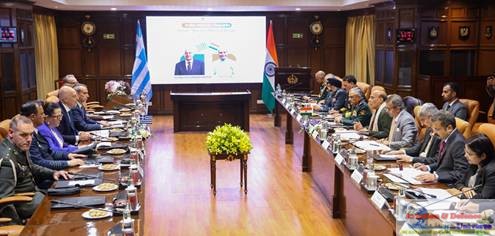
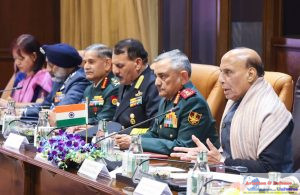
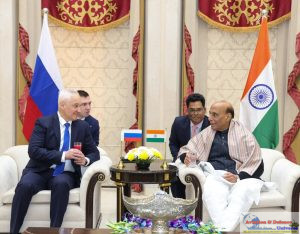
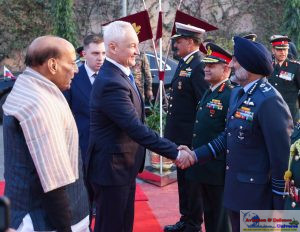
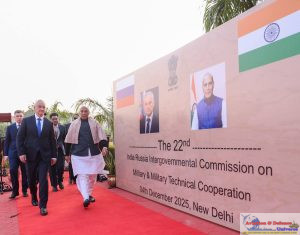 New Delhi. 05 December 2025. India and Russia reiterated the depth of their long-standing defence partnership as Raksha Mantri Rajnath Singh and Russian Defence Minister Andrei Belousov co-chaired the 22nd India–Russia Inter-Governmental Commission on Military & Military Technical Cooperation (IRIGC-M&MTC) at the Manekshaw Centre in New Delhi on Thursday.
The meeting, held on the eve of the 23rd India–Russia Annual Summit between Prime Minister Narendra Modi and President Vladimir Putin, underscored the strategic importance both nations place on defence collaboration built on “trust, common principles and mutual respect.”
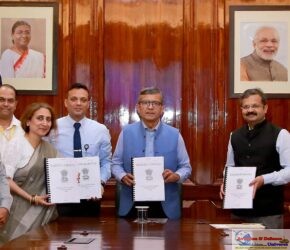
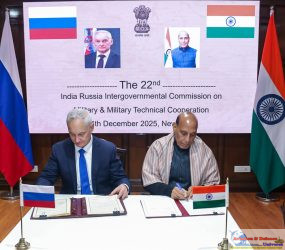
Rajnath Singh emphasised India’s national priority of strengthening indigenous defence manufacturing under the Aatmanirbhar Bharat vision and highlighted the need to expand cooperation into advanced and niche technologies. Minister Belousov, noting the historic depth of the bilateral partnership, stated that the Russian defence industry stands ready to support India’s journey toward defence self-reliance. The two ministers signed a formal protocol outlining ongoing and future areas of cooperation.
 India and Russia’s military-technical cooperation, rooted in the legacy of the erstwhile USSR, has evolved into one of the most enduring and comprehensive defence partnerships in the world. Beginning in the 1960s, when Moscow emerged as New Delhi’s most reliable provider of advanced military hardware, the cooperation has expanded into a vast ecosystem of joint production, licensed manufacturing, technology transfer, and R&D. Over these decades, India has acquired an extensive range of Russian-origin platforms—from aircraft, tanks and submarines to missile systems and naval assets—laying the foundation for a relationship that remains central to India’s defence preparedness. Today, more than 200 industrial facilities across India continue to operate using technologies built with Soviet and Russian assistance, supporting domestic production, repair, overhaul, and lifecycle maintenance of a wide array of military equipment. This includes armoured vehicles, aircraft, naval platforms, anti-tank guided systems, and ammunition of multiple categories. Joint research and development programmes have added a new dimension, enabling both nations to co-create next-generation weapons and systems tailored to evolving operational requirements.
The legal architecture underpinning this partnership has steadily expanded since the end of the Cold War, establishing a robust framework for long-term cooperation. Starting with the 1993 Agreement on Military Cooperation, the two sides put in place successive institutional mechanisms, including the 1996 Defence Ministry–level cooperation agreement and the landmark 2000 agreement establishing the India–Russia Intergovernmental Commission on Military-Technical Cooperation (IRIGC-MTC). Two further agreements—also signed in 2000—secured mutual protection of confidential materials and created safeguards for intellectual property arising from joint projects. Subsequent legal instruments, including the 2005 agreement on IP protection during MTC and the 2017 Roadmap for bilateral military cooperation, broadened and deepened the relationship. These agreements work alongside long-term programmes such as the MTC Programme for 2011–2020, which provided a structured path for procurement, joint production, upgrades, and R&D collaboration.
 At the heart of this framework is the IRIGC-MTC, the principal body that supervises implementation, resolves bottlenecks, and charts future cooperation. By 2018, the Commission had convened 18 times, the last in New Delhi, where both sides signed a protocol transforming the MTC-focused body into a broader Intergovernmental Commission on Military and Military-Technical Cooperation. The next meeting, scheduled in Russia in 2019, was expected to finalise the structure of this expanded mechanism. Russia continues to dominate India’s defence inventory, supplying over 60% of India’s imported military equipment, while also providing critical components and spares for systems under licensed production. In support of this cooperation, high-level interactions and working exchanges have remained intense.
In 2018 alone, India and Russia conducted an extensive slate of military exchanges. Indian delegations travelled to Russia for the Moscow Conference on International Security, naval and army leadership visits, participation in the National Security Week Forum, staff talks between navies, as well as reciprocal visits between naval and land warfare academies. Russia’s prestigious Navy Day parade in St. Petersburg also saw participation from the Indian Navy and its band. On the Indian side, New Delhi hosted staff consultations between the two General Staffs, visits by senior Russian military educators and commanders to Indian institutions such as the National Defence College, the Air Force Academy, and training grounds in Rajasthan, as well as Russian participation in Defexpo-2018. The year also saw Indian teams taking part in the International Army Games competitions—including the Tank Biathlon and Elbrus Ring—while observers attended several other events. Importantly, India for the first time deployed a 200-member contingent to Russia for “Peaceful Mission,” a major SCO multinational counter-terror exercise.
 Bilateral military exercises further anchor the cooperation, with the INDRA series symbolising trilateral jointness across Army, Navy, and Air Force components. In 2018, Russia hosted the first phase of the air exercise “Avia Indra-2018,” while India hosted the “INDRA-2018” ground forces exercise, “Indra Navy-2018,” and the concluding phase of “Avia Indra-2018.” These drills not only enhance interoperability but also diversify the operational experience shared between the two militaries.
Together, these institutional mechanisms, high-level exchanges, joint training exercises, and industrial linkages form an unbroken continuum of India–Russia military-technical cooperation—an enduring partnership that remains central to both countries’ strategic calculations and defence industrial aspirations.
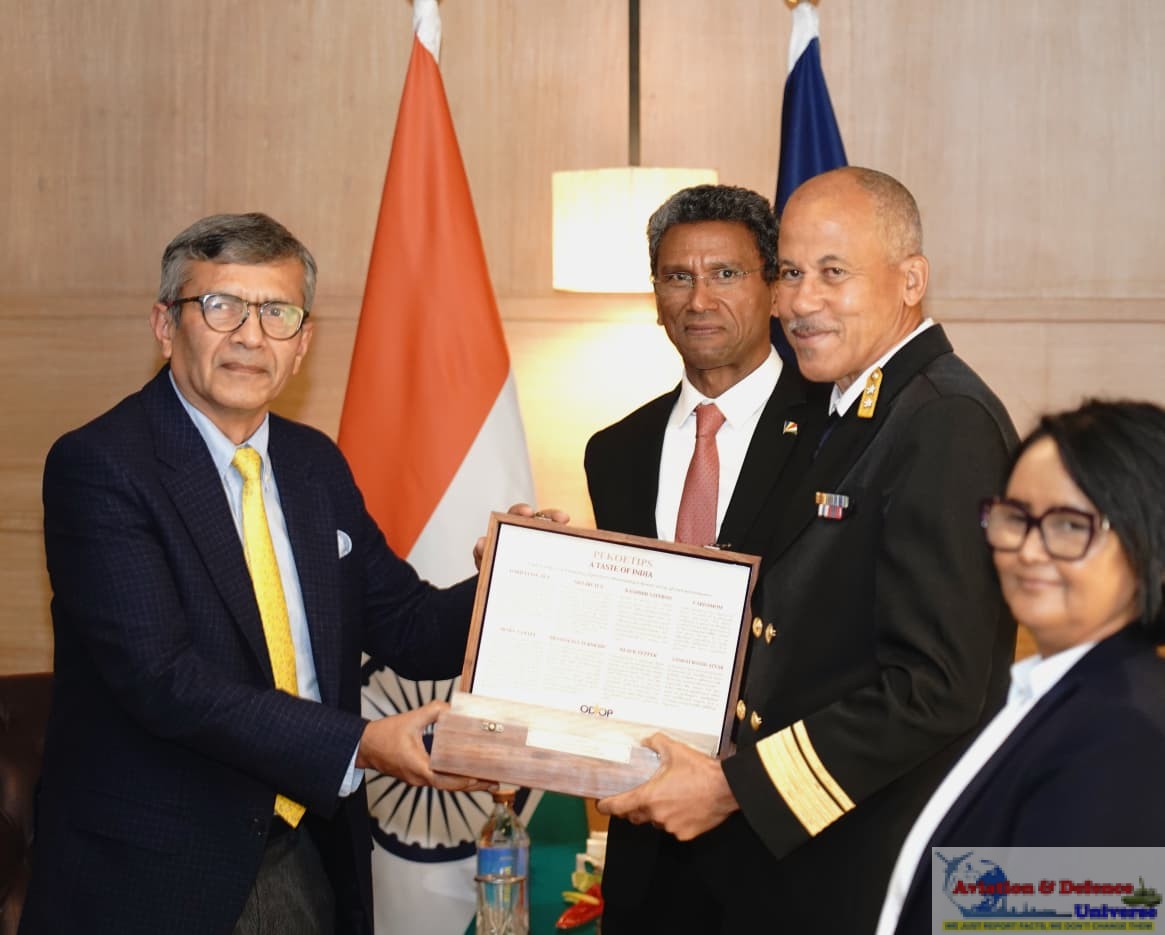
Earlier in the day, both dignitaries laid a wreath at the National War Memorial, New Delhi, paying homage to India’s fallen soldiers. Minister Belousov also inspected a ceremonial Tri-service Guard of Honour.
India and Russia (formerly the Soviet Union) share one of the oldest and most reliable defence partnerships in the world. Since the 1960s, Moscow has been a principal supplier of India’s military platforms—from MiG and Sukhoi fighters to T-72 and T-90 tanks, Kilo-class submarines and missile systems. Co-development milestones such as BrahMos and long-standing cooperation in nuclear submarine programmes cemented the relationship as one of deep strategic trust. For decades, Russian technology and support formed the backbone of India’s armed forces.
 While India has diversified its defence partnerships globally, Russia remains a major pillar in its military ecosystem. Today’s cooperation spans joint production, licensed manufacturing, spare parts support, training, and technology transfers. The IRIGC-M&MTC remains a key institutional mechanism that guides operational cooperation, maintenance agreements, and future acquisitions. The present phase places strong emphasis on local manufacturing, life-cycle support, and the modernisation of legacy Russian-origin platforms. Thursday’s meeting reaffirmed mutual commitment to these shared goals.
The future of India–Russia defence ties is poised to focus on high-tech collaboration, including AI-enabled systems, next-generation land platforms, aerospace technologies, advanced air defence, and maritime capabilities. With India pushing for deeper indigenisation and Russia offering co-production and design support, the partnership is moving toward a co-development model rather than traditional buyer–seller engagement.
Minister Belousov’s assurance that Russia is ready to support India’s self-reliance ambitions, and his invitation to Rajnath Singh for the next IRIGC session in 2026, signal a continued and evolving strategic defence relationship.