








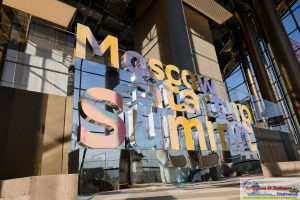
 Moscow is hosting the Moscow Startup Summit, an international summit on tech entrepreneurship and innovation, on October 1–2
The Moscow Startup Summit hosted a session titled “Support and Development of Technology Business in BRICS and SCO Countries: Balancing Interests of Business and Government.”
Aleksey Parabuchev, CEO of the Moscow Innovation Cluster Fund, noted that Moscow emphasizes creating a favorable environment for tech entrepreneurs, encompassing both large businesses and startups. The city has deployed a vast network of venues for piloting innovations, spanning various sectors of Moscow residents’ lives: transport, logistics, healthcare, utilities, and others. Municipal and commercial companies are ready to test new technologies, reducing their time-to-market by a factor of 3-3.5. The speaker stressed that the Smart City SberCity in Rublevo-Arhangelskoye is also an effective testing site widely implementing top innovative solutions.
Bangani Mpangalasane, CEO of The Innovation Hub, reported that startups in South Africa receive tax benefits, registration assistance, incubation support, and help in achieving profitability at early stages. The tech hub he represents spans 60 hectares and collaborates with many countries worldwide, including Russia. Ensuring startups have a “soft landing” is crucial for their entry not only into the domestic but also the global market.
Kirill Zalessky, Minister of Communications and Informatization of Belarus, also emphasized the importance of tech companies entering foreign markets. According to him, in small states like Belarus, it is challenging for startups to succeed. However, through integration structures like BRICS, SCO, and with state support, it is feasible. He also pointed out that the state’s primary role is not to alter the rules or hinder business. Entrepreneurs need assurance that the state will not change its plans for many years to come, rather than tax incentives.
Anna Ryabova, Secretary-General of the Supervisory Council of the Hi-Tech Park Belarus, also participated in the discussion. According to her, the Park has always worked with the boldest and most ambitious projects. Starting with 10 companies, they now have over 1,000, contributing 3% of the country’s GDP and 20% of service exports. Currently, the Park adopts a proactive stance, discovering talented young individuals in schools and universities and supporting their endeavors.
Damirbek Bikulov, Deputy Director of the National Investment Agency under the President of Kyrgyzstan, shared the country’s experience in supporting tech entrepreneurship. Kyrgyzstan plans to achieve a tech breakthrough by embracing openness to technologies, integration with other nations, security, and creating opportunities for merchants. Recognizing that AI is not just a tool but the foundation of future governance, the country is establishing computing centers and developing AI platforms. Over nine months, Kyrgyzstan’s economy grew by 11% compared to the same period last year, partly due to support for tech businesses.
Khalil Suleiman Halilu, Executive Vice Chairman of Nigeria’s National Agency for Science and Engineering Infrastructure (NASENI), emphasized that his country is Africa’s largest economy and one of the continent’s most dynamic. According to him, tech entrepreneurs should be supported mainly in areas that consumers demand, such as food security, energy, and banking technology. For instance, banking apps are widely used and can be exported to other African markets, but this requires adequate infrastructure.
Manpreet Singh, President of the Indian Chamber of Commerce and Industry, noted that chamber companies are present in 42 countries, including Russia. India is a massive market with millions of startups, but not all of them reach commercialization and become giants. This realization is crucial for both the government and entrepreneurs themselves, emphasizing the need for realistic aspirations. According to the speaker, an ecosystem can help bring good ideas to market. When a thousand startups are centralized and their activities are known, it becomes possible to provide tax incentives, offer maturation periods, and support growth—not necessarily to gigantic proportions, but to firmly established businesses.
Alevtina Penkalskaya, an RBC host, moderated the discussion.
October 1-2 sees the Moscow Startup Summit, an international summit on technology entrepreneurship and innovation, held in the smart city of SberCity. The business program features over 60 sessions and addresses by more than 150 experts from Russia and other countries. The summit concludes with the Startup Summit Awards of the Moscow Government and Sber. Over 1,700 submissions were received from 79 regions of the country. On October 2, winners will be awarded in 17 categories—from startups and investors to corporations, universities, and media outlets. The event can be watched live on the official summit website.