























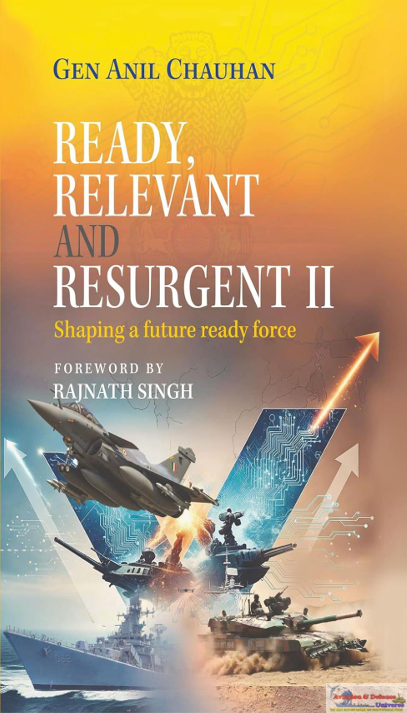
 New Delhi. 29 October 2025. In the first part of the book ‘Ready, Relevant and Resurgent’, CDS, Gen Anil Chauhan, PVSM, UYSM, AVSM, SM, VSM, had laid a visionary foundation for India’s military transformation, drawing timeless wisdom from the Ramayana, Mahabharata, and Arthashastra to blend ancient ethics with modern strategy. He illuminated geography’s strategic role, redefined warfare amid technological revolutions, and championed jointness 2.0 alongside the urgent push for Atmanirbharta. With a clarion call to selflessness, innovation, and youth leadership, the first part inspired both soldiers and citizens to embrace resilience and excellence, setting the stage for a nation reborn.
The second part of the book is a commanding strategic primer for India’s security in the 21st century. The author has seamlessly integrated ancient Indian strategic principles with the realities of modern multi-domain warfare cyber, space, cognitive, and maritime domains. Through incisive analysis and actionable insights, it
challenges policymakers, military leaders, analysts, and citizens to confront evolving threats and rethink national security frameworks, from integrated border management and defense self-reliance to space diplomacy and youth-driven innovation. Far more than a theoretical exercise, it serves both as a strategic audit and an execution plan, offering a clear, decade-long vision for building a resilient, sovereign, and technologically advanced India.
Understanding War: Its Evolution and Future
 The opening section that spans across nine chapters, delivers a concise yet profound examination of how the character of conflict is transforming. It compels a reassessment of national policy and resource allocation. The chapter on Military Strategy demands an immediate review of security frameworks. It serves as a strategic audit for decision-makers. The discussion in Wars with Clausewitz’s Percepts adeptly modernizes classical principles for the complexities of contemporary domains and technologies, demonstrating that foundational strategy remains relevant when adapted to the contemporary realities. Future Wars and Indian Armed Forces chapter functions as a strategic threat assessment. It offers precise insights that equip analysts and policymakers with the vocabulary and frameworks to articulate India’s evolving security landscape. The chapter on Military Staff System: Way Forward for Indian Armed Forces provides essential guidance on achieving the jointness and integration required for high-level decision-making. The chapter on Air Power and National Security is an indispensable one for those focused on aspects of warfare related to aerospace domain. It outlines the strategic adjustments necessary to secure air superiority and space dominance in contested Anti-Access/Area Denial (A2/AD) environments. The chapter on Cyber Space: A New Frontier of Warfare delivers a stark warning, urging immediate audits of network security and critical infrastructure across government and industry. The threats described underscore their direct impact on national and economic stability. The chapter on Space Enabled Operations, presents a compelling case for recognizing
space as a war fighting domain rather than merely a support function, with far reaching implications for R&D priorities and foreign policy. Future Wars and the Relevance of Indian Principles of War is the one demonstrating how ancient texts continue to inform modern targeting algorithms and decision-making frameworks, affirming the enduring value of cultural strategic heritage. Chapter dealing with
Cognitive Warfare emphasizes the need to dominate the information environment and decision-making cycles, serving as a critical reference for media and information professionals. Collectively, these chapters argue persuasively for a comprehensive overhaul of India’s national security doctrine to address multi domain realities.
The Building Blocks
 This section transitions from conceptual analysis to structural implementation, detailing the systems, institutions, and capabilities that must be developed, preserved, and leveraged. Frontiers Borders, Et Al provides a definitive framework for integrated border management, translating sovereignty into operational resilience and deterrence that is essential for regional stability. Preserving India’s Military Heritage is one more important chapter that underscores the importance of institutional ethos, historical consciousness, and national character in sustaining effectiveness amid technological advancement. The chapter on Great Game in the IOR maps the maritime competition in the Indian Ocean Region and India’s central role in shaping its future. Charting a Comprehensive Vision of Security in the Indo Pacific, this one illustrates how diplomatic, economic, and regional engagements can be converted into strategic leverage. The paired chapters Military Space Culture and Military Space Diplomacy highlight the need for a new technical workforce and the use of soft power to secure critical space assets and partnerships. Indian Defence University: Sine Qua Non of Defence Reforms offers a clear blueprint for an integrated institution to cultivate joint leaders and break down silos across government, military, and academia. Empowering India’s Defence Industry Future presents a practical, self-reliant roadmap that links industrial growth to war fighting capability and economic development. Together, these chapters provide a ten-year architectural vision for a secure and capable India.
Leadership in Military Eco-System
The concluding chapters focus on human capital i.e., the leaders, innovators, and citizens who are essential to execute the national strategy. Military Leadership in an Evolving Landscape of Warfare outlines the specific skills, attributes, and mental models required for success in complex environments, serving as a professional development guide across sectors. Emerging Role of the Young Entrepreneurs in the
Nation Building is one such chapter that advocates for the integration of agile startups into the defense and technology ecosystems, recognizing their role in driving rapid innovation. Inspiring Young Indians chapter reframes the contributions of youth, connecting individual career paths and technical expertise to the broader narrative of national renewal and technological leadership.
To sum up, this volume is more than just a military sequel. It is a national strategic primer and an execution plan. While the first part provided directional vision, this one delivers actionable clarity for citizens, policymakers, and strategic thinkers alike. It synthesizes ancient wisdom, modern technology, and geopolitical realities into a cohesive framework. I recommend this book to everyone irrespective of their
background who seeks to understand India’s security architecture. This book is an indispensable and immediately relevant resource. It will reshape perspectives on national security and deserves a place on the shelves of professionals across government, industry, academia, and civil society.
Review by
Vinayak Kumbar
Technical Research Assistant, CENJOWS