
















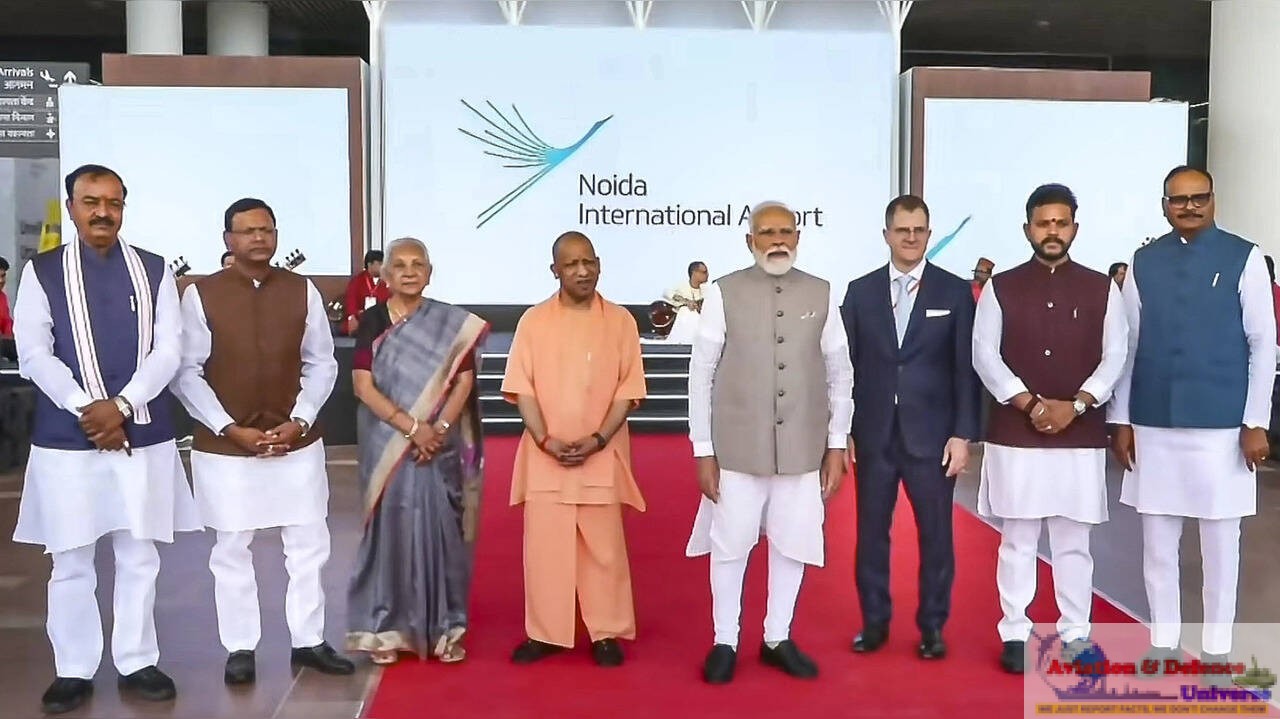
- CM UP Yogi Adityanath led the host team
- MoCA K Ramamohan Naidu adds another feather to his brimming cap
By Sangeeta Saxena
New Delhi. 28 March 2026. Prime Minister Narendra Modi inaugurated the first phase of the Noida International Airport at Jewar on marking a landmark moment in India’s aviation and infrastructure journey. Located in Gautam Buddha Nagar district of Uttar Pradesh, the airport is set to become a major gateway for the National Capital Region (NCR) and a key driver of economic growth in northern India.
This represents a significant turning point in India’s civil aviation journey. More than just an addition to airport capacity, it reflects the country’s shift toward building large-scale, future-oriented aviation infrastructure. By introducing a second international gateway for the Delhi-NCR region, the airport not only addresses congestion challenges but also strengthens regional connectivity and logistics capabilities. Its design as an integrated, multi-modal transport hub highlights a broader vision of linking aviation with economic development. In essence, Jewar airport stands as a symbol of India’s ambition to create a modern, decentralised aviation network that supports growth, accessibility, and global competitiveness.
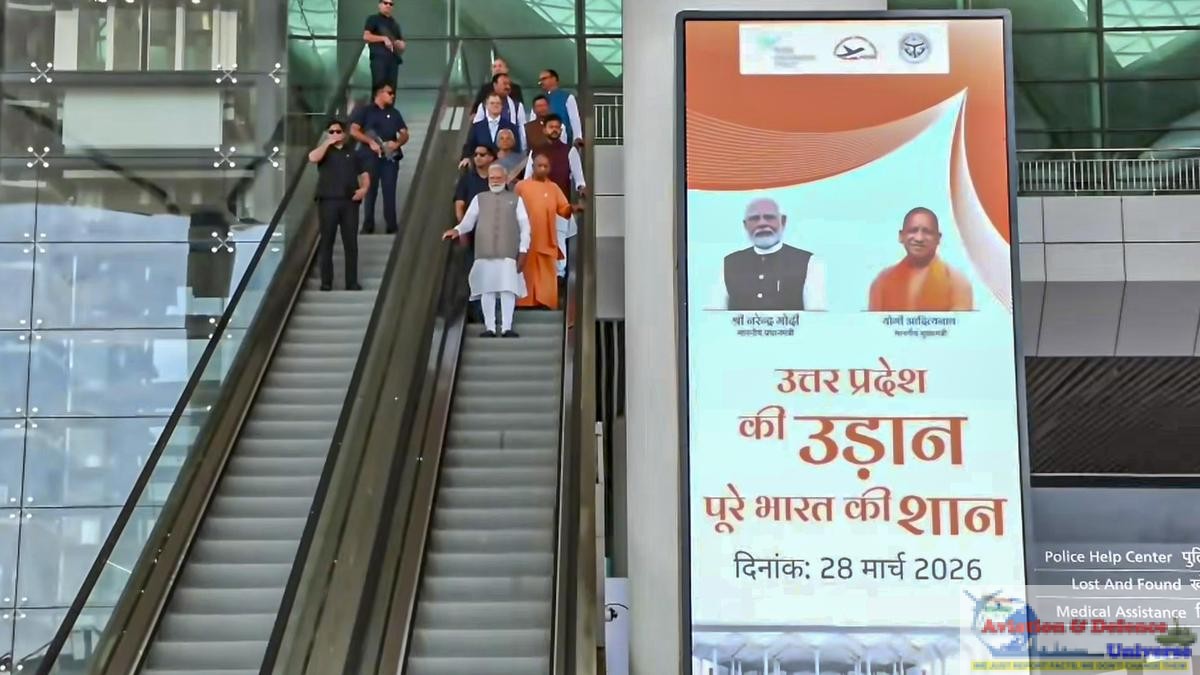
The ceremony, attended by Uttar Pradesh Chief Minister Yogi Adityanath, Union Civil Aviation Minister Kinjarapu Ram Mohan Naidu and other dignitaries, was conducted amid extensive security arrangements and large public participation. The Prime Minister also undertook a walkthrough of the terminal building before formally inaugurating the airport and addressing a public gathering.
Prime Minister Narendra Modi reiterated the transformative significance of the Noida International Airport inauguration, stating, “The inauguration of Phase-I of Noida International Airport marks a major step in Uttar Pradesh’s growth story and India’s aviation future. Noida International Airport will connect north India to the entire world and it will become an airport from where a flight will take off every two minutes. From here, aircrafts will fly around the world, and along with this, it will also become the symbol of the flight of developed Uttar Pradesh. I would like to congratulate the people of Uttar Pradesh, especially the people of West Uttar Pradesh, for this magnificent airport. This entire region is going to benefit greatly. This airport is going to bring many new opportunities for the farmers, small and medium-sized businesses and the youth of West UP.”
Beyond inaugurating the airport, the Prime Minister also laid the foundation stone for a 40-acre state-of-the-art Maintenance, Repair and Overhaul (MRO) complex and an Integrated Cargo Terminal (ICT) being developed by AISATS, positioning Jewar as a major aviation and logistics powerhouse for North India. As one of the country’s largest greenfield airport ventures, the first phase of the Noida International Airport has been built with an investment of nearly ₹11,200 crore under the Public-Private Partnership model. The scale of ambition is equally striking—the airport begins operations with the capacity to handle 12 million passengers annually, but its long-term master plan allows expansion to an impressive 70 million passengers per year, signalling not just an airport, but the rise of an integrated aero-logistics and economic hub for the future.
Uttar Pradesh Chief Minister Yogi Adityanath exhorted, “Prime Minister, over the last 11–12 years, you have taken significant steps to move ‘New India’ toward the goal of a ‘Developed India’ across every sector. The Noida International Airport is a vital part of this journey. The people of Uttar Pradesh are now providing the nation with a new direction on the global aviation map, fulfilling your vision. Due to the rapid development witnessed by the country over the last 12 years and by Uttar Pradesh over the last nine years, we are breaking through those bottlenecks and presenting a new identity to the world.”
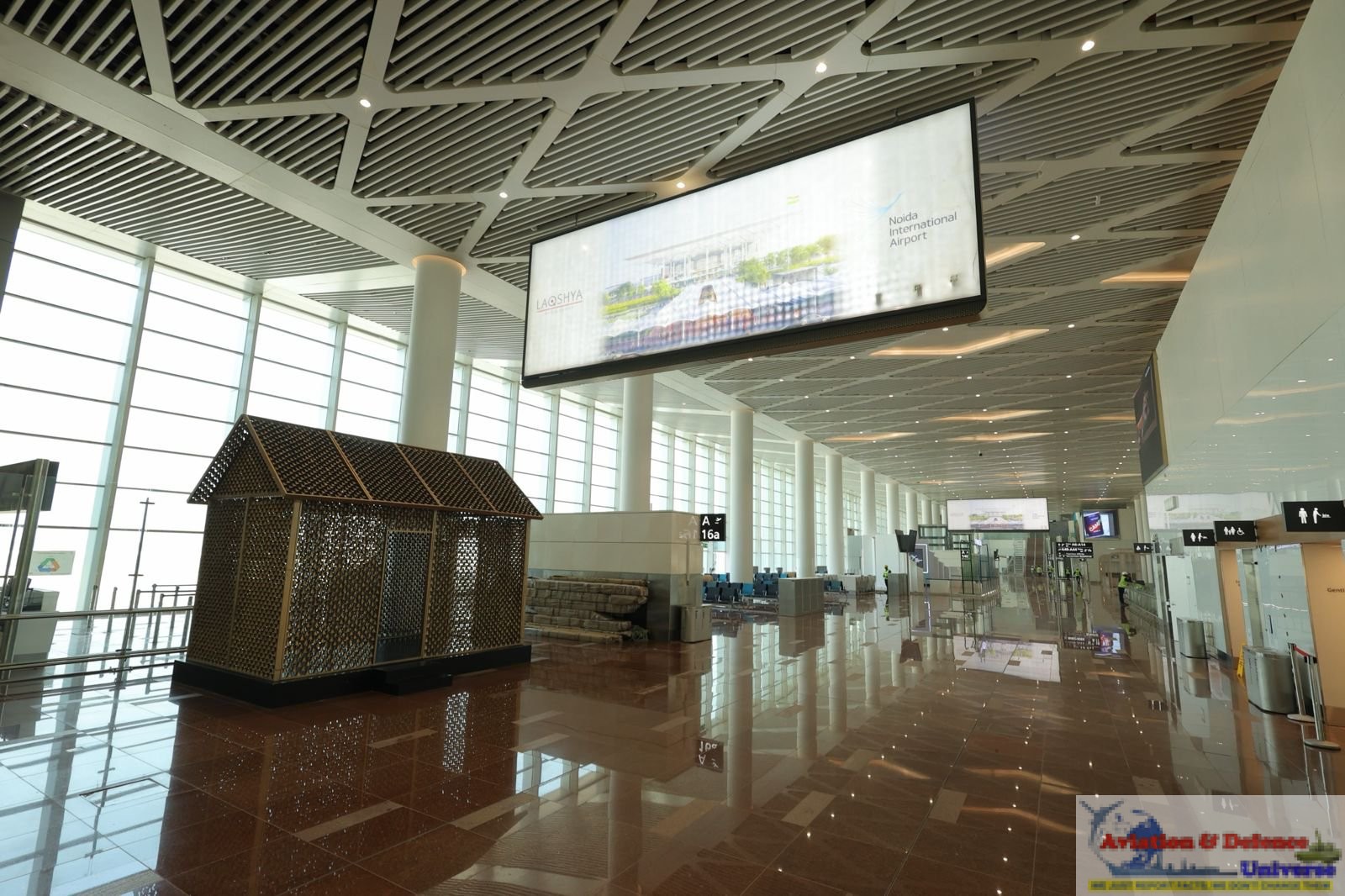
The Noida International Airport is one of India’s most ambitious greenfield aviation projects and is expected to significantly ease congestion at Indira Gandhi International Airport, which has long handled the bulk of air traffic in the region. Phase I of the airport introduces substantial passenger and cargo handling capacity, along with modern infrastructure designed to support future expansion. The project is planned as a multi-modal transport hub, integrating road, rail, and metro connectivity, thereby enhancing accessibility across the NCR and adjoining regions.
At the inauguration of the Noida International Airport, Union Civil Aviation Minister K. Rammohan Naidu highlighted the project’s scale and long-term impact, stating, “The first phase of the airport, with its 4 km-long runway, built at a cost of around ₹11,200 crore, is fully equipped for international air travel. The air cargo services from the airport will ensure that locally manufactured products will be able to reach around the world, while the aircraft maintenance, repair and overhaul facilities spread over 40 acres will create employment opportunities for local people. The impact of the UDAN scheme in boosting the aviation sector has already been significant, and it has now been further strengthened for the next decade. The benefits of Jewar airport will reach the common citizens of the country, because for the Prime Minister, the common citizen is special.”
Strategically, the airport is expected to play a crucial role in boosting logistics, trade, and tourism. Its development is also likely to catalyse growth in sectors such as real estate, manufacturing, and services across western Uttar Pradesh. Analysts believe the project will generate large-scale employment opportunities and position Jewar as a new economic hub in the region. In the long term, the airport is envisaged as one of Asia’s largest aviation hubs, with plans to expand to multiple runways and significantly increase annual passenger capacity by 2040.
After the inauguration, PM said, “The Noida, which was once left to its own due to superstition, out of fear of losing elections, previous rulers were afraid of coming here. I remember when the Samajwadi Party government was in power, and I made a plan to visit Noida; the Chief Minister was so scared that he did not follow through with that plan. People tried to scare me too… I said, ‘I am going to seek the blessings of this place, which will give me the strength to serve until the end of my life.’ Now, that area is ready to welcome the whole world. This entire region is fulfilling the selfless resolve of India.”
The first phase of the airport, with its 4 km-long runway, built at a cost of around ₹11,200 crore, is fully equipped for international air travel,” Naidu said. The Minister said that the air cargo services from the airport will ensure that locally manufactured products will be able to reach around the world. He added that aircraft maintenance, repair and overhaul facilities spread over 40 acres will ensure jobs for the local people. He also highlighted the impact of the UDAN scheme in boosting the aviation sector and said it has been further strengthened for the next decade. “The benefits of Jewar airport will reach the common citizens of the country, because for the Prime Minister, the common citizen is special,” he said.
A major highlight of the Noida International Airport’s first phase is its advanced cargo ecosystem, anchored by the Integrated Cargo Terminal (ICT) and the Integrated Warehousing & Logistics Zone (IWLZ), which together offer an initial handling capacity of nearly 2.5 lakh metric tonnes annually, scalable to an impressive 18 lakh metric tonnes per year in future phases. Managed by AISATS—the joint venture between Tata-owned Air India and SATS—the facility is designed to handle general cargo, e-commerce shipments, and courier logistics with high efficiency, supported by 19 truck docks, 9 X-ray machines, and advanced COSYS+ automated real-time tracking systems. Its strategic location along the Yamuna Expressway ensures rapid connectivity to Delhi NCR, Agra, and Mathura, while future integration with the Delhi–Mumbai rail corridor will further strengthen multimodal logistics access. Built with a sustainability-first approach, the cargo terminal combines fast, technology-driven freight movement with low-carbon infrastructure, reinforcing the airport’s broader ambition of achieving net-zero operations.
The inauguration of the Noida International Airport marks a defining moment in India’s aviation growth story. Beyond adding capacity, it signals a strategic shift toward building world-class infrastructure that supports economic expansion, regional connectivity, and global competitiveness. As India continues its journey toward becoming a major aviation hub, projects like Jewar airport will play a critical role in reshaping the country’s air transport landscape—reducing congestion, unlocking new growth corridors, and strengthening India’s position on the global aviation map.
Uttar Pradesh’s transformation is one of the most compelling development stories in contemporary India. Once burdened by the old BIMARU tag—a label associated with slow growth and weak infrastructure—the state is now steadily redefining its identity through expressways, airports, industrial corridors, defence manufacturing hubs, and digital governance. The emergence of projects like the Noida International Airport at Jewar symbolises a new confidence: Uttar Pradesh is no longer seen as a lagging state, but as a driver of national growth and investment. With its scale, young population, improving connectivity, and rising industrial ambition, the state is moving decisively forward, leaving behind outdated perceptions and positioning itself as one of India’s most dynamic engines of progress.