
















- IdeaForge Showcases India’s Battle-Tested Drones at DSEI 2025
- Switch, Netra, Zolt – IdeaForge Brings India’s Indigenous Drone Power to London
- From Operation Sindoor to DSEI 2025. IdeaForge’s Ankit Mehta on India’s UAV Success Story in a one on one with ADU
By Sangeeta Saxena
Excel Centre, London. 11 September 2025. Under the Indian government’s Make in India initiative, indigenous drone manufacturing has transitioned from prototypes to combat-ready systems. With Make-II programmes, indigenous firms like ideaForge are not only addressing national security needs but also positioning themselves for exports. The development of platforms like Zolt demonstrates how Indian industry is innovating multi-role, modular drones that meet modern military requirements while contributing to India’s emergence as a drone manufacturing hub.
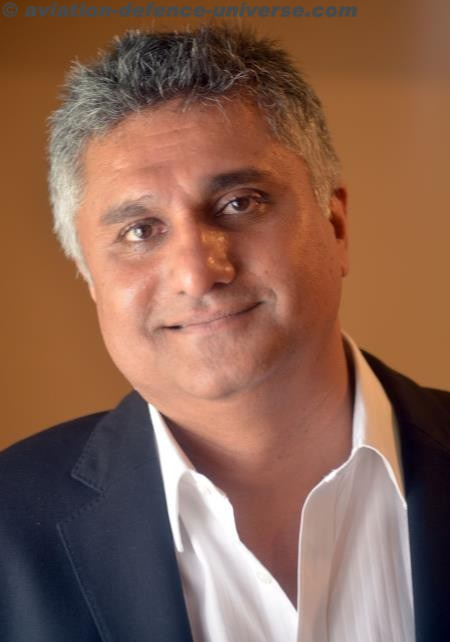
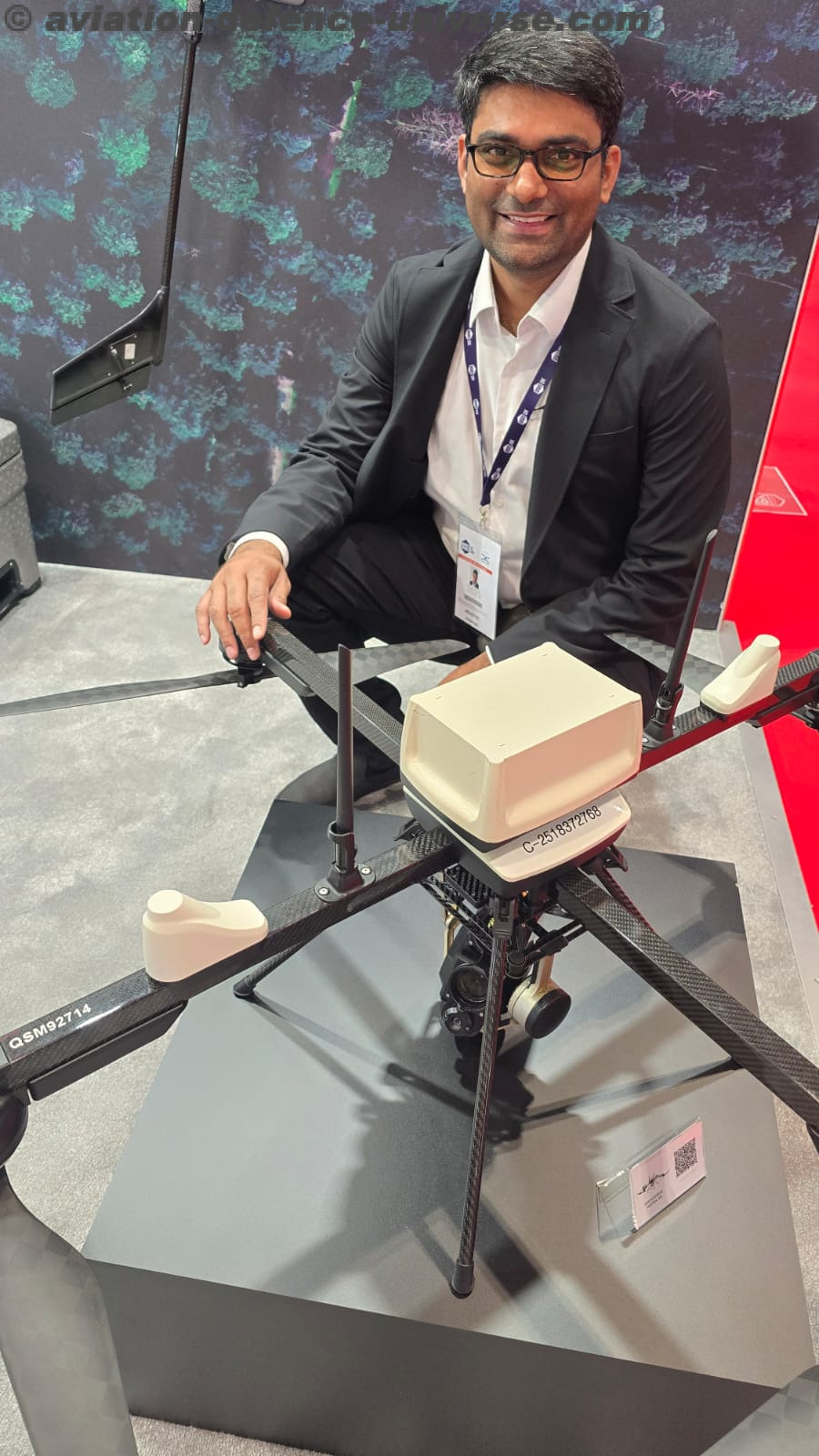
At DSEI 2025 in London, Indian drone manufacturer ideaForge stood out with its cutting-edge unmanned aerial platforms, showcased both in the US & Canadian Partnership Pavilion and the India Pavilion. Known for their battle-tested drones like Switch, Netra, and Zolt, ideaForge has been central to India’s indigenous drone ecosystem. ADU sat down with Ankit Mehta, CEO & Co-Founder of ideaForge, to discuss the company’s global presence, its operational role in India’s military engagements, and the future of Indian drone manufacturing under Atmanirbhar Bharat.
ADU. Ankit, welcome to DSEI 2025. Could you tell us why ideaForge is present at both the US/Canadian pavilion and the India Pavilion?
Ankit Mehta. Thank you. We are here in the Canadian pavilion primarily because of our North American partnership with Volatus. We’ve done successful demonstrations with them, proving the resilience and reliability of our platforms. Our products are being pitched across multiple opportunities in the US, and we felt that our technology represents some of the most potent dual-use and battle-tested platforms to display at this exhibition. And most importantly be able to demonstrate the fact that when we say that we do something, we actually deliver that on ground. So that’s one of the very strong reasons for a lot of our partners to trust us even in the US. Our products are being pitched in many opportunities along with them.
And when they decided that they want to participate in this event, we believe that our technology is one of the most potent technologies to demonstrate and display over here. Because we have not just particularly in DSEI come with the experience of doing a dual use surveillance or a geospatial platform. But now with whatever has happened in India, our platforms are battle tested at Op Sindoor as well, and the platforms now offer the ability to do EW resilience in an unprecedented way.
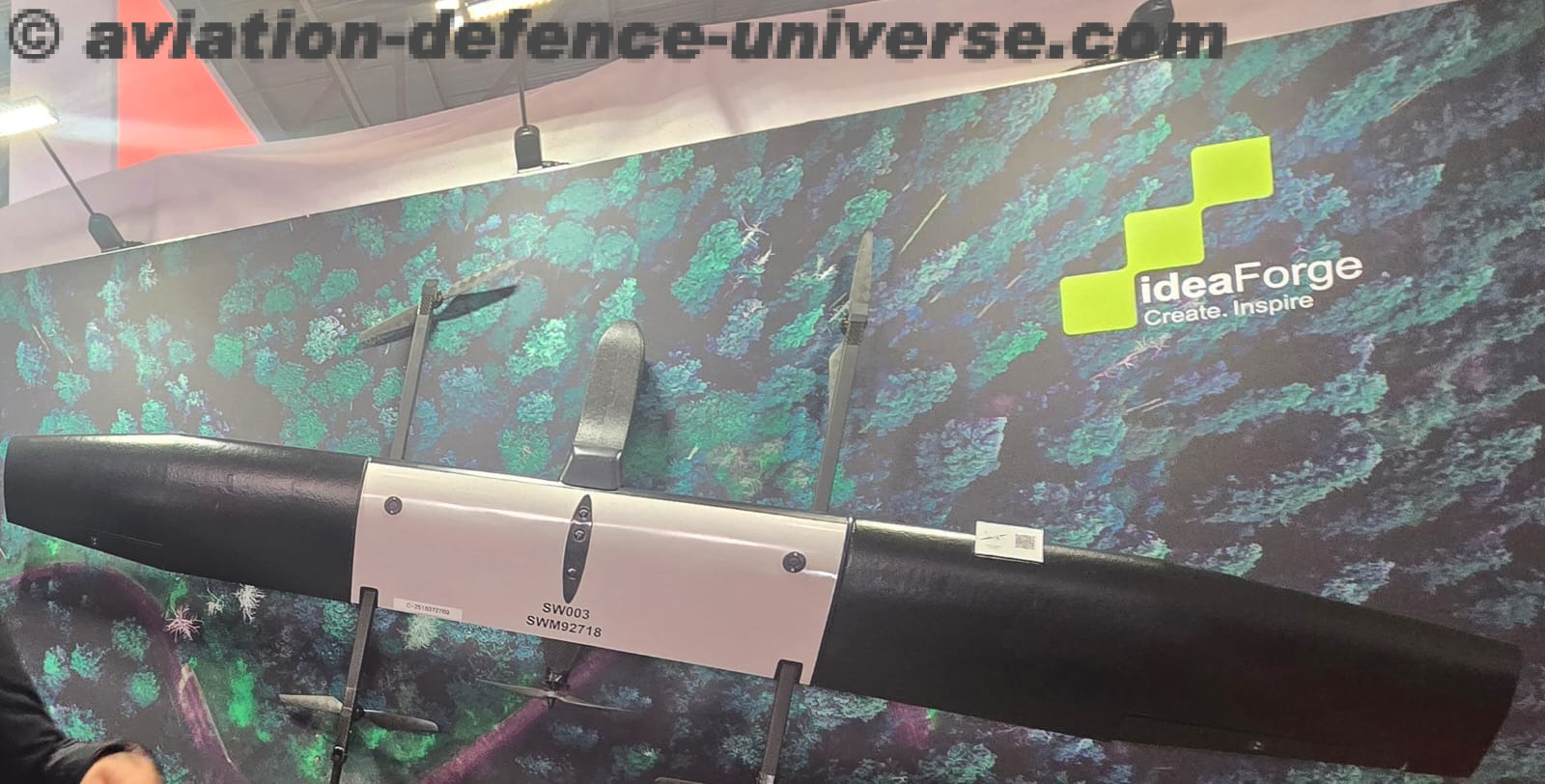 ADU. Let’s talk about your flagship platform, Switch. What makes it unique in India’s operating environment?
Ankit Mehta. Switch has been our flagship eVTOL platform since 2014–15, designed with separate lift and propulsion systems. We built it because India’s terrain and high-altitude environments are very demanding and not always suitable for hand-launch systems. Switch can operate at altitudes above 5,000 metres, in extreme temperatures down to minus 30°C, and has proved itself in real combat scenarios . It is resilient against electronic warfare (EW) jamming and has become a daily driver for our armed forces.
ADU. Netra has also been a key part of your portfolio. How does it complement Switch?
Ankit Mehta. Netra, our quadcopter platform, is extremely versatile. It can take off at altitudes above 6,000 metres, provide high-quality last-mile imagery, and operate in even more challenging environments than Switch. It is multi-role, capable of payload drops, carrying LIDAR, geospatial mapping sensors, and EW resilience. Like Switch, Netra can function in GPS-denied and communication-denied environments. This makes it a comprehensive solution for modern battlefields.
ADU. Zolt is turning heads at the India Pavilion. What makes it different?
Ankit Mehta. Zolt is our armed UAV, designed as a multi-role platform beyond Switch’s range. It carries up to 10 kg of payload with 3 hours of endurance, or can be configured for 6–8 hours of surveillance. It was developed under Make-II programmes to support capabilities like swarming, precision payload delivery, and ISR. While optionally armed, it offers modular flexibility for both surveillance and tactical missions.
ADU. And that is an armed one. It’s really catching eyeballs. So, you know, specially for Indians who come at the pavilion, they realise that they are seeing something like this for the first time. So tell us more about it.
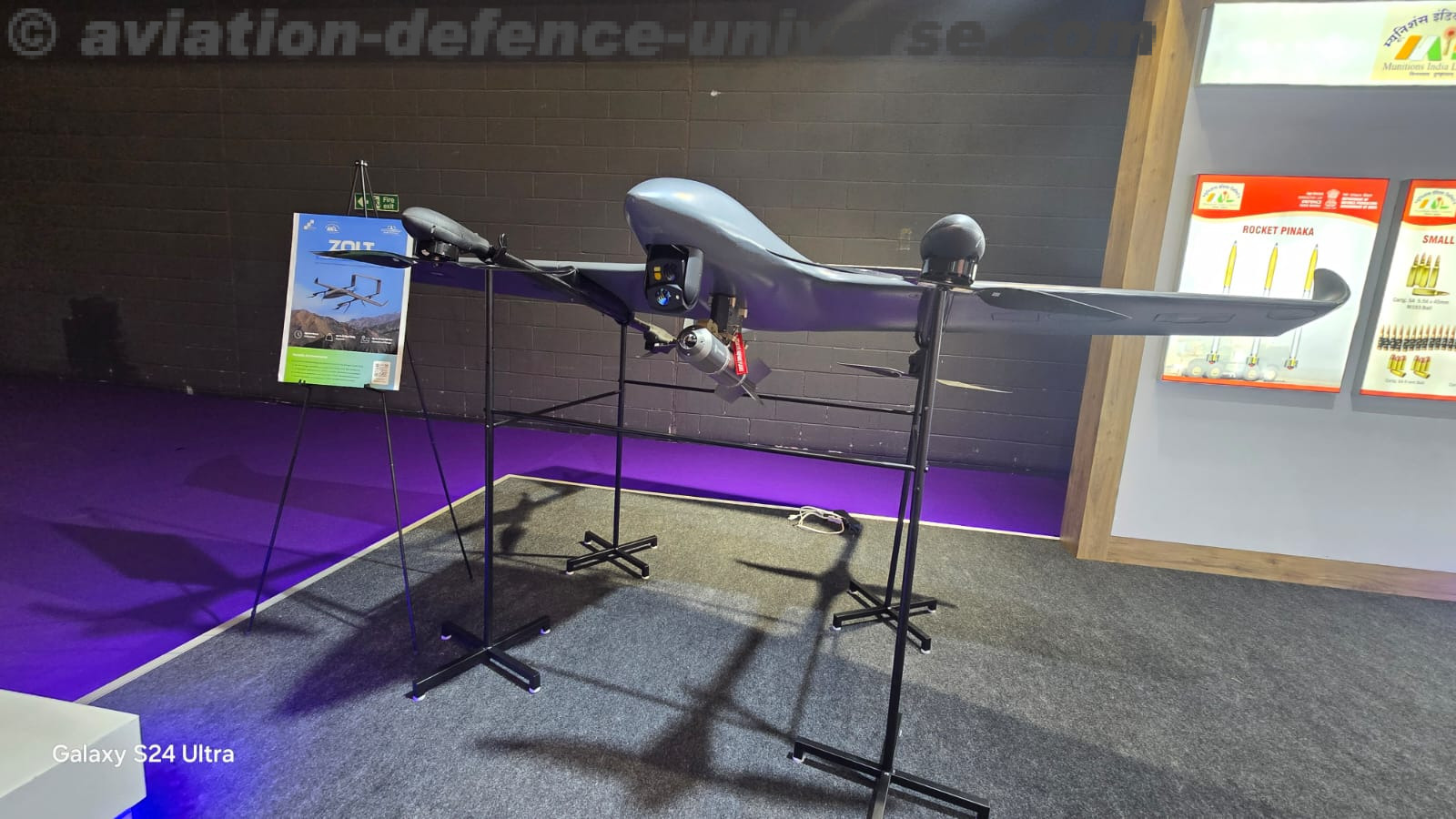 Ankit Mehta. Essentially, when we were looking at what’s the next class of platforms we want to build beyond Switch, it was obvious for us that whatever we build has to be multi-role. And there were many opportunities like the opportunity in the Make 2 programmes for us to build unique capabilities that could meet the vast requirements of both doing surveillance or picking up targets.Also doing precision payload delivery in the form of various assets that we saw on the booth there as well. And of course there are multi-roles that it can play in the geospatial world as well. And delivery.
So when we looked at a platform capability and class, we were very clear that we wanted to build something that can go beyond the operating range of Switch. That can carry more payload and be able to do more flight time. And ZOLT is trying to bridge that gap in a very, very effective manner by allowing you to do up to 10 kgs of payload with a 3 hour flight time. And is able to convert that 10 kg payload into a hybrid pod that can also do 6 to 8 hours of flight time for surveillance activity. So it is capable of doing a lot of flexible, modular operations. And those operations become very effective and useful for us to do.
ADU. Right, absolutely. And because it’s an armed version, so I will presume that there is a demand post-op Sindhu for such advancement on technology of drones. And is it already with the, are you in talks with the Indian Armed Forces for it? It’s a platform that is optionally, you can put a payload on it.
 Ankit Mehta. And it was already something that we were designing for many Make-2 programmes. And those Make-2 programmes demand for us to offer capabilities like swarming, payload delivery, etc. So that way it was something that we were building. And a lot of technologies of that class cannot be built as a reactive opportunity. For EW Resilience, we were planned 2-3 years prior to the incident. We have been developing that capability because we knew the time for that capability is here and now. Given what was happening in the conflicts in Europe and other parts of the world. Predictive upgradation basically. So we were very clear that we will have to build those capabilities.
We spent those 2-3 years of building the platform as well as building the EW resilience capabilities. And lo and behold, Opsindoor came. And the deployment of it will now accelerate because now the demand and the conditions have become real on ground.
ADU. How do you see the global response to ideaForge at DSEI 2025?
Ankit Mehta. The response has been fantastic. We’re meeting potential European partners and generating renewed interest thanks to the success of our drones in Operation Sindoor. Our North American partner Volatus is distributing our products in Canada, the US, and other markets, and we are seeing growing opportunities globally. DSEI has been a great platform to showcase India’s indigenous drone capability to the world.
 The Indian drone industry has grown rapidly over the past decade, supported by government reforms, defence modernisation, and the Drone Rules 2021. Indigenous companies like ideaForge have pioneered platforms that match global standards while addressing India’s unique geographic and operational challenges. This growth has been further accelerated by defence requirements, start-up innovation, and the strategic push under Atmanirbhar Bharat.
They have already played critical roles in live operations such as Operation Sindoor and high-altitude deployments along the Line of Actual Control. Platforms like Switch and Netra have provided vital ISR, target identification, and EW-resilient surveillance, enabling India’s armed forces to act decisively. These real-world deployments have validated indigenous drone capabilities and increased global confidence in Indian platforms.
At DSEI 2025, ideaForge demonstrated why India’s indigenous drone ecosystem is gaining international recognition. With its battle-tested Switch, versatile Netra, and modular armed UAV Zolt, the company is meeting the demands of modern warfare while actively pursuing global partnerships. As Ankit Mehta highlighted, the future of drones lies in resilience, modularity, and adaptability—principles that ideaForge has embedded in its platforms. The company’s journey reflects not only the rise of Indian drone technology but also the broader ambitions of Atmanirbhar Bharat.
As told to Sangeeta Saxena