


 Raksha Mantri Rajnath Singh to represent India at SCO Council of Heads of Government Meeting in Tajikistan





-By Our Special Correspondent
Manesar. 16th October 2015. Raised in 1984, following Operation Blue Star and the assassination of Indira Gandhi, for combating terrorist activities with a view to protect States against internal disturbances, National security Guard(NSG) on its 31st raising day is all set to deploy its women commandos for anti-terror operations for the first time.
 Director General, NSG RC Tayal emphasised on the constant need to upgrade both techniques and tactics in order to face the new challenges and highlighted various modernisation and upgradation initiatives undertaken by NSG during the last one year. These included enhancement of surveillance capabilities, strengthening of the Regional Hubs, conduct of joint training of NSG with Special Forces of other countries, review of VVIP security issues and capacity building of State Police as a first responder by conduct of Joint Training exercises. The Director General assured the Nation that NSG was ready to tackle terrorism in all its manifestations.
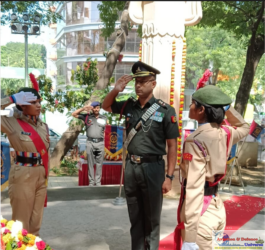
The Minister of State for Home Affairs Kiren Rijiju took the salute of the parade at NSG headquarters in Manesar, Gurgaon . Addressing the gathering, he assured the Force of the government’s commitment to meet its critical requirements.
NSG is under the authority of Ministry of Home Affairs (India), however it is not categorised under uniform nomenclature of Central Armed Police Forces. It has a special forces mandate, and its core operational capability is provided by Special Action Group (SAG) which is drawn from Indian Army. The Special Rangers Group (SRG), the police component of NSG, which also handles VIP security, is composed of personnel on deputation from other Central Armed Police Forces-State Police Forces.
 The head of NSG, designated as Director General (DG), is selected by the MHA-Home Minister. Since its raising in 1984, the NSG has had 28 DGs, in 31 years, with an average tenure one year and few months. Many have served as DG just for few months, while waiting for promotion or a more desirable post. None of the DGs has had experience of commanding NSG special actions groups, or any other special forces command experience . All the selected DGs have been officer from Indian Police Service (IPS). As per the government policy, NSG is to be headed by an Officer from IPS. Since the Combat Units under the NSG, which conduct counter terror operations are commanded by the Army Officers, this effectively negates the possibility of any officer with experience in terror operations heading the organisation as its DG at a later stage. This definitely needs to be looked into.
The list of achievements of the NSG is long but so is the list of their needs. They slither down from a helicopter but have no choppers of their own to get trained on. The force is dependent on loaned ones for regular training, which is sad keeping in mind their requirement of practice of slithering.
 Guns, rifles, small arms, night vision devices all have taken their own time to be a part of the NSG inventory and the government needs to sit up think of how to fulfill the needs of the elite force as soon as possible.
Selection is demanding and has a drop out rate of about 70–80 percent. Three of their 14 months of training in Manesar, Haryana, are devoted to the basics. The basic training period lasts 90 days. Physical fitness training has 26 elements, ranging from an cross-country obstacle course to jumping from heights and across divides and scaling different kinds terrain. One endurance test involves martial arts, target shooting at the end of an obstacle-ridden cross-country run. This is meant to gauge the candidate’s performance under conditions of stress and exhaustion. Those who successfully complete the tests are sent for nine months of advanced training.
 The SAG is the main offensive or the strike wing of the NSG. Its members are drawn exclusively from the Indian army. The SAGs includes headquarters, support units, and training wing. The training of both the action and ranger group is conducted by the officers and NCOs drawn from the army. There are two SAGs – 51 Special Action Group and 52 Special Action Group. The two SAGs (51 and 52) are tasked for counter-terror and counter-hijack operations respectively. The smallest operation sub unit of the SAG is called “hit”, usually commanded by an NCO. A “hit” has five members – two pairs, or buddies, and a technical support member. Four hits make a team. A team is commanded by a Captain. In hostage rescue operations, depending on the situation, team size may vary between 50 to 90 NSG personnel. For immediate transport airlift IL-76MD strategic transport aircraft are stationed at New Delhi’s Palam Air Force Station and are ready to deploy within 30 minutes.
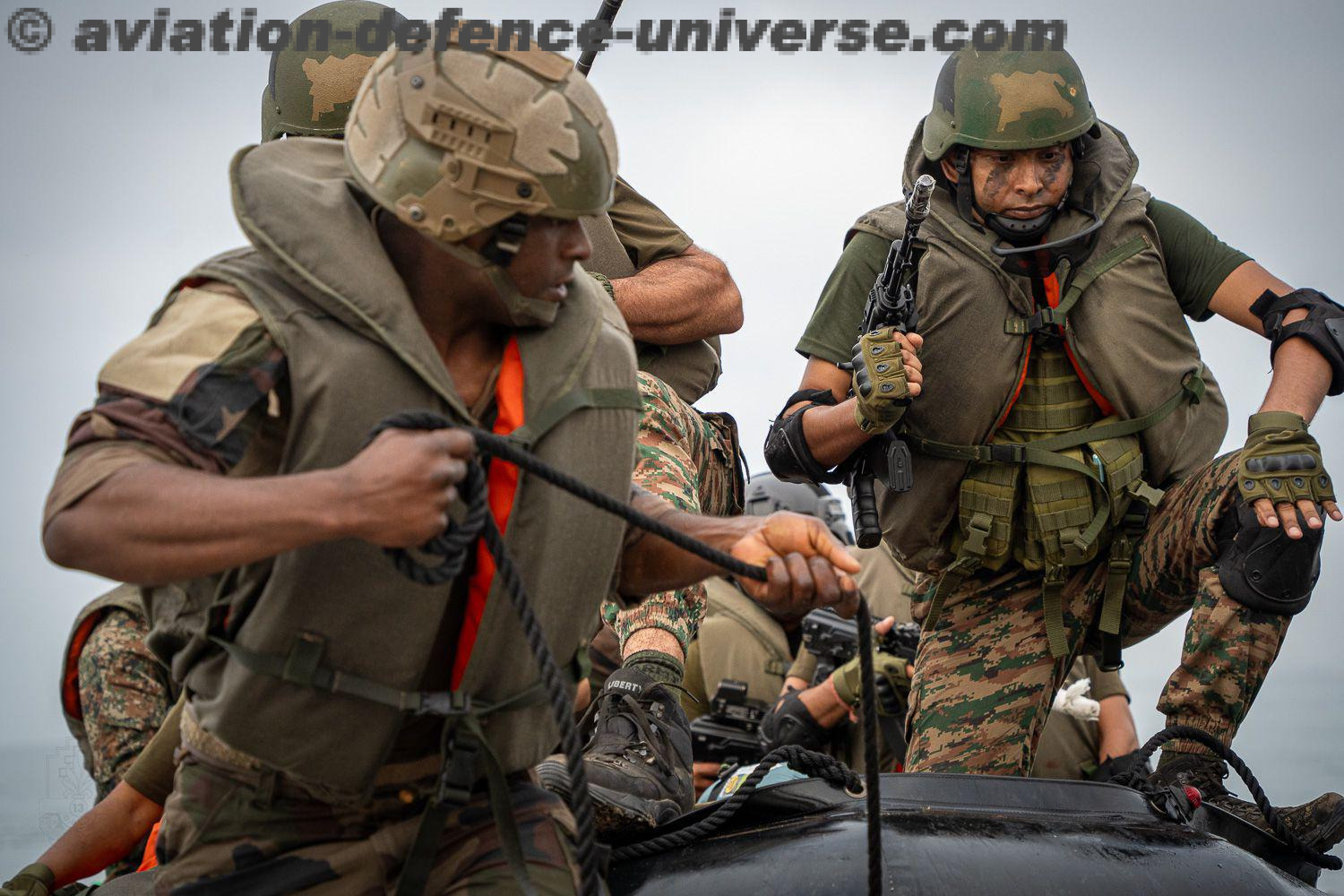
NSG Commandos presented a thrilling demo on the operational capabilities of the Force including VVIP security drills, K-9 Dog show, Aircraft intervention, Paramotor sailing, Free Fall and various Small Team insertion techniques.
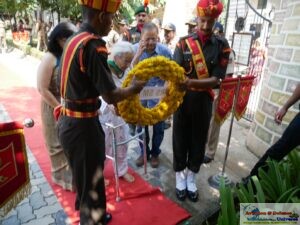
On the occasion, Rijiju felicitated the awardees of President’s Police Medal for Meritorious Service, the Best Commando, Shooter and Trainer and Next of Kins of the NSG Martyrs. He also unveiled the “The Black Cat Journal” special issue-2015.
He later visited the Prerna Facilitation Centre which was started by NSG Wives Welfare Association (NWYA) for providing rehabilitation facilities to special children of NSG personnel on October 16, 2014. The facilitation Centre is equipped with State-of-Art equipments and highly skilled therapists and Counsellors. Presently, 39 children including 10 children from neighbouring villages are availing therapy at the Centre.























































-A4-Size-(2)_page-0001.jpg)