


















- William Boeing’s baby zooms ahead into the 2nd century
- A salute to its history
By Team ADU
Farnborough, UK. 15th July 2016. It has indeed been a century of the survival of the fittest. In March 1910, when William E. Boeing bought Heath’s shipyard in Seattle on the Duwamish River, which later became his first airplane factory and incorporated it on 15th July 1916 as “Pacific Aero Products Co”, little would he have imagined that the baby he nurtured would become a giant one day and the legacy he would leave would become synonymous with the aerospace industry when the world would celebrate its 100th birthday.
From workers who assembled in a lakeside hangar located on the northeast shore of Seattle’s Lake the first Boeing airplane, its workers today not only build passenger planes, helicopters, fighters but also send astronauts to the moon .
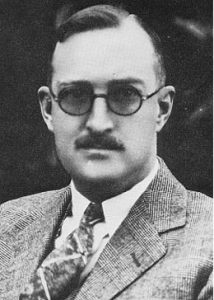
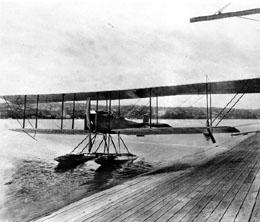
William Boeing founded his company a few months after the June 15 maiden flight of one of the two “B&W” seaplanes built with the assistance of George Conrad Westervelt, a U.S. Navy engineer. Boeing and Westervelt decided to build the B&W seaplane after having flown in a Curtiss aircraft. Boeing bought a Glenn Martin “Flying Birdcage” seaplane (so called because of all the guy-wires holding it together) and was taught to fly by Glenn Martin himself. Boeing soon crashed the Birdcage and when Martin informed Boeing that replacement parts would not become available for months, Boeing realized he could build his own plane in that amount of time. He and his friend Cdr. G.C. Westervelt agreed to build a better airplane and soon produced the B&W Seaplane.
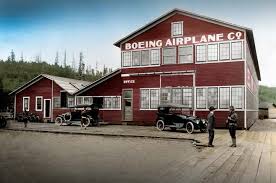 On May 9, 1917, the company became the “Boeing Airplane Company”. It was just the right time as in late 1917, the U.S. entered World War I and Boeing knew that the U.S. Navy needed seaplanes for training. So Boeing shipped two new Model Cs to Pensacola, Florida, where the planes were flown for the Navy. The Navy liked the Model C and ordered fifty more. The company moved its operations to a larger former shipbuilding facility known as Boeing Plant 1, located on the lower Duwamish River.
In 1919 the Boeing B-1 made its first flight. It was a flying boat that accommodated one pilot and two passengers and some mail. Over the course of eight years, it made international airmail flights from Seattle to Victoria, British Columbia. On May 24, 1920, the Boeing Model 8 made its first flight. It was the first plane to fly over Mount Rainier.
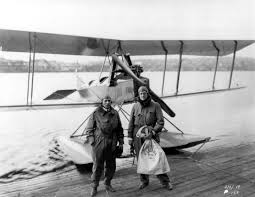 Boeing’s never say die attitude made him develop PW-9 fighter in 1923 along with the Boeing P-12/ F4B fighter, making the little company he had started a leading manufacturer of fighters . In 1925, Boeing built its Model 40 mail plane for the U.S. government to use on airmail routes. In 1927, an improved version of this plane was built, the Model 40A which won the U.S. Post Office’s contract to deliver mail between San Francisco and Chicago. The 40A also had a passenger cabin that accommodated two passengers.
That same year, Boeing created an airline named Boeing Air Transport, which merged a year later with Pacific Air Transport and the Boeing Airplane Company. The first airmail flight for the airline was on July 1, 1927. The company changed its name to United Aircraft and Transport Corporation in 1929 and acquired Pratt & Whitney, Hamilton Standard Propeller Company, and Chance Vought. United Aircraft then purchased National Air Transport in 1930.
On July 27, 1928, the 12-passenger Boeing 80 biplane made its first flight. With three engines, it was Boeing’s first plane built with the sole intention of being a passenger transport. An upgraded version, the 80A, carrying eighteen passengers, made its first flight in September 1929.
 In 1930, the Monomail, a low-wing monoplane that carried mail, was built. Built entirely out of metal, it was very fast and aerodynamic, and had retractable landing gear. In fact, its design was so revolutionary that the engines and propellers of the time could not handle the plane. By the time controllable pitch propellers were developed, Boeing was building its Model 247 airliner. Two Monomails were built. The second one, the Model 221, had a 6-passenger cabin.
In 1933 the Boeing 247 was introduced, the first truly modern airliner. The 247 was an all-metal low-wing monoplane that was much faster, safer, and easier to fly than other passenger aircraft. For example, it was the first twin engine passenger aircraft that could fly on one engine. In an era of unreliable engines, this vastly improved flight safety. Boeing built the first sixty aircraft exclusively for its own United Airlines subsidiary’s operations.
The Air Mail Act of 1934 prohibited airlines and manufacturers from being under the same corporate umbrella, so the company split into three smaller companies – Boeing Airplane Company, United Airlines, and United Aircraft Corporation, the precursor to United Technologies. As a result, William Boeing sold off his shares and left Boeing. Claire Egtvedt, who had become Boeing’s president in 1933, became the chairman as well. He believed the company’s future was in building bigger planes. Boeing was later incorporated in Delaware, the original Certificate of Incorporation was filed with the Secretary of State of Delaware on July 19, 1934. Work began in 1936 on Boeing Plant 2 to accommodate the production of larger modern aircraft.
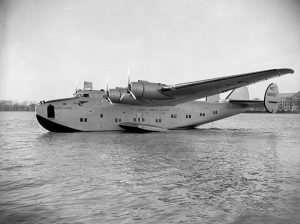
 Shortly after, an agreement with Pan American World Airways (Pan Am) was reached, to develop and build a commercial flying boat able to carry passengers on transoceanic routes. The first flight of the Boeing 314 Clipper was in June 1938. It was the largest civil aircraft of its time, with a capacity of 90 passengers on day flights, and of 40 passengers on night flights. One year later, the first regular passenger service from the U.S. to the UK was inaugurated. Subsequently other routes were opened, so that soon Pan Am flew with the Boeing 314 to destinations all over the world.
In 1938, Boeing completed work on its Model 307 Stratoliner. This was the world’s first pressurized-cabin transport aircraft, and it was capable of cruising at an altitude of 20,000 feet (6,100 m) – above most weather disturbances. It was based on the B-17, using the same wings, tail and engines.
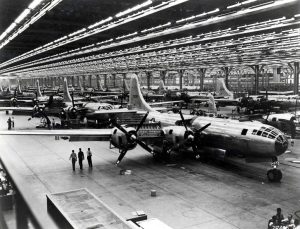
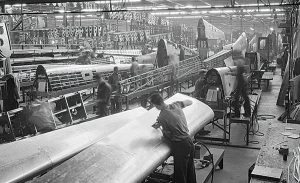
During World War II, Boeing built a large number of B-17 and B-29 bombers. Boeing ranked twelfth among United States corporations in the value of wartime production contracts. Many of the workers were women whose husbands had gone to war. In the beginning of March 1944, production had been scaled up in such a manner that over 350 planes were built each month. To prevent an attack from the air, the manufacturing plants had been covered with greenery and farmland items. During these years of war the leading aircraft companies of the U.S. cooperated. The Boeing-designed B-17 bomber was assembled also by Lockheed Aircraft Corp. and Douglas Aircraft Co., while the B-29 was assembled also by Bell Aircraft Co. and by Glenn L. Martin Company.
 After the war, most orders of bombers were cancelled . The company aimed to recover quickly by selling military derivatives of the Stratocruiser, such as the C-97 adapted for troop transportation and the KC-97 for aerial refuelling. During the early 1950s, Boeing used company funds to develop the 367–80 jet airliner demonstrator that led to the KC-135 Stratotanker and Boeing 707 jetliner. Some of these were built at Boeing’s facilities in Wichita, Kansas, which existed from 1931 to 2014.
In the mid-1950s technology had advanced significantly, which gave Boeing the opportunity to develop and manufacture new products. Very few know that one of the first was the guided short-range missile used to intercept enemy aircraft. Boeing used its short-range missile technology to develop and build an intercontinental missile.
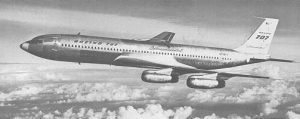
In 1958, Boeing began delivery of its 707, the United States’ first commercial jet airliner, in response to the British De Havilland Comet, French Sud Aviation Caravelle and Soviet Tupolev Tu-104, which were the world’s first generation of commercial jet aircraft. With the 707, a four-engine, 156-passenger airliner, the U.S. became a leader in commercial jet manufacture. A few years later, Boeing added a second version of this aircraft, the Boeing 720, which was slightly faster and had a shorter range.
No technology can be said to have remain untouched by Boeing, during this time. It was a major producer of small turbine engines during the 1950s and 1960s. Development on the gasoline turbine engine started in 1943 and Boeing’s gas turbines were designated models 502, 520, 540, 551 and 553. Boeing built 2,461 engines before production ceased in April 1968. Many applications of the Boeing gas turbine engines were considered to be firsts, including the first turbine-powered helicopter and boat.
 Vertol Aircraft Corporation was acquired by Boeing in 1960 and was reorganized as Boeing’s Vertol division. The twin-rotor CH-47 Chinook, produced by Vertol, took its first flight in 1961. This heavy-lift helicopter remains a work-horse vehicle up to the present day. In 1964, Vertol also began production of the CH-46 Sea Knight.
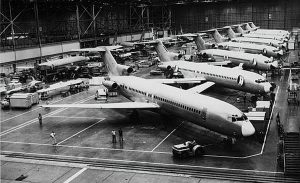
In December 1960, Boeing announced the model 727 jetliner, which went into commercial service about three years later. Different passenger, freight and convertible freighter variants were developed for the 727. The 727 was the first commercial jetliner to reach 1,000 sales, and a few years later the 1,500 mark was reached.
Boeing won a contract in 1961 to manufacture the S-IC stage of the Saturn V rocket, manufactured at the Michoud Assembly Facility in New Orleans, Louisiana. In 1966, Boeing president William M. Allen asked Malcolm T. Stamper to spearhead production of the new 747 airliner on which the company’s future was riding. This was a monumental engineering and management challenge, and included construction of the world’s biggest factory in which to build the 747 at Everett, Washington, a plant which is the size of 40 football fields.
In 1967, Boeing introduced another short- and medium-range airliner, the twin-engine 737 which remains in production as of 2016. The roll-out ceremonies for the first 747-100 took place in 1968, at Everett. The aircraft made its first flight a year later. The first commercial flight occurred in 1970. The 747 has an intercontinental range and a larger seating capacity than Boeing’s previous aircraft. The company has delivered over 1,500 Boeing 747s. The 747 has undergone continuous improvements to keep it technologically up-to-date. Larger versions have also been developed by stretching the upper deck. The newest version of the 747, the 747-8 is in production as of 2015.
 Boeing also developed hydrofoils in the 1960s. The screw-driven USS High Point (PCH-1) was an experimental submarine hunter. The patrol hydrofoil USS Tucumcari (PGH-2) was more successful. Only one was built, but it saw service in Vietnam and Europe before running aground in 1972. Its waterjet and fully submersed flying foils were the example for the later Pegasus-class patrol hydrofoils and the Model 929 Jetfoil ferries in the 1980s. The Tucumcari and later boats were produced in Renton. While the Navy hydrofoils were withdrawn from service in the late 1980s, the Boeing Jetfoils are still in service in Asia.
In the 80s Boeing 757 aircraft replaced the 707 and 727 and the Boeing twin-aisle 767replaced the Boeing 707 completely. An important project of these years was the Space Shuttle, to which Boeing contributed with its experience in space rockets acquired during the Apollo era. Boeing participated also with other products in the space program, and was the first contractor for the International Space Station program.
During the decade several military projects went into production, including Boeing support of the stealth B-2 bomber. As part of an industry team led by Northrop, Boeing built the outboard portion of the B-2 stealth bomber wing, the aft center fuselage section, landing gear, fuel system and weapons delivery system. At its peak in 1991, the B-2 was the largest military program at Boeing, employing about 10,000 people. The same year, the National Aeronautic Association of the USA awarded the B-2 design team the Collier Trophy for the greatest achievement in aerospace in America. The first B-2 rolled out of the bomber’s final assembly facility in Palmdale, California, in November 1988 and it flew for the first time on July 17, 1989.
 The Avenger air defense system and a new generation of short-range missiles also went into production. During these years, Boeing was very active in upgrading existing military equipment and developing new ones. Boeing also contributed to wind power development with the experimental MOD-2 Wind Turbines for NASA and the United States Department of Energy, and the MOD-5B for Hawaii.
In the 90s Boeing was one of seven competing companies that bid for the Advanced Tactical Fighter. Boeing agreed to team with General Dynamics and Lockheed, so that all three companies would participate in the development if one of the three companies design was selected. The Lockheed design was eventually selected and developed into the F-22 Raptor.
In April 1994, Boeing introduced the twin-engine 777, with a seating capacity of approximately 300 to 370 passengers in a typical three-class layout, in between the 767 and the 747. The longest range twin-engine aircraft in the world, the 777 was the first Boeing airliner to feature a “fly-by-wire” system and was conceived partly in response to the inroads being made by the European Airbus into Boeing’s traditional market.
 This aircraft reached an important milestone by being the first airliner to be designed entirely by using computer-aided design (CAD) techniques. The 777 was also the first airplane to be certified for 180 minute ETOPS at entry into service by the FAA. Also in the mid-1990s, the company developed the revamped version of the 737, known as the 737 “Next-Generation”, or 737NG. It has since become the fastest-selling version of the 737 in history, and on April 20, 2006 sales passed those of the “Classic 737”, with a follow-up order for 79 aircraft from Southwest Airlines.
 In 1996, Boeing acquired Rockwell’s aerospace and defense units. The Rockwell business units became a subsidiary of Boeing, named Boeing North American, Inc. In August 1997, Boeing merged with McDonnell Douglas in a US$13 billion stock swap under the name The Boeing Company. However this name had actually been Boeing’s official name previously adopted on May 21, 1961. Following the merger, the McDonnell Douglas MD-95 was renamed the Boeing 717, and the production of the MD-11 was limited to the freighter version. Boeing introduced a new corporate identity with completion of the merger, incorporating the Boeing logo type and a stylized version of the McDonnell Douglas symbol, which was derived from the Douglas Aircraft logo from the 1970s. And now you have the Boeing787-the Dreamliner.
Boeing’s expertise spans a broad range of products in defence. Fighter jets, rotorcraft, embedded product support, cybersecurity products, surveillance suites, advanced weapons, missile defense and commercial aircraft derivatives all fit in Boeing’s portfolio. The company can leverage this holistic knowledge and deliver the value of those integrated systems to its customers.
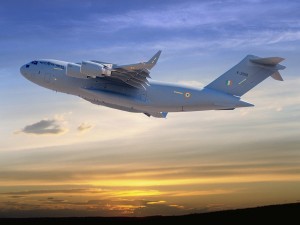
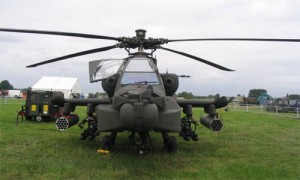
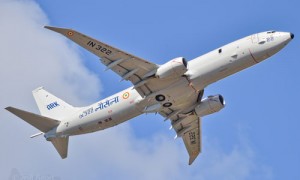
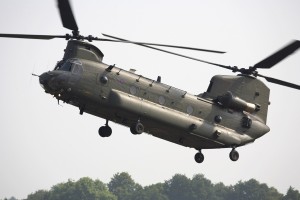 Boeing Defense, Space & Security (BDS) formerly known as Boeing Integrated Defense Systems (IDS) is a unit of The Boeing Company responsible for defense and aerospace products and services. Boeing Integrated Defense Systems was formed in 2002 by combining the former “Military Aircraft and Missile Systems” and “Space and Communications” divisions. Transport aircraft like C-17 Globemaster III and P8 , fighters like the FA-18 Super Hornet , military helicopters like Apache and Chinook, unmanned combat air vehicle like X-45 , re-usable space vehicle X-37, also known as the Orbital Test Vehicle to being awarded the first Commercial Human Spaceflight Mission by NASA –the list is endless.
 Today Boeing turns with élan and the world remembers it with nostalgia. It is a century well struck and the next one promises to be as good. Ups and downs and challenges have not been able to deter its drive. Technology and market needs as the key drivers and excellence in achievement have got William Boeing’s legacy to stand tall amidst a very competitive ecosystem of the aerospace world. Happy second century to Boeing.
Pictures: Courtesy Boeing







































































-A4-Size-(2)_page-0001.jpg)