




























- From Barmer to Assam : India Expands Strategic Emergency Landing Grid
New Delhi. 12 February 2026. The state of Assam is going to witness a historic event, inauguration of an Emergency Landing Facility (ELF) on the Moran bypass in Dibrugarh district on 14 February 2026. This ELF is first of its kind in the North East region. Prime Minister Narendra Modi will be inaugurating and dedicating this facility to the nation. The facility opens an identified stretch on the highway as an alternative runway during contingencies which would be capable of handling emergency landing and take off operations of fighters, transport aircraft and helicopters. This will also prove instrumental during Humanitarian Assistance and Disaster Relief (HADR) operations in far-flung areas.
In a significant display of operational preparedness and strategic capability, the Indian Air Force (IAF) successfully conducted experimental take-offs and landings over two days at the newly constructed Emergency Landing Facility (ELF) on a four-lane National Highway stretch at Moran in Dibrugarh district of Assam. The exercise showcased the operational viability of the highway as an alternative runway in emergency or wartime scenarios.
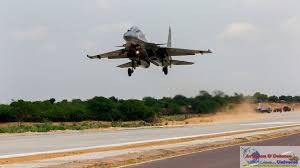
The trials included a series of aircraft operations involving both transport and frontline fighter platforms. Among the aircraft that operated from the facility were the heavy-lift C-130J Super Hercules and fighter jets such as the Sukhoi Su-30 MKI, Rafale, Jaguar, and MiG variants. The aircraft performed multiple low passes, touch-and-go manoeuvres, full landings, and take-offs, validating the structural robustness and operational readiness of the highway strip.
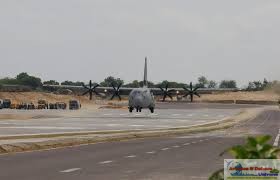 The Emergency Landing Facility has been developed as part of India’s broader strategy to strengthen air defence infrastructure and enhance operational flexibility. Highway airstrips such as the one at Moran are designed to allow the Air Force to disperse assets and sustain air operations even if conventional airbases are rendered unavailable.
Senior officials from the Indian Air Force and the local civil administration were present to supervise the operations and coordinate security arrangements. The highway section was temporarily closed to civilian traffic during the trials, with comprehensive safety protocols implemented.
The successful execution of the exercise marks a major milestone for Assam and the Northeast region, reinforcing strategic connectivity and rapid response capabilities in a geographically sensitive area. The Moran facility now becomes part of an expanding national network of emergency highway landing strips, further strengthening India’s defence preparedness and highlighting effective coordination between military and civil authorities.
Emergency Landing Facilities (ELFs) are a critical component of national air power strategy, particularly for the Indian Air Force (IAF), which operates along some of the world’s most sensitive and contested borders. With India facing complex security dynamics across its northern and western frontiers, ELFs provide vital operational depth, redundancy and survivability. In the event of runway damage, adverse weather, technical emergencies or hostile action against primary airbases, these alternate landing strips—often developed on highways or remote airfields—ensure that fighter jets, transport aircraft and surveillance platforms can recover safely and rapidly return to operations. For a force that must remain combat-ready at short notice, ELFs enhance dispersal capability, reduce vulnerability to pre-emptive strikes, and sustain high sortie generation rates during conflict. In a theatre where terrain ranges from deserts to high-altitude mountains, and where reaction time is critical, a robust network of emergency landing facilities is not merely a contingency measure—it is a strategic necessity that strengthens deterrence and reinforces India’s air defence posture.
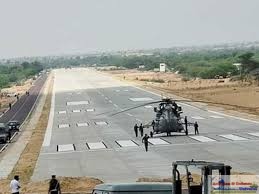 India is rapidly expanding its network of Emergency Landing Facilities (ELFs) along National Highways to serve as alternative runways for Indian Air Force aircraft, particularly in strategically sensitive regions near international borders. Of the more than 28 planned sites, around 15 are already operational, with prominent facilities developed on the Taj, Ganga, and Purvanchal Expressways. The first operational highway-based landing strip was inaugurated in 2021 on NH-925A in Barmer, Rajasthan, featuring a 3-kilometre stretch designed to accommodate IAF fighter jets and transport aircraft. The most recent addition is on the Moran Highway (NH-37) in Assam, inaugurated in February 2026, marking the first such facility in the Northeast and significantly strengthening India’s strategic posture near the China border. In Uttar Pradesh, a 3.2-kilometre stretch on the Purvanchal Expressway has been developed for emergency air operations, while both the Taj Expressway and the Ganga Expressway incorporate specially engineered segments for high-speed military landings.
Over 20 additional ELFs are under construction, including in West Bengal and other border states, reinforcing national security and disaster response capabilities. These facilities are dual-use infrastructure, functioning as regular highways in daily operations but engineered with reinforced pavement, extended straight stretches of 3–4 kilometres, and structural strength to withstand the heavy landing impact of combat and transport aircraft. Primarily conceived for military contingencies and rapid force deployment, particularly in sensitive regions such as the Northeast, ELFs significantly enhance India’s operational flexibility, deterrence capability, and emergency preparedness. The occasion holds profound significance towards National Security and would be witnessed by Prime Minister, Governor and Chief Minister of Assam as well as senior civil and military dignitaries.